
What Is APY in Crypto? A Simple Guide
What is APY in crypto? This guide breaks down compounding interest, how to calculate returns, and how to spot the real risks behind high-yield DeFi.
When you start exploring ways to make your crypto work for you, one acronym pops up everywhere: APY. So, what is APY in crypto? Think of it as the real return you can expect on your digital assets over a year, because it accounts for the powerful effect of compounding interest. It's the key metric for comparing staking, lending, or yield farming opportunities in DeFi.
The Power of Compounding Crypto Growth
Imagine a snowball rolling downhill. It doesn't just get bigger it picks up more snow faster and faster as it grows. That's compounding in a nutshell. Your earnings start generating their own earnings, creating a feedback loop of accelerated growth. This isn't a new concept; it's the foundation of wealth-building in traditional finance, too.
What’s different in crypto is the speed. A traditional bank might compound your interest monthly. A DeFi protocol, on the other hand, could compound your earnings daily, hourly, or even with every new block added to the blockchain—which is about every 12 seconds on Ethereum. You can see how crypto returns stack up against historical market data on platforms like CoinMarketCap. This rapid compounding is how a seemingly modest interest rate can balloon into an impressive annual yield.
Why APY Matters More Than APR
This is where it’s super important to know the difference between APY and its simpler cousin, APR (Annual Percentage Rate). APR is just a flat rate. If a platform offers a 10% APR, you’ll earn exactly 10% on your initial capital over the year. Simple.
But a 10% APY that compounds daily will always result in a higher return because the interest you earn each day gets added back to your principal, and you start earning interest on that too.
The core takeaway is this: APY provides a more accurate picture of your potential earnings because it reflects the real-world impact of your returns generating more returns.
Getting this distinction right is the first step to properly comparing different yield opportunities across the crypto world. When you see a high APY, you know a big chunk of that projected return is coming from the protocol automatically reinvesting your profits for you. It puts your growth on autopilot, maximizing your potential without you having to lift a finger.
The Real Difference Between APY and APR
It's easy to glance at APY and APR and think they're just two ways of saying the same thing. But that common mix-up can be a costly one, especially in DeFi. The two metrics are fundamentally different, and knowing how they work is critical for figuring out what you’ll actually earn.
The entire difference boils down to one powerful concept: compounding.
APY vs APR: A Quick Comparison
Before we dive deep, let's get a high-level view of what separates these two core metrics. The main takeaway is that APY gives you a much truer picture of your potential earnings because it accounts for growth on your growth.
FeatureAPR (Annual Percentage Rate)APY (Annual Percentage Yield)CalculationSimple InterestCompounding InterestCompoundingExcludes the effect of compoundingIncludes the effect of compoundingReal-world ReturnDoesn't show the true annual returnShows the true annual returnUse CaseOften used for borrowing (loans, credit cards)Often used for earning (savings, staking)
Simply put, while both are annualized rates, APY will always be higher than APR for the same base rate, as long as interest is compounded more than once a year.
How Compounding Makes APY the King
Let's break this down with a practical example.
Annual Percentage Rate (APR) is the straightforward, no-frills interest rate you earn on your principal investment each year. If a staking pool offers 10% APR on your $1,000 deposit, you'll walk away with exactly $100 in profit after one year. Clean and simple. Your earnings don't start earning anything themselves.
Annual Percentage Yield (APY), on the other hand, is the metric that shows you what you really get. It includes the magic of compounding interest. APY calculates the return you earn not just on your initial capital, but also on the accumulated interest that gets added back to your principal over and over again.
Imagine you have two protocols to choose from. Both offer a 10% rate on a $1,000 investment.
- Protocol A (10% APR): Your return is a flat $100 for the year. Your total ends up at $1,100. Easy.
- Protocol B (10% APY, compounded daily): Every single day, a tiny bit of interest is calculated and added back into your investment pile. The next day, you earn interest on that slightly larger amount. It might seem small, but those daily boosts add up. By the end of the year, your total would actually be $1,105.16.
Sure, an extra $5 might not sound like much, but that gap gets exponentially wider with larger investments, higher rates, and longer time horizons.
The key takeaway is simple: For the same stated interest rate, an investment calculated with APY will always yield a higher return than one calculated with APR because your earnings start working for you.
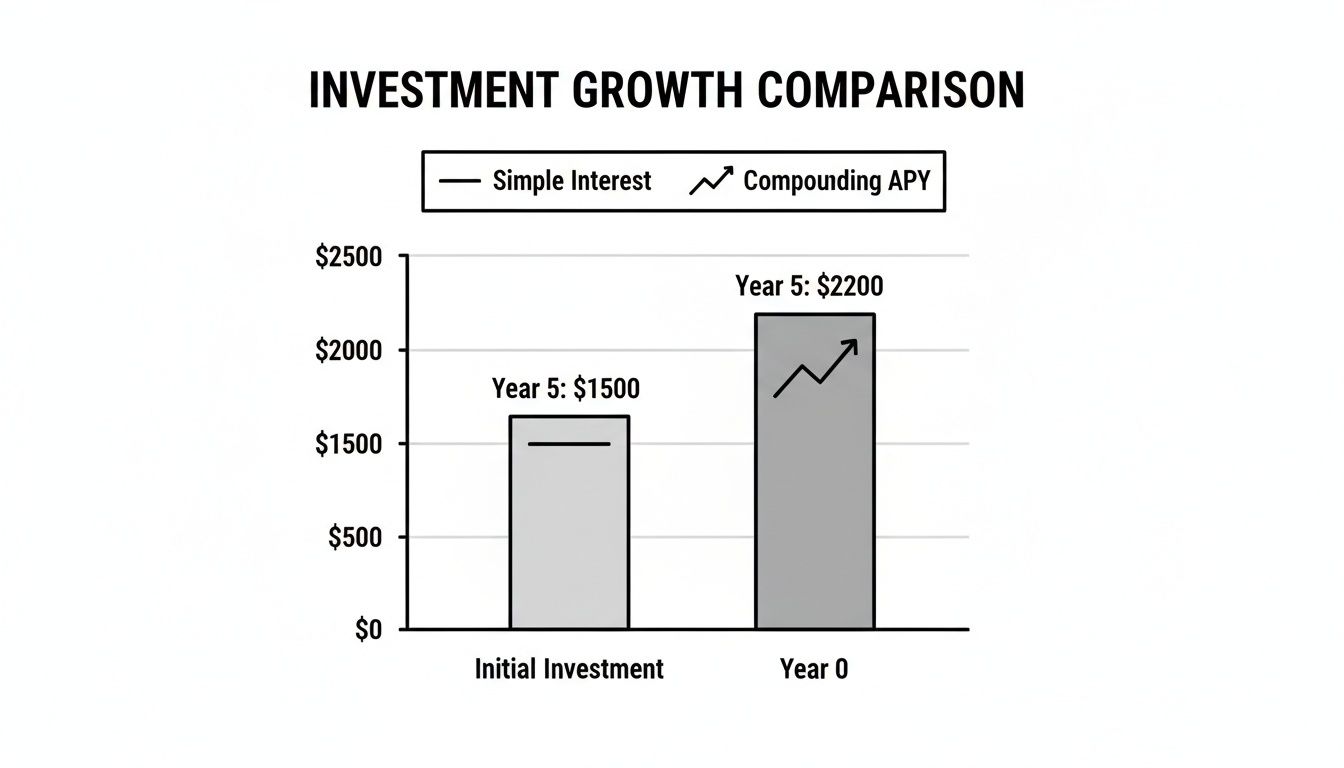
This chart shows it perfectly. Look at how an initial investment grows with simple interest versus the accelerating curve you get from compounding APY.
Start tracking smart money today
Join thousands of traders using WalletFinder.ai to find profitable wallets and copy their trades.
Start Free Trial →

