
Your Guide to a Whale Tracker App
Discover how a whale tracker app can give you a market edge. Learn to track smart money, analyze on-chain signals, and make smarter crypto trading decisions.
A whale tracker app is one of the most powerful tools in a modern crypto trader's arsenal. At its core, it monitors and analyzes huge transactions on the blockchain, letting you see exactly what the biggest players—the "whales"—are doing with their money.
Think of it as a radar for smart money. Instead of waiting for market moves to hit the news, these apps give you an inside look at the trades that are big enough to cause those moves in the first place. They turn the transparent, public data of the blockchain into genuinely actionable signals.
Understanding the Power of a Whale Tracker App

In the vast ocean of the crypto market, not all traders are created equal. Small retail investors are like tiny fish, but crypto whales are the massive entities whose every move can create waves. Their buys, sells, and even simple transfers can shift market prices and sentiment in an instant.
A whale tracker app is your periscope into their world. It automatically sifts through the millions of transactions happening every day to zero in on the ones that actually matter. You don't have to spend hours digging through blockchain explorers; the app does the heavy lifting and serves you the insights.
What Is a Crypto Whale?
So, what makes someone a "whale"? While there's no official dollar amount, a crypto whale is simply an individual or organization holding enough of an asset to impact its price with a single trade. These aren't your average traders. They're typically:
- Early Adopters: People who got into assets like Bitcoin or Ethereum when they were still dirt cheap.
- Institutional Investors: Hedge funds, venture capital firms, and other big financial players moving into the space.
- Crypto Exchanges: Platforms like Binance or Coinbase that hold enormous reserves.
- Decentralized Autonomous Organizations (DAOs): Treasuries managing protocol funds based on community votes.
By keeping an eye on these wallets, you get a front-row seat to where the most capitalized players are placing their bets.
Why Tracking On-Chain Activity Is a Game Changer
Every single transaction on a blockchain is public. It’s all out there for anyone to see. This transparency is a goldmine if you have the right tools to interpret the data. A good whale tracker takes all that raw, chaotic information and weaves it into a coherent story.
For example, you can see when a whale moves millions in ETH from a cold storage wallet to an exchange—a classic signal that they might be about to sell.
The real edge a whale tracker app gives you is its ability to cut through the noise. It helps you focus on the actions of well-funded traders, whose decisions often come right before major market shifts. That's a huge informational advantage.
Pioneering platforms in this space have shown just how vital this data can be. Take Whale Alert, for instance. Launched around 2018, it quickly became an essential tool for the entire crypto community. By December 2025, it was monitoring major blockchains and had tracked over 10 million large transfers since its launch, firing off more than 5,000 alerts per month during busy market periods.
Ultimately, using a crypto whale tracker isn't about blindly copying someone else's trades. It's about gathering intelligence to make smarter decisions for yourself. When you understand the flow of smart money, you can anticipate trends, spot new opportunities, and manage your own portfolio with a lot more confidence.
How to Read the Signs of Whale Activity
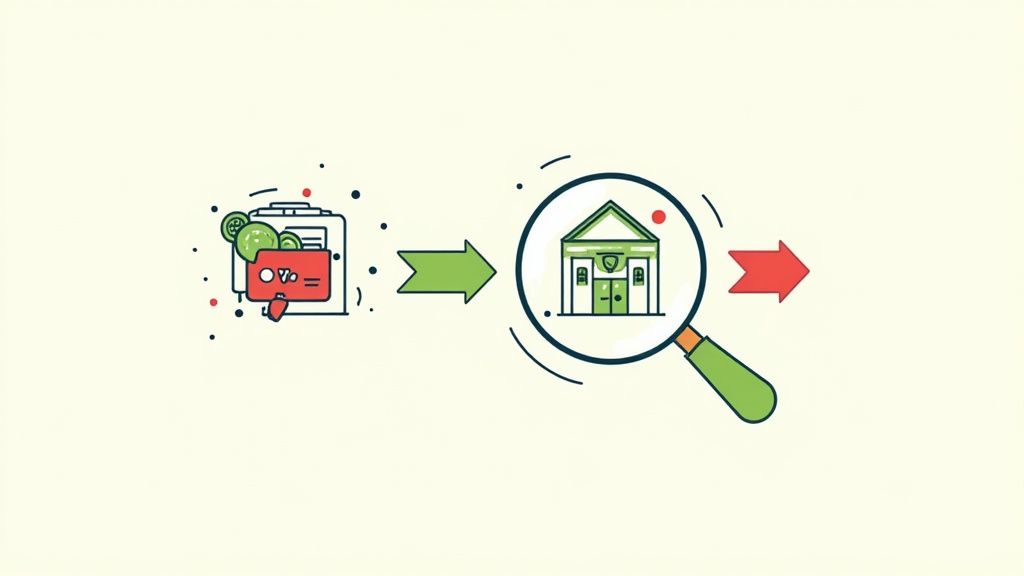
Getting an alert from a whale tracker app about a huge transaction is just the first step. The real magic is learning how to turn that raw on-chain data into a story you can actually use. To get there, you have to learn how to read the signals that hint at a whale’s next move.
At a high level, whale behavior really boils down to two main actions. Nailing this difference is the first building block for your entire analysis.
Differentiating Accumulation from Distribution
The most critical thing to figure out is whether a whale is accumulating (buying) or distributing (selling). These two moves leave completely different footprints on the blockchain, signaling opposite pressures on the market.
Accumulation (Bullish Signal): This is when whales are scooping up more of an asset. The classic sign is a massive transfer from a centralized exchange (CEX) like Coinbase to a private, non-custodial wallet. This move screams that the whale isn't planning to sell anytime soon and is settling in for a long-term hold, effectively taking supply off the market.
Distribution (Bearish Signal): This is what happens when whales are getting ready to sell. The dead giveaway is a big transfer of tokens from a private wallet to a known exchange address. This floods the market with more available supply and often happens right before a major sell-off.
While these are the basics, the context around these moves is where the real alpha is found.
Decoding the Narrative Behind the Numbers
A whale’s actions are rarely just black and white. Where the money comes from and where it’s going tells a much deeper story about their strategy and how confident they are in their play. A great whale tracker helps you see past the surface-level transaction to understand the why.
For example, a $5 million buy on a decentralized exchange (DEX) like Uniswap sends a totally different signal than the same buy on a CEX like Binance. The DEX purchase is completely transparent and can immediately rock the price because of how liquidity pools work. In contrast, a CEX purchase could be part of a quiet over-the-counter (OTC) deal, hiding its true size from the public order book.
Think of on-chain analysis as crypto forensics. Every transaction is a clue, and your job is to piece them together to form a hypothesis about what the smart money is planning next. The goal isn't certainty, but a high-probability insight.
This is where top-tier analytics platforms really shine. For instance, Nansen uses its 'Token God Mode' to offer incredibly deep dives into whale wallets. Data from Q3 2025 showed that whales they tracked held 43% of Ethereum's top tokens, and their average daily trades of $50 million influenced about 25% of daily price movements. You can find more insights on their forecasting strategies over on Nansen's blog.
Common Whale Signals and Their Potential Meaning
To help you get up to speed, we've broken down some common on-chain whale activities and what they typically signal. Learning to spot these patterns will help you react much faster and smarter when your tracker sends you an alert.
Start tracking smart money today
Join thousands of traders using WalletFinder.ai to find profitable wallets and copy their trades.
Start Free Trial →

