
Trading History Analysis: A DeFi Trader's Playbook
Master trading history analysis with our step-by-step playbook. Learn to analyze on-chain data, track smart money, and copy-trade with confidence in DeFi.
You've seen the wallet. It bought early, sold near the highs, and the dashboard shows a return that makes you want to copy every move from the next block onward.
That's where most traders get sloppy.
A wallet can look elite on a screenshot and still be a terrible copy-trading target. One lucky rotation into a memecoin. One oversized bet that happened to work. One week of perfect timing that hides months of churn, bad exits, or reckless sizing. If you only look at headline PnL, you're not analyzing a trader. You're reacting to an outcome.
Real trading history analysis is what separates signal from bait. On-chain, that means reading a wallet the way a discretionary PM or quant would read a track record: full trade set, holding behavior, sizing discipline, category focus, consistency, and how performance changes when conditions shift. A wallet's edge only matters if you can identify what produced it and whether that process is repeatable enough to follow.
Beyond the PnL The Need for Real Trading History Analysis
A common mistake in DeFi is treating a wallet like a tip channel. You find one huge winner, then assume every future trade from that address is worth mirroring. In practice, the first question isn't “How much did this wallet make?” It's “How did this wallet make it?”
That difference matters because raw profit hides ugly details. A wallet may have made most of its gains from one outlier trade while the rest of its activity was mediocre. Another may show strong realized profit but only because it never cut losers and happened to get bailed out by a market bounce. A third may be profitable, but impossible to copy because it trades illiquid pairs where your entry will always be worse.
Results without process are weak signals
When analysts work with long-run market data, the value comes from having enough history to compare behavior across cycles, not from staring at isolated charts. The CFA Institute notes that good U.S. stock and bond data series go back to the 1790s, and precise individual-stock daily data begin in January 1926, which is what makes nearly 100 years of comparative return history usable for serious analysis in modern datasets (CFA Institute on historical market data). The same logic applies on-chain. One trade tells you almost nothing. A full wallet history starts to tell you whether the trader has a method.
Don't copy a wallet because it had a big win. Copy only if its history shows a repeatable decision pattern you can recognize in real time.
That's why I care less about a flashy winner and more about the shape of the wallet's full tape. Does it keep taking the same kind of setup? Does it survive bad stretches? Does it perform only in one token niche, or across several market conditions? Those answers tell you whether you're looking at skill, luck, or heightened risk appearing as skill.
What hidden risk usually looks like
Most weak wallets fail one of these tests:
- Survivorship bias: You found the wallet because it won. You didn't see the many similar wallets that disappeared.
- Unsustainable risk-taking: The trader sizes aggressively, so the upside looks great until one bad trade wipes the curve.
- One-hit dependence: A single outlier dominates the entire history.
- Execution mismatch: Even if the wallet is good, your copy will be worse if you enter later or pay more in gas and slippage.
If you want a benchmark for what a healthier evaluation looks like, compare traders against a structured framework rather than isolated wins. A useful starting point is how to benchmark trading performance.
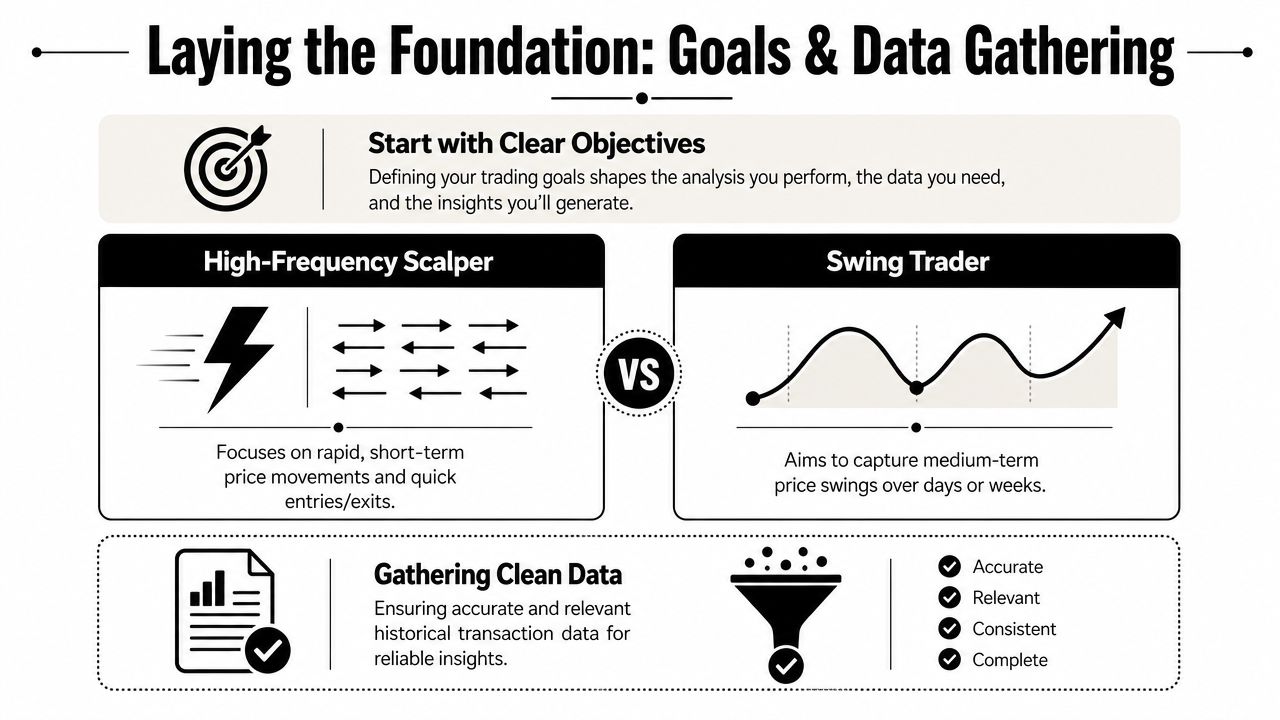
Laying the Foundation Goals and Data Gathering
You find a wallet that caught three early runners in a week. Before treating it as a copy-trading candidate, define what you are trying to prove. Are you screening for a wallet you can follow trade for trade, or a wallet that is only useful as a signal source for narratives and rotation timing? That decision changes what data you need and how strict your filters should be.
The mistake I see most often is mixing incompatible trader types into one bucket. A Solana meme wallet that flips positions in minutes should not be graded on the same standard as a Base wallet that scales into themes over several days. If your goal is to vet wallets for copy-trading, style fit matters almost as much as PnL. A good wallet with the wrong style for your execution will still produce bad copy results.
Define the wallet profile before you export anything
Start with a plain-English profile of the behavior you want.
- High-frequency operator: Many trades, short holding periods, thin edge per trade, strong dependence on entry speed and fees.
- Narrative swing trader: Fewer trades, longer holds, stronger token selection, more exposure to trend shifts.
- Conviction accumulator: Adds repeatedly to related positions, often shows sector insight, can hide poor exits behind strong entries.
- Event-driven trader: Trades around launches, listings, release events, migrations, or major news, often profitable only in specific conditions.
That profile tells you what deserves attention. For a fast trader, I care about whether the wallet can repeat small wins after costs and whether late followers would still have room. For a swing wallet, I care more about how early it enters, how long it can sit through noise, and whether the gains came before broad attention showed up.
Start tracking smart money today
Join thousands of traders using WalletFinder.ai to find profitable wallets and copy their trades.
Start Free Trial →

