
Guide to Trading Crypto Pairs
Unlock profitable strategies for trading crypto pairs. Learn how to use on-chain data, manage risk, and execute trades like a professional.
At its core, all crypto trading comes down to one thing: pairs. When you trade a pair like BTC/USDT, you're really just speculating on the value of one asset against another. This simple concept fuels the entire market, creating liquidity and helping everyone figure out what an asset is actually worth.
Getting a Grip on Crypto Pairs and Why They're So Important
Think of a crypto pair as a seesaw. One side has the base currency—the crypto you’re buying or selling. The other side has the quote currency, which is what you're using to price it.
In the ETH/BTC pair, Ethereum is the base, and Bitcoin is the quote. The price you see is simply how much Bitcoin it costs to get one Ethereum.
Understanding this dynamic is what separates passive investors from active traders. Instead of just hoping the entire market trends upward, you can make strategic bets on the relative strength between two specific assets. This opens up a whole new playbook of trading strategies that work even when the market is flat or choppy.
The Three Flavors of Crypto Pairs
Not all trading pairs are the same. They're built for different purposes, and you can generally lump them into three main categories. Each one gives traders a unique angle on the market.
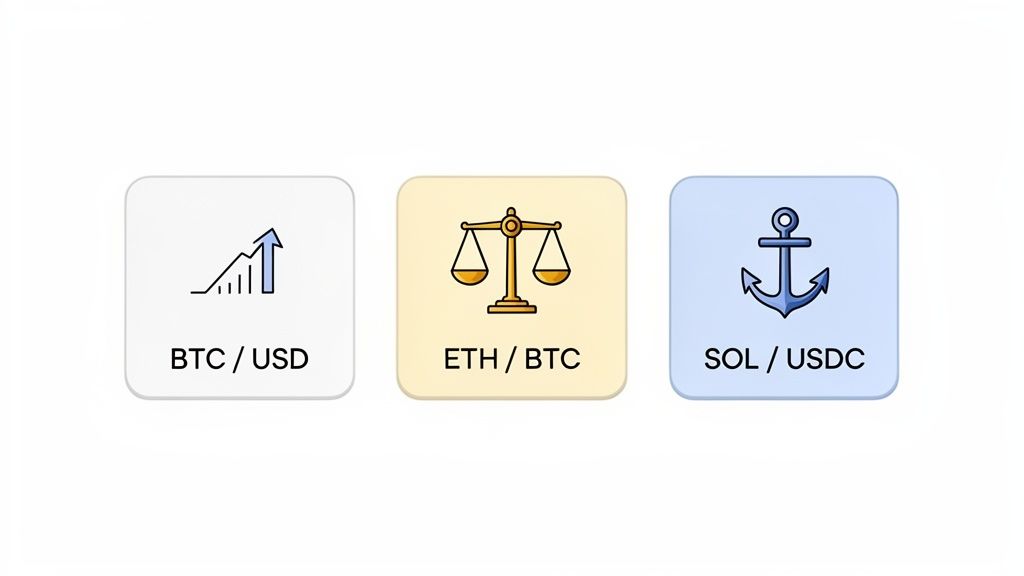
- Crypto-to-Fiat Pairs (e.g., BTC/USD): This is your main bridge to the traditional financial world. Pairs like Bitcoin versus the US Dollar are the go-to for measuring a crypto's value in familiar, real-world terms. It's usually how new money enters the ecosystem.
- Crypto-to-Crypto Pairs (e.g., ETH/BTC): These pairs are for pure crypto-on-crypto speculation. Trading ETH/BTC is a direct bet that you think Ethereum will outperform Bitcoin, regardless of what either is doing against the dollar. It's a true crypto-native play.
- Crypto-to-Stablecoin Pairs (e.g., SOL/USDC): This has become the standard for most active traders today. Pairing an asset like Solana with a stablecoin like USDC lets you trade its volatility while giving you a stable asset to park your profits in. It’s the perfect way to sidestep a market crash without having to cash out to fiat completely.
At its heart, trading crypto pairs is about managing relativity. You're not just asking, "Will this asset go up?" You're asking, "Will this asset go up more or down less than the other asset in the pair?"
Why Picking the Right Pair Is Half the Battle
The pair you decide to trade fundamentally shapes your strategy and your risk. For example, if you trade an altcoin against BTC, you're exposed to the volatility of both assets. But if you trade that same altcoin against a stablecoin like USDT, your risk is isolated to just that one crypto's performance.
A Quick Guide to Crypto Trading Pairs
This table breaks down the three primary types of crypto pairs, highlighting their unique characteristics and best-use scenarios for traders.
| Pair Type | Example | Primary Use Case | Key Trader Insight |
|---|---|---|---|
| Crypto-to-Fiat | BTC/USD | Cashing out profits or buying crypto with traditional currency. | Directly links crypto value to the real-world economy. Most common for new investors. |
| Crypto-to-Crypto | ETH/BTC | Speculating on the relative performance of two cryptocurrencies. | Ideal for capitalizing on momentum shifts between major assets without exiting the crypto market. |
| Crypto-to-Stablecoin | SOL/USDC | Trading crypto while hedging against market volatility. | The standard for active traders. Allows for securing gains in a stable asset between trades. |
Start tracking smart money today
Join thousands of traders using WalletFinder.ai to find profitable wallets and copy their trades.
Start Free Trial →.avif&w=3840&q=75)

