
Token Contract Address: Find, Verify & Avoid Scams
Learn what a token contract address is, find & verify it on any chain, spot red flags. Essential guide for DeFi traders to trade safely & copy wallets.
A new token starts trending. You see screenshots of early buys, a few wallet trackers lighting up, and chat rooms posting what looks like the ticker you need to catch before everyone else does.
Then the problem appears. Two different token contract addresses are circulating. One is probably real. The other may be a clone built to trap late buyers, split liquidity, or impersonate the original. If you trade the wrong one, the chart can still look active while your exit path disappears.
That is why the token contract address matters so much. It is not background technical detail. It is the identity layer of the asset you are about to buy, track, import, or copy from another wallet. If you trade DeFi seriously, you need to know how to find it, verify it, and use it without making the common mistakes that wipe out otherwise good trade ideas.
The Trader's Dilemma A New Token Appears
A trader spots a new launch on social media. The token is moving fast, and a few recognizable wallets have already touched it. The ticker looks right. The logo looks right. The replies are full of urgency.
Then the first real check happens on a block explorer. There is more than one contract using the same name or symbol.
This is a normal DeFi problem. Tickers are cheap to copy. Logos are cheap to copy. Narratives are cheap to copy. The token contract address is what separates the asset from the lookalike.
For traders, this changes the workflow completely. You are not asking, “Is this the right token name?” You are asking, “Am I interacting with the exact smart contract that the market, the team, and the smart money wallets are using?”
Why this matters in live trading
When speed matters, traders often cut corners. They paste a contract from a Telegram post, import a token from a random DEX search result, or mirror a wallet trade without checking whether the wallet bought the original contract or a copy.
That is how good setups turn into bad executions.
A contract address is the anchor for almost everything that follows:
- Wallet imports: Your wallet needs the correct contract to display the right asset.
- DEX swaps: The pool you trade against is tied to a specific token contract.
- Explorer research: Holder data, transfers, and bytecode all point back to that address.
- Copy trading: If you mirror a wallet, you need the exact contract they bought, not a token with a similar ticker.
Practical takeaway: In DeFi, the address is the asset. Treat the name and symbol as labels, not proof.
What separates careful traders from reactive traders
Careful traders slow down for one minute before they commit capital. They verify the address, confirm the network, check whether the contract is verified, and inspect whether trading activity looks organic.
Reactive traders skip those checks because they fear missing the move. Usually, they are not avoiding risk. They are just moving it from market risk to contract risk.
That is a bad trade-off. Market risk can be managed. Contract risk can make the position worthless before the market even has a chance to move in your favor.
What Exactly Is a Token Contract Address
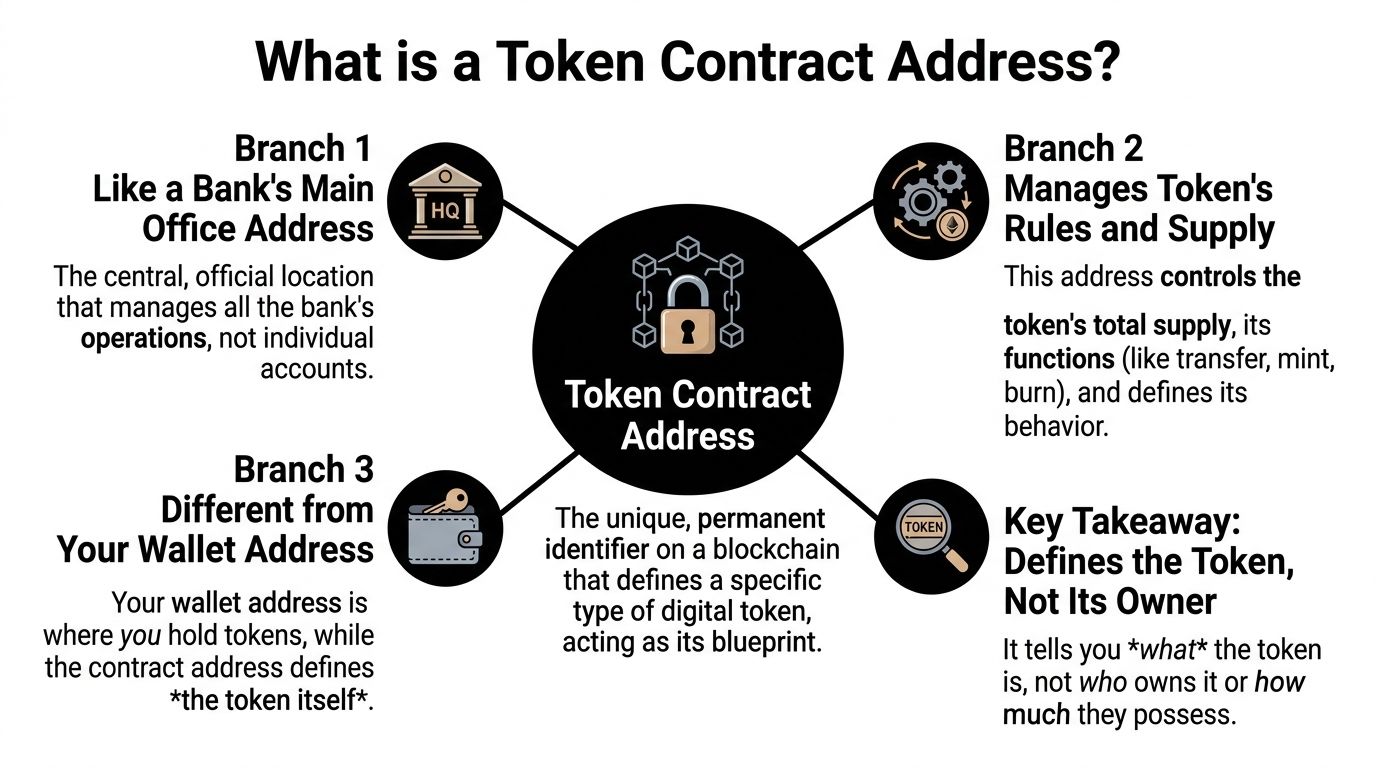
A token contract address is the unique on-chain identifier for the smart contract that defines a token. On Ethereum and similar networks, that contract contains the token’s rules, including how balances are tracked and how transfers work.
The easiest way to think about it is this. The contract address is like a bank’s headquarters. Your wallet address is your personal account number. You interact with the bank’s system through the main office, but your funds belong in your own account, not in the building itself.
What the contract controls
A token contract is not just a label on-chain. It is the executable rulebook for the asset.
For ERC-20 tokens, that typically includes functions such as:
balanceOf(address)to read how many tokens a wallet holdstransferFrom(address _from, address _to, uint256 _value)to move tokens under approved conditionstotalSupply()to expose the token’s total supply
That is why wallets, DEXs, portfolio trackers, and analytics tools all rely on the contract address. They are querying the contract directly to understand what the token is and how balances move.
Why each address is unique
A token contract address is generated deterministically from the deployer and their nonce. That makes it unique on its chain and immutable once deployed. The practical implication is simple. Once traders, wallets, and dApps point to that contract, they are all referring to the same on-chain object.
This also explains why chain context matters. The same token brand can exist on multiple networks, but each network has its own contract address.
The mistake that keeps costing traders money
The bank analogy matters for one more reason. You do not send your money to the bank’s building. You send it to your own account or to another person’s account.
The same logic applies here. If you send tokens directly to the token contract address itself, those assets can become permanently stuck. The reason is mechanical. The contract often has no logic to receive and reassign those tokens back out. According to Cointracker’s explanation of contract addresses, this mistake has historically led to over $100M in frozen ERC-20 assets.
That is not an edge case. It is a recurring operational error.
Tip: Before any transfer, ask one question. Am I sending to a wallet that can own and control tokens, or am I sending to a contract that was never designed to hold them on my behalf?
What traders should remember
A token contract address tells you:
| What it tells you | What it does not tell you |
|---|---|
| Which exact token contract you are looking at | Whether the token is safe |
| Which rules govern balances and transfers | Whether liquidity is healthy |
| Which asset your wallet or DEX should recognize | Whether the project team is trustworthy |
Start tracking smart money today
Join thousands of traders using WalletFinder.ai to find profitable wallets and copy their trades.
Start Free Trial →

