
A Developer's Guide to String and Sol
Unlock the 'string and sol' ecosystem. Learn to manage strings in Solidity and on Solana for optimized cost, performance, and security in your dApps.
When you hear a developer mention a "string and sol" problem, they're not talking about a simple coding error. They’re pointing to one of the most fundamental—and expensive—challenges in blockchain development.
The term refers to handling textual data (string) within either the Solidity programming language (the .sol files that power EVM chains) or on the high-performance Solana blockchain. Getting this right is what separates a functional dApp from one that's actually efficient and scalable enough for real-world use.
Unpacking The String and Sol Challenge
For anyone building on-chain, the "string and sol" dilemma isn't just about syntax—it's a massive issue of cost and performance. Storing text directly on a blockchain is notoriously resource-intensive, no matter which platform you're on.
Think of it this way: writing a string directly to the chain is like trying to mail a solid gold bar. It's incredibly heavy, slow to move, and the shipping costs—calculated for every ounce—are astronomical.
A much smarter approach? Mail a secure, digital certificate of ownership for that gold instead. The certificate is lightweight, transfers instantly, and costs next to nothing to handle, all while providing verifiable proof of your asset. This is the core trade-off.
This diagram helps visualize that flow, showing how raw text is converted into a functional blockchain asset.
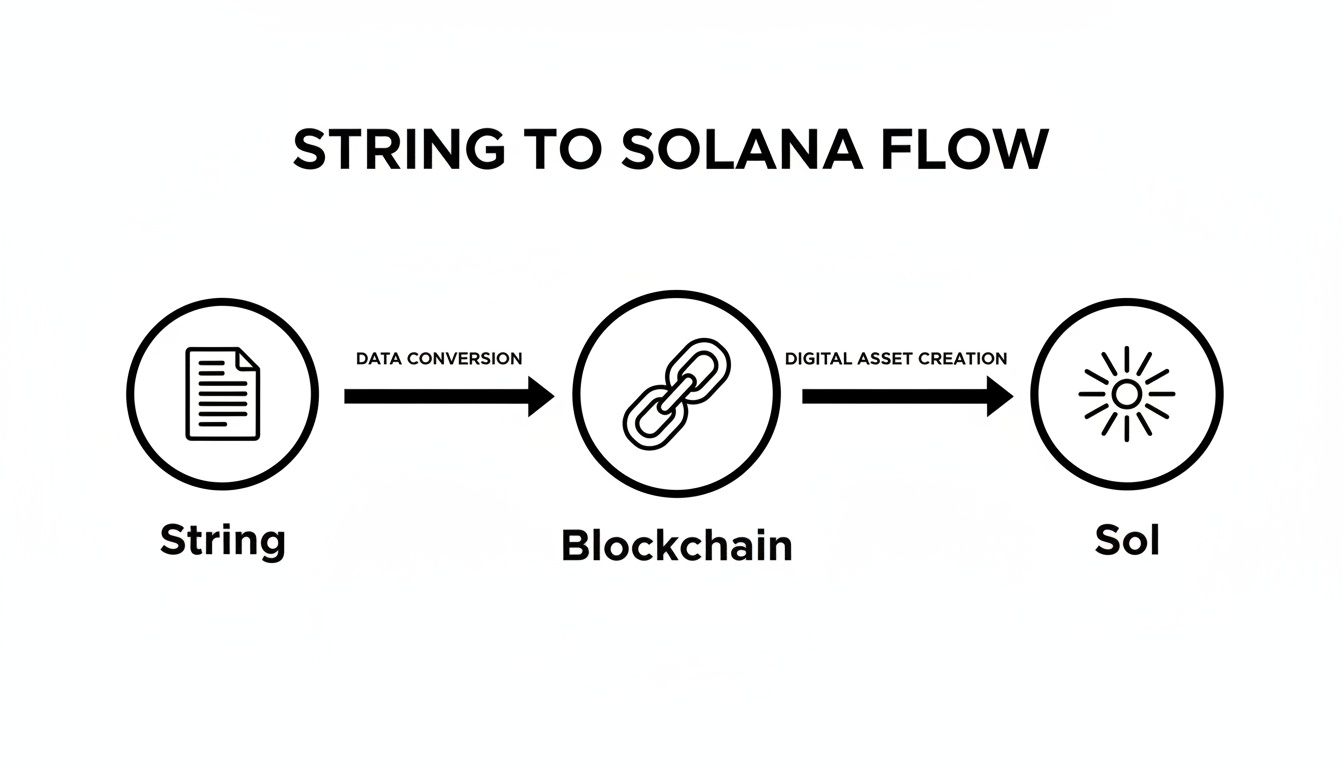
Here, we see the conceptual journey from a basic "string" to a processed asset on a chain like Solana, represented by "Sol".
Understanding this difference—storing bulky raw data versus a lightweight reference—is crucial for building effective dApps. Whether you're battling Ethereum's gas fees or managing Solana's compute units, optimizing how you handle strings is what keeps costs down and ensures your application can actually scale.
Key Takeaway: At its heart, the "string and sol" problem is an economic one. Poor string management blows up transaction fees and tanks performance, directly harming your app's viability and user experience.
Of course, the term "sol" itself can pop up in a few different contexts in crypto. To get a full picture of its uses, you can explore our guide on what sol stands for. Mastering these foundational concepts is the first step toward writing smarter, more cost-effective smart contracts on any blockchain.
String Handling At a Glance Ethereum vs Solana
Before we dive deeper, it's helpful to see how the two biggest smart contract ecosystems approach this problem. While both face the same core economic constraints, their architectural differences lead to different developer strategies.
| Aspect | Ethereum (Solidity) | Solana (Rust) |
|---|---|---|
| Primary Data Type | string (dynamic bytes array) | String (UTF-8 growable) |
| On-Chain Storage | Extremely expensive; stored in storage | Expensive; stored in account data |
| Typical Pattern | Store hashes or URIs on-chain; data off-chain (IPFS) | Store data in separate accounts; use Program Derived Addresses (PDAs) |
| Cost Model | Gas fees per byte | Rent for account space + Compute Units for processing |
| Manipulation | Limited native functions; libraries (e.g., Strings.sol) are common | Rich native functions in Rust's standard library |
Start tracking smart money today
Join thousands of traders using WalletFinder.ai to find profitable wallets and copy their trades.
Start Free Trial →

