
Spark Token Price: Actionable Analysis for 2026
Get the ultimate Spark token price analysis for 2026. Explore SPK's on-chain data, key drivers, and trading tactics to spot smart money moves.
Spark dropped 86.60% from its all-time high to roughly $0.02499 by mid-April 2026 according to KuCoin SPK price data. That single fact changes how professionals should approach the spark token price. This isn't a token you evaluate with a lazy chart glance and a recycled prediction thread.
SPK had an explosive launch, a sharp unwind, and then signs of stabilization. That pattern usually attracts two very different groups: traders looking for a rebound trade, and long-horizon DeFi investors looking for a protocol token whose value may reconnect with usage. Both groups can make money. Both groups can also get trapped if they focus only on candles.
The edge isn't in guessing the next green day. The edge is in understanding what moves SPK, how protocol usage feeds into token demand, and which wallets are positioning before the move becomes obvious.
Decoding the Spark Token Price Puzzle
SPK rallied about 244% within roughly a month of launch, then gave back almost all of that move over the following months. That kind of price history attracts the wrong kind of certainty. Traders either fixate on the early breakout and call every dip a bargain, or they treat the drawdown as proof that every rally should be sold.
Both reactions miss how DeFi governance tokens usually trade after launch. Early price action is often a mix of thin liquidity, incentive-driven positioning, exchange discovery, and fast-rotating momentum capital. That makes the opening chart useful as a record of who showed up first. It does not make it a reliable map for where SPK should trade next.
Why the chart alone misleads
A sharp decline can reflect repricing rather than failure. A flat range can hide distribution from larger holders or quiet accumulation from wallets building size before liquidity improves. SPK sits in a zone where traders need more than support and resistance lines.
A better read starts with market structure:
- Launch flows matter: SPK's first move was strong enough to pull in short-horizon traders who usually exit as soon as volatility compresses.
- The long decline matters more: extended weakness in a governance token often signals that the market is resetting growth assumptions, incentive expectations, and supply overhang.
- The bounce off the lows matters: SPK did not disappear after the unwind. Buyers defended lower levels, which keeps the token in the category of tradable recovery candidates rather than abandoned listings.
My rule on names like this is simple. Treat SPK as a protocol-linked trading instrument with event risk, supply risk, and on-chain signal value. That framing is much more useful than arguing over whether it is "cheap" relative to a past high.
The more useful question
The key question is not whether SPK once traded much higher. It is why demand appears in one area, fades in another, and whether that behavior is being led by informed wallets or retail reaction.
For SPK, price usually makes more sense when three datasets line up. Protocol activity. Token supply mechanics. Wallet behavior on-chain. If one of those starts diverging, the chart can look stable right before a break.
That is where traders can gain an edge. Instead of asking whether spark token price will bounce, track whether high-quality wallets are accumulating before volume expands, whether liquidity is deep enough to absorb exits, and whether new buying is tied to actual protocol traction or just short-term speculation.
Use this framework:
- Check whether protocol usage is strengthening or stalling.
- Track whether skilled wallets are adding, trimming, or rotating out.
- Measure whether market depth can support a real move.
- Watch supply-related pressure that can cap rallies.
That process is slower than chasing green candles. It is also how traders avoid buying a reflex rally that smart money is already selling into.
What Is Spark (SPK) and Why Does It Matter
SPK is the governance token of the Spark protocol on Ethereum. Spark itself is a DeFi protocol built around stablecoin capital efficiency, with core products including SparkLend and Spark Savings. If you're trading the spark token price seriously, you need to think like a protocol analyst first and a chartist second.
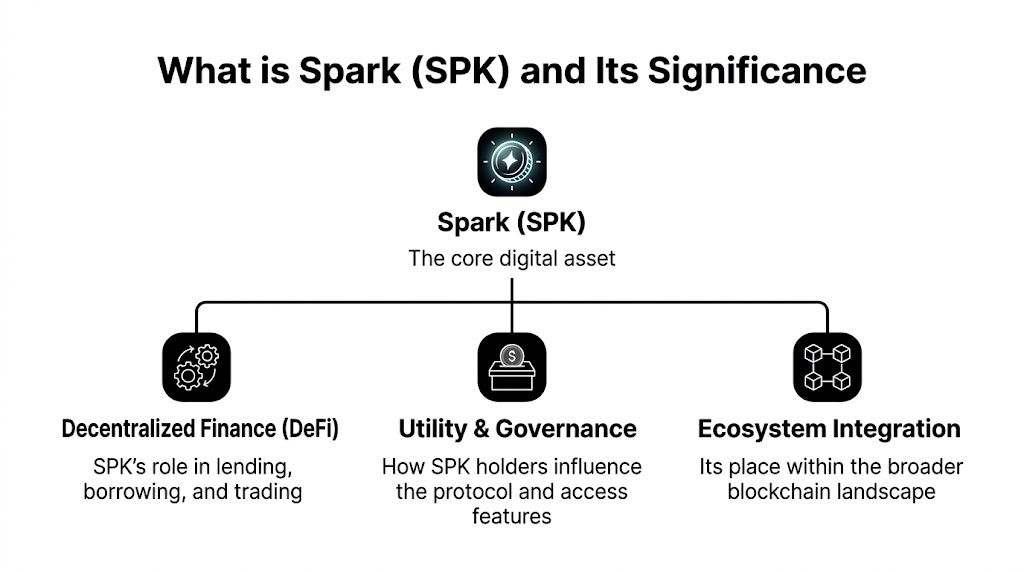
According to Kraken's Spark market overview, SPK trades around $0.0245 to $0.0304, has a circulating supply of 2.57 billion SPK out of a 10 billion total supply, carries a market cap around $63M, and a fully diluted valuation around $245M. The same source notes that 17% was made available at launch, with the remaining supply vesting over time, which is critical for understanding both risk and valuation.
What the protocol actually does
Spark isn't trying to be a generic token with vague ecosystem language. Its utility comes from governance within a protocol focused on stablecoin yield optimization.
At a practical level, traders should think about Spark in three layers:
- SparkLend: a lending and borrowing venue tied to stablecoin activity.
- Spark Savings: a yield-focused module for stablecoin deposits.
- Governance layer: the part that connects protocol growth to SPK holder influence.
That structure matters because governance tokens usually trade best when the underlying protocol is doing something economically relevant. Stablecoin yield and lending are relevant. That doesn't guarantee price appreciation, but it gives SPK a more concrete analytical basis than many thinly traded governance names.
The tokenomics that traders can't ignore
Most retail traders look at price and maybe market cap. Professionals always add two more checks: circulating supply and fully diluted valuation.
Here's the quick framework.
| Metric | What it tells you | Why it matters for SPK |
|---|---|---|
| Price | What the market pays now | Useful, but incomplete on its own |
| Circulating supply | How much supply is currently tradable | Helps estimate actual float and near-term pressure |
| Market cap | Current token value based on circulating supply | Better than price alone for peer comparison |
| Total supply | Maximum token base | Important for future dilution analysis |
| FDV | Valuation if total supply were in the market | Crucial for judging whether current pricing understates future supply risk |
Start tracking smart money today
Join thousands of traders using WalletFinder.ai to find profitable wallets and copy their trades.
Start Free Trial →

