
Smart Contract Platforms: A Trader's Guide
Discover the best smart contract platforms for DeFi trading. Our guide compares Ethereum, Solana, Base, and L2s to improve your on-chain analysis and strategy.
Smart contract platforms are the bedrock of decentralized finance (DeFi). They're the blockchains where dApps get built and smart contracts execute. For a trader, the choice of platform creates a fundamental trade-off: some chains, like Ethereum, prioritize security and decentralization, which usually means higher fees. Others, like Solana, are built for raw speed and low costs. These two philosophies create entirely different playgrounds for trading.
Why Smart Contract Platforms Matter for Traders
If you're a DeFi trader or an on-chain analyst, the smart contract platform you're on isn't just tech—it's your trading floor. It’s the arena where every swap, yield farm, and arbitrage opportunity plays out. The DNA of each platform, from Ethereum and Solana to Layer 2s like Base, directly molds market dynamics and, ultimately, your PnL.
Understanding these differences is non-negotiable. A platform's architecture dictates its transaction speed, cost, and security, creating distinct advantages for specific trading styles. Here’s a quick breakdown of what this means for you:
- For memecoin hunting: You need a low-fee, high-speed chain where you can get in and out fast without gas fees destroying your profits.
- For managing a large portfolio: You’ll feel more comfortable on a battle-tested network where security is paramount, even if it's a bit slower.
The Foundation of On-Chain Trading
At its heart, a smart contract platform is a decentralized computer running code that powers everything from DEXs to lending protocols. How that platform reaches agreement on transactions—its consensus mechanism—has a direct line to your wallet.
A platform's finality—the moment a transaction becomes irreversible—is a make-or-break factor for traders. Fast finality slashes the risk of your trade getting rolled back during market volatility, which is absolutely critical for anyone running arbitrage bots or high-frequency strategies.
The rules of the game are set by a few key traits:
- Transaction Speed and Finality: How fast do your trades confirm and become permanent? This is crucial when reacting to news or getting ahead of a large order. Learn more by exploring our deep dive into how transactions per second impact trading strategies.
- Transaction Costs (Gas Fees): Sky-high fees can make entire strategies, like micro-scalping, completely worthless. Low fees encourage experimentation and fuel higher trading volumes.
- EVM Compatibility: The Ethereum Virtual Machine (EVM) is the industry standard. EVM-compatible platforms feel familiar; you can use your go-to tools like MetaMask, and protocols can launch across multiple chains, opening up juicy cross-chain opportunities.
A Rapidly Expanding Market
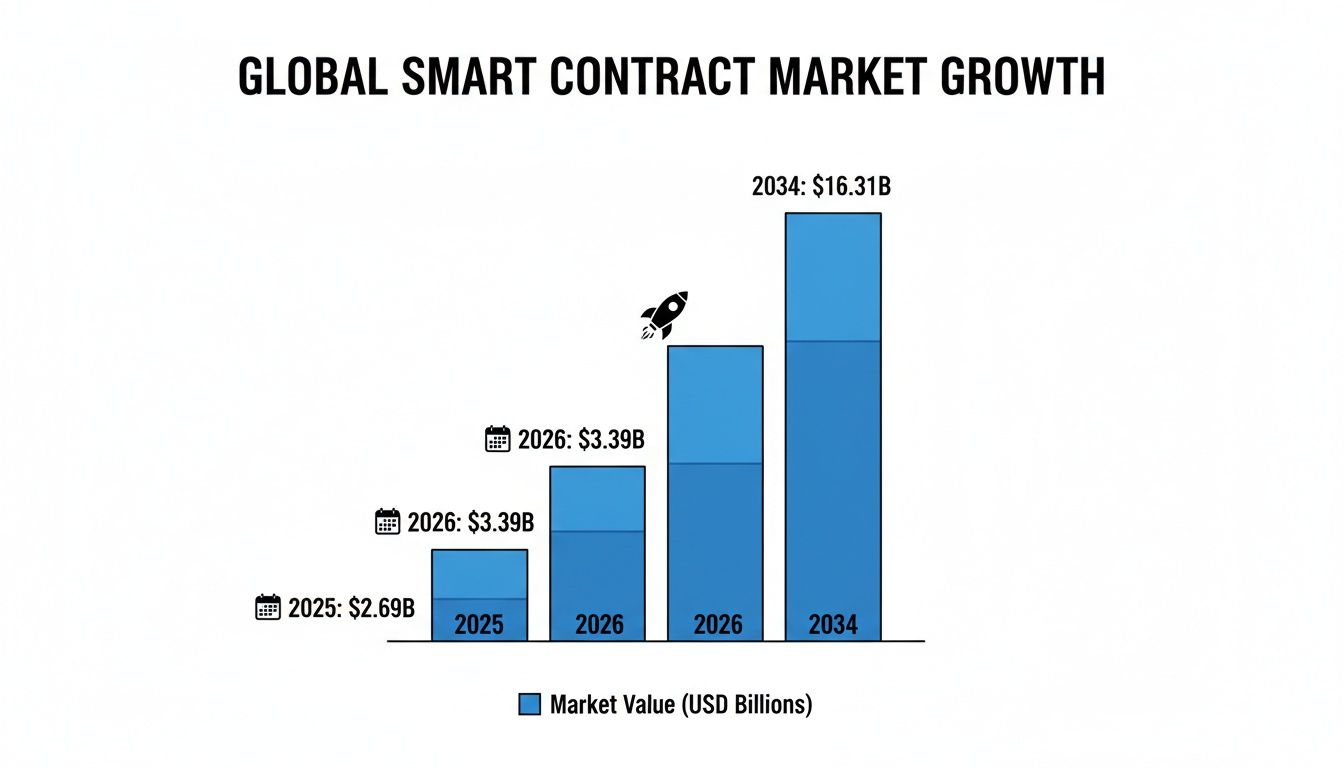
The economic gravity of these platforms is undeniable. The global smart contracts market is on a tear, valued at USD 2.69 billion in 2025 and projected to rocket to USD 16.31 billion by 2034. This growth means a firehose of new capital, protocols, and trading opportunities is pointed right at us. Discover more insights about the smart contracts market growth on fortunebusinessinsights.com. For traders, that translates to deeper liquidity and more complex markets to master. Picking the right platform is the first move you make to capitalize on it.
Comparing the Top Smart Contract Platforms
Choosing a smart contract platform is like a race car driver picking a car for a specific track. You wouldn't bring a car built for the tight corners of Monaco to the long, fast straights of Monza. The blockchain you choose dictates your strategy, affecting everything from execution speed to the fees that chip away at your profits.
To make the right call, you must look past the marketing noise and get into the core mechanics of each chain. The architectural decisions made by developers—whether a chain is monolithic or modular—have a direct impact on real-world performance. This is where you find your edge.
This section breaks down the dominant platforms today, focusing on the technical guts that matter for active DeFi traders. We'll compare Ethereum, the hardened veteran; Solana, the high-speed upstart; and the crucial Ethereum Layer 2s like Arbitrum, Optimism, and Base that are changing the game.
Core Architecture and Consensus Mechanisms
Blockchains generally come in two flavors: monolithic or modular. A monolithic chain like Solana handles everything—execution, settlement, consensus, and data—on a single, highly optimized layer. The goal is pure, unadulterated speed.
A modular design, best seen in Ethereum and its Layer 2 ecosystem, splits up the jobs. Ethereum acts as the secure settlement layer, while Layer 2 solutions like Arbitrum and Optimism handle the heavy lifting of transaction execution much more cheaply. This approach aims for massive scale without compromising decentralization. You can dive deeper into this in our complete Ethereum Layer 2 guide for traders.
For traders, the takeaway is straightforward: Monolithic chains like Solana often deliver faster finality and dirt-cheap fees, making them a playground for high-frequency strategies. Modular systems built on Ethereum offer battle-tested security, which is what you want when you're parking large amounts of capital for the long haul.
Throughput and User Fees: A Practical Look
Don't get fooled by theoretical "transactions per second" (TPS) numbers. What really counts is how a platform performs under pressure and what you actually pay in fees. This is where the differences become stark.
Ethereum mainnet prioritizes security, chugging along at 15-30 TPS with fees that can skyrocket to hundreds of dollars during congestion. This makes it a no-go for most retail trading but perfect for large, infrequent moves where security is non-negotiable.
This is the problem that Layer 2s and alternative Layer 1s fix. Solana routinely handles over 2,000 TPS, with fees that are fractions of a penny. Layer 2s like Arbitrum and Base also blow Ethereum mainnet out of the water on speed, with fees usually under $0.10.
The market for these platforms is exploding, projected to grow from $2.69 billion in 2025 to over $16.31 billion by 2034.
Start tracking smart money today
Join thousands of traders using WalletFinder.ai to find profitable wallets and copy their trades.
Start Free Trial →

