
Security Edge Coin: Find Legitimacy in Crypto
Stop guessing. Learn to spot a crypto project's 'security edge coin'—the on-chain signals that prove legitimacy. This guide shows you how.
A coin dealer turns a silver piece sideways before saying a word. He isn't admiring the artwork. He's checking the edge, because the rim often tells the truth faster than the face.
Crypto works the same way. The loudest claims usually sit on the surface, while legitimacy hides in the hard-to-fake details.
The Collector's Dilemma and the Crypto Parallel
Collectors learn early that a convincing fake can look perfect from the front. The portrait is crisp. The date looks right. The metal even feels close enough in the hand. Then the coin gets rotated, and the edge gives it away.
That instinct matters because a security edge on coins exists for a reason. One concrete example is the American Silver Eagle's interrupted reeded edge introduced in 2021, where subtle variations or missing reeds in specific areas make tampering or counterfeiting harder by adding a discontinuity that's difficult to replicate, as explained in GovMint's overview of American Silver Eagle security features.
The lesson is simple. Real authentication rarely depends on one obvious feature. It depends on details that are costly to fake and easy to inspect if you know where to look.
Crypto has its own version of the same problem. A token can have a polished website, an active social feed, and a flood of hype posts. None of that proves the contract is safe, the liquidity is stable, or the holders behind the first wave of buying are trustworthy.
Why surface-level checks fail
A beginner often asks, “Is this a good coin?” That question is too broad to help. A better question is, “What hidden signals would be hard for a weak project to fake?”
For a coin collector, that includes the rim. For a crypto trader, it includes on-chain behavior.
Consider the parallel:
- Coin face vs token branding: Both are easy to polish.
- Coin edge vs on-chain records: Both expose structure you can verify.
- Collector expertise vs trader discipline: Both come from repeatable checks, not gut feel.
A fake usually wins at first glance and loses under inspection.
That's the useful way to think about the phrase security edge coin in crypto. It isn't a ticker. It's a method. You're looking for the digital equivalent of a coin edge, meaning evidence that survives scrutiny from multiple angles.
The real problem in crypto
Most crypto losses don't come from missing a trend. They come from trusting appearance over verification.
Anonymous teams aren't automatically bad. Aggressive marketing isn't automatically fraudulent. But neither should count as proof. If you can't inspect a project's “edge,” you're trading on narrative alone.
That's where on-chain analysis becomes powerful. It gives you something collectors have always valued: a way to inspect authenticity without relying on the seller's story.
Defining a Crypto Security Edge
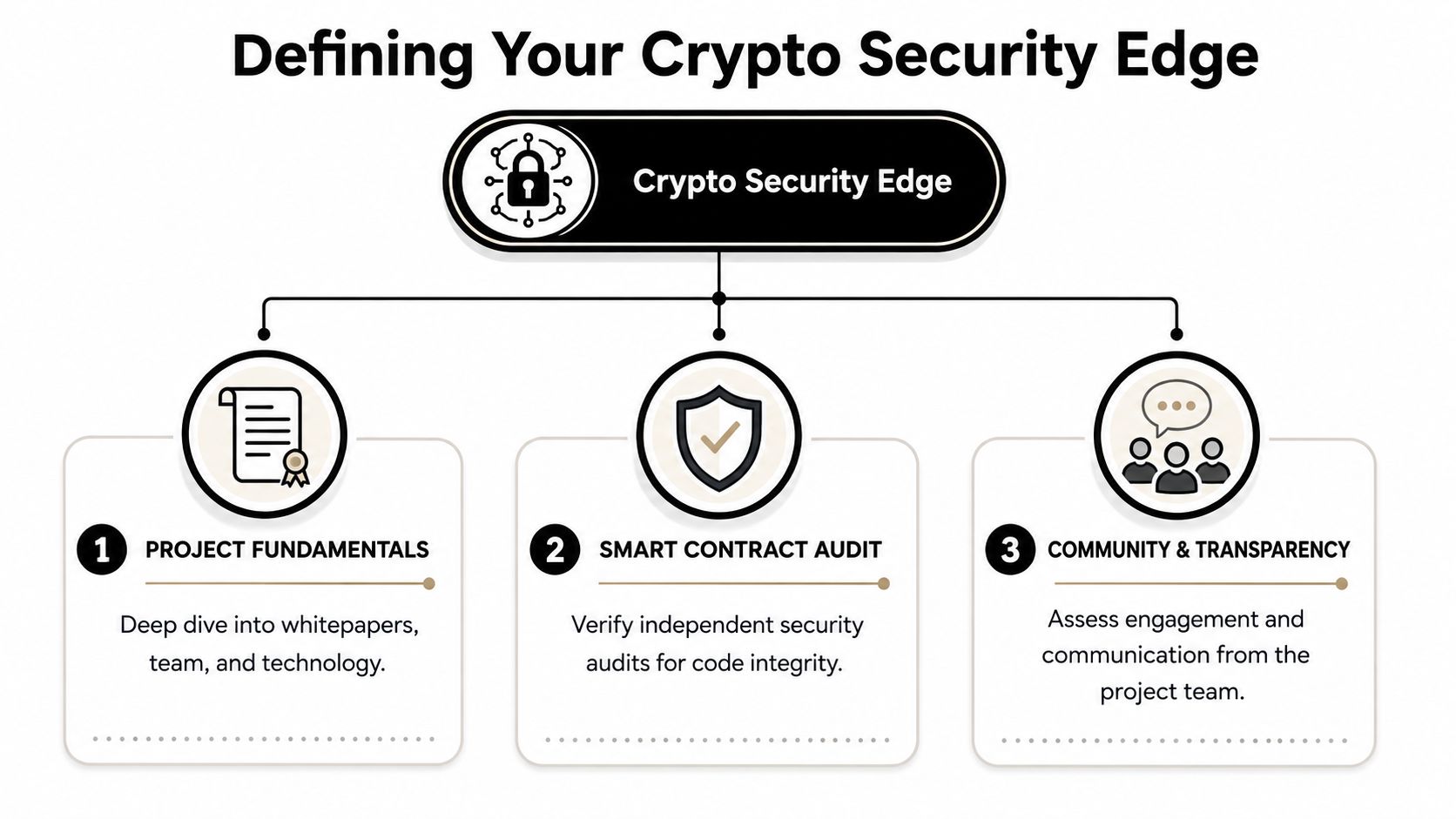
A practical crypto security edge is a stack of checks, not a single signal. Traders get in trouble when they chase one shortcut. They want one metric, one influencer mention, or one chart pattern that answers everything. That shortcut doesn't exist.
A stronger framework looks at several layers together. If multiple layers line up, the asset has a better claim to legitimacy. If they conflict, slow down.
Four pillars that matter
I'd define a Security Edge Coin framework around four pillars.
Technical soundness
Start with the contract itself. Is the code verified on the relevant block explorer? Is ownership structure clear? Are permissions narrow or broad? Can someone still change core behavior after launch?
This is the “metal and minting” layer. If it's weak, the rest doesn't matter much.
Financial stability
A token also needs structural support. That means asking where liquidity sits, whether it appears dependable, and whether the token design creates obvious pressure points.
You don't need a perfect model of tokenomics to spot danger. If the setup makes exit risk or manipulation easy, the project has no real edge.
Holder health
Next, inspect distribution. A token can look active while a small cluster of wallets controls too much of the supply or too much of the tradable float.
Healthy distribution doesn't guarantee success. Unhealthy concentration can make failure sudden.
Smart money endorsement
The last pillar is behavioral. After a project passes foundational checks, ask who is buying. Not random wallets. Not headline-chasing tourists. Wallets with a visible history of disciplined entries and exits.
Practical rule: Don't treat any single green flag as proof. Treat alignment across pillars as evidence.
What this framework changes
This approach changes how you read crypto opportunities.
Instead of asking, “Is this token hot?” ask:
- Can I verify the contract?
- Can I inspect the market structure?
- Can I see who holds it?
- Can I identify credible wallets entering early?
That's the digital equivalent of turning a coin sideways.
People get confused here because they think due diligence should produce certainty. It won't. The point is narrower. You're reducing the chance of buying something that only looks authentic from the front.
A true security edge coin, in this sense, is any crypto asset that holds up when you inspect its hidden structure.
Analyzing a Token's Technical Foundation
Before you study narratives, momentum, or wallet flows, inspect the base layer. Coins use physical properties to make forgery harder. Crypto projects need their own equivalent set of checks.
For circulating coins, the edge profile is a meaningful anti-counterfeiting control. The European Central Bank notes that euro coins use standardized physical and electromagnetic properties for machine identification that are “extraordinarily difficult to counterfeit,” which matters because a forgery must match multiple independent verification channels, not just visual appearance, as described in the ECB's euro coin leaflet.
That's a strong analogy for token analysis. Don't rely on one visible cue when you can inspect several independent signals.
What to verify first
A token's technical foundation should answer one question fast: can this project be altered, drained, or trapped in ways casual buyers won't notice?
Use this checklist before you spend serious time on a chart.
| Signal | Green Flag (Legitimacy Indicator) | Red Flag (Warning Sign) |
|---|---|---|
| Contract verification | Source code is publicly verified on the chain explorer | Contract isn't verified, so buyers must trust claims blindly |
| Audit quality | Audit is easy to locate, readable, and tied to the exact deployed contract | “Audited” appears in marketing, but no clear report or matching deployment is available |
| Ownership controls | Admin permissions are limited, transparent, and clearly explained | A single owner can change fees, blacklist wallets, pause trading, or alter core behavior without warning |
| Liquidity structure | Liquidity status is clear and the project explains how trading infrastructure is protected | Liquidity details are vague, missing, or easy for insiders to withdraw |
| Upgradeability | Any upgrade path is documented and justified | Upgradeability exists but nobody explains who controls it or how changes are governed |
| Transaction mechanics | Buy, sell, and transfer behavior is consistent with what the project states publicly | Hidden taxes, transfer failures, or unusual restrictions appear only after users interact |
| Documentation consistency | Whitepaper, explorer data, and token behavior align | Public materials contradict what the contract actually allows |
Start tracking smart money today
Join thousands of traders using WalletFinder.ai to find profitable wallets and copy their trades.
Start Free Trial →

