
Robinhood Transfer to Bank: A Trader's Guide
Learn how to complete a Robinhood transfer to bank with our guide. We cover transfer times, limits, fees, and how to fix common withdrawal issues.
Getting cash from your Robinhood account to your bank is simple. You have two main options: a standard ACH transfer, which is free but takes a few days, or an Instant Transfer, which costs a small fee but gets your money to you in about 30 minutes.
The most critical step is ensuring your cash is fully settled. This is the most common hurdle for users, so understanding it is key to a smooth process.
The Settlement Period Trap That Costs Traders Thousands
Everyone knows about the T+2 settlement rule. Sell a stock Monday, wait until Wednesday to withdraw. Simple, right? Except there's a hidden layer of complexity that catches traders off guard and locks up their capital when they need it most.
The issue isn't just when funds settle—it's which funds settle first and how that affects your withdrawal ability. Robinhood uses a FIFO (First In, First Out) system for determining what cash is available. This creates scenarios where you think you have withdrawable cash, but the platform tells you otherwise.
The Multi-Day Trading Confusion
Here's a real scenario that happens daily: You have $10,000 in your account on Monday. You buy and sell different stocks throughout the week, keeping roughly the same cash balance. By Friday, you still show $10,000 in cash. You try to withdraw $8,000. Robinhood says you can only withdraw $2,000. What happened?
The answer is settlement stacking. Each trade you made has its own T+2 settlement timeline. Monday's trades settle Wednesday. Tuesday's settle Thursday. Wednesday's settle Friday. By Friday afternoon, only Monday and Tuesday's trades have fully settled. Everything else is still in the settlement pipeline.
Robinhood doesn't let you withdraw cash that's tied up in unsettled trades, even if your total cash balance looks fine. This is how you can have $10,000 showing but only $2,000 withdrawable.
The solution: track your settlement calendar manually if you're an active trader. Before initiating any withdrawal, calculate which trades have actually cleared T+2. Don't trust the total cash balance—only trust the "withdrawable cash" figure shown on the transfer screen.
The Pattern Day Trader (PDT) Withdrawal Lock
If you're flagged as a pattern day trader (4+ day trades in 5 business days), you're required to maintain a $25,000 minimum account balance. What most traders don't realize is that this minimum applies to withdrawals too.
You can't withdraw funds that would drop your account below $25,000 while you have open positions. Even if all your cash is settled, even if you're trying to withdraw your own money you deposited years ago, Robinhood will block it if it violates the PDT minimum.
The workaround: close all positions first, then withdraw. Once you have zero open trades, the PDT minimum doesn't apply to withdrawals. You could drop to $5,000 and still pull the money out—as long as you're not holding any stocks at the time.
But here's the catch: if you close positions just to withdraw funds, you'll trigger wash sale rules if you rebuy those same stocks within 30 days. Any loss you took on the sale gets disallowed for tax purposes. You've just turned a tax deduction into taxable income.
Good Faith Violations: The Silent Account Killer
This one destroys beginners. You deposit $1,000 on Monday via ACH. Robinhood gives you instant buying power, so you immediately buy stocks. Tuesday morning, you sell those stocks for $1,100. You made profit! Now you try to withdraw the $1,100. Denied.
Why? You bought stocks with unsettled deposit money (your Monday ACH hasn't cleared yet). Then you sold those stocks before the deposit settled. This is called a good faith violation. You're essentially trying to withdraw money you never actually deposited yet because ACH takes 5 business days to fully clear.
Three good faith violations in 12 months gets your account restricted to settled cash only for 90 days. No more instant buying power. No more day trading. You're basically trading with one hand tied behind your back.
The prevention is simple but annoying: never sell a position until your deposit that funded it has fully settled (5 business days). If you deposited $1,000 Monday, don't sell anything you bought with that money until the following Monday.
Navigating Your Robinhood Withdrawal Options
Before you can withdraw money, you need to know the difference between settled and unsettled funds. Just because you see cash in your account doesn't mean it's ready to move.
- Settled Funds: This is money that has officially cleared and is available for withdrawal. It comes from deposits that have completed their holding period or stock sales that have passed the mandatory T+2 settlement period (trade date plus two business days).
- Unsettled Funds: This is cash from a recent transaction, like a stock sale you made yesterday. If you sell shares on Monday, the funds won't settle and become withdrawable until Wednesday.
Understanding this rule prevents most transfer issues. Robinhood manages a massive volume of transactions—net deposits reached $7.1 billion in a single month at one point—so these settlement rules are crucial for operational integrity.
Why Your ACH Transfer Actually Takes Longer Than Robinhood Claims
Robinhood says 1-3 business days for ACH transfers. In reality, many users report 4-6 days. The discrepancy isn't Robinhood lying—it's how the banking system actually works versus how it's marketed.
The Hidden ACH Processing Timeline
When you initiate a withdrawal Tuesday at 2pm, here's what actually happens behind the scenes:
Day 1 (Tuesday 2pm): You click "transfer." Robinhood queues your request.
Day 1 (Tuesday 8pm ET): Robinhood batches your transfer with thousands of others and submits to the Federal Reserve's ACH network.
Day 2 (Wednesday): Federal Reserve processes the batch and forwards to your bank. Your bank receives notification but doesn't credit your account yet.
Day 3 (Thursday): Your bank verifies the transfer, checks for fraud flags, and processes it internally. Still no money in your account.
Day 4 (Friday morning): Your bank finally posts the deposit to your account. The cash appears in your available balance.
That's 3 full business days after initiation, landing Friday morning. But if you initiated Tuesday evening instead of afternoon, Robinhood's 8pm batch already passed. Your transfer doesn't enter the queue until Wednesday 8pm, pushing everything back 24 hours. Now you're looking at Monday arrival.
Weekend in the middle? Add two more days. Initiated Friday at 3pm? You're not seeing that money until Thursday at the earliest.
Why Some Banks Are Slower Than Others
Not all banks process ACH deposits at the same speed. Some credit your account as soon as they receive the notification (Day 2). Others hold it for "verification" until Day 4 or even Day 5.
Banks known for fast ACH: Ally Bank, Chime, SoFi, Marcus by Goldman Sachs. These usually credit within 2 business days.
Banks notorious for slow ACH: Wells Fargo, Bank of America, Chase (sometimes). These can take the full 5 business days.
Credit unions are wildly inconsistent. Some are faster than big banks. Others take a week. The only way to know is testing it yourself with a small transfer first.
The ACH Reversal Nightmare
Here's a scenario that ruins people: You deposit $5,000 into Robinhood via ACH. Robinhood gives you instant buying power. You buy stocks. You sell them two days later for $5,500. Your ACH deposit still hasn't fully cleared (remember, ACH takes 5 business days). Your original bank reverses the ACH deposit for insufficient funds or fraud suspicion.
Now Robinhood is out $5,000 they advanced you. Your account goes negative. Robinhood sells whatever positions you still have to cover the deficit. If you've already withdrawn some of that $5,500 profit, they'll freeze your account until you repay the negative balance.
This happens more than you'd think. Your bank might reverse an ACH for:
- Insufficient funds when the transfer actually processes (5 days later)
- Fraud alerts triggered by unusual account activity
- Closed account that hadn't updated in Robinhood
- Errors in routing number or account number
The protection: never trade with money from a pending ACH deposit until it fully settles. I know Robinhood gives you instant buying power. Don't use it for anything you plan to sell quickly. Only use it for long-term holds where you're confident your deposit will clear.
Which Robinhood Transfer Method Is Right for You?
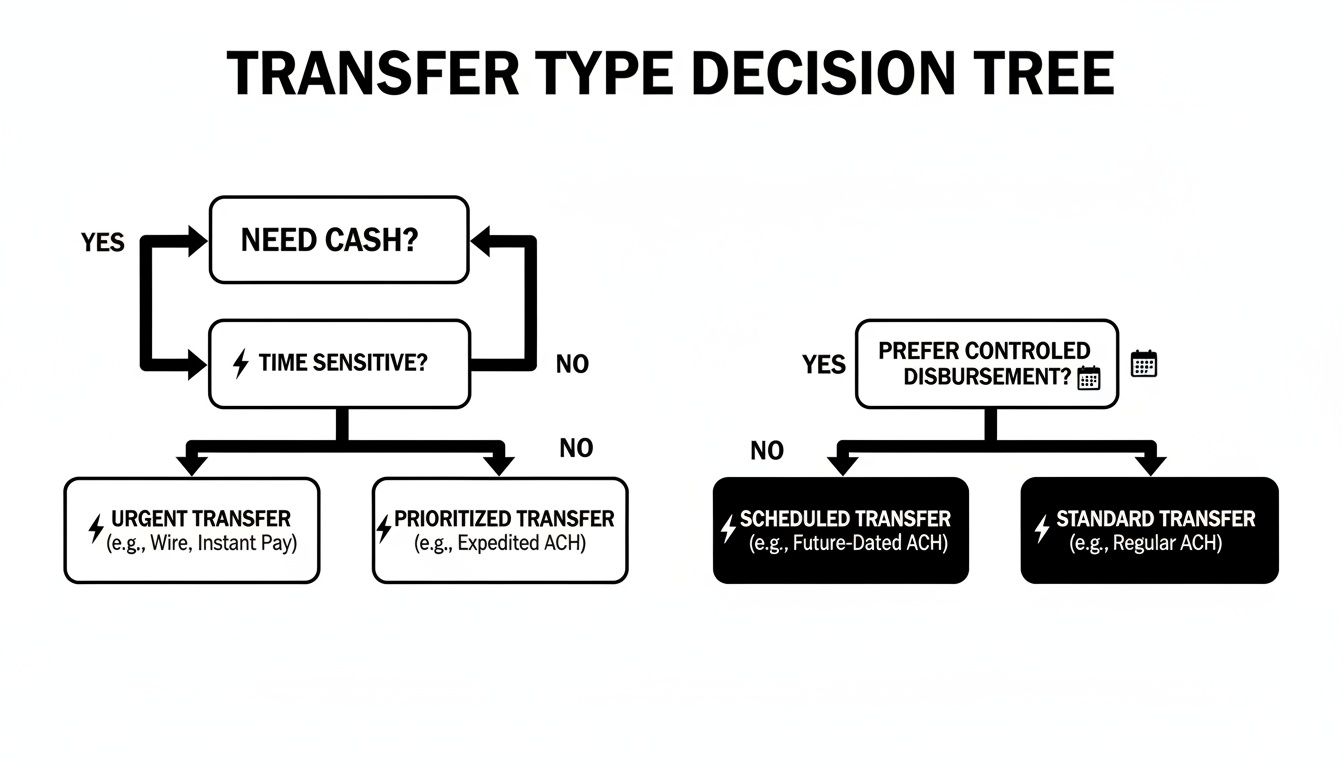
Once your funds are settled, choose the transfer method that fits your needs. Do you need the money immediately, or can you wait to avoid fees?
FeatureStandard ACH TransferInstant TransferSpeed1-3 business daysWithin 30 minutesCostFree1.75% fee (min $0.25)Best ForNon-urgent needs, fee-conscious usersUrgent cash needs, convenience
This decision tree gives you a simple visual for picking the right method based on your situation.
Start tracking smart money today
Join thousands of traders using WalletFinder.ai to find profitable wallets and copy their trades.
Start Free Trial →

