
Master Risk Management Software for 2026
Discover risk management software, from enterprise to DeFi. Evaluate tools, manage on-chain risk, and see how Wallet Finder.ai works.
USD 3,677.5 million in 2024, projected to reach USD 10,713.28 million by 2032. That's one estimate for the global risk management software market, reflecting a projected 14.3% CAGR as organizations adopt automated risk and compliance tools, according to Credence Research's market outlook.
That number matters because it changes how we should think about this category. Risk management software isn't just a compliance department purchase anymore. It has become operating infrastructure for companies that need to see threats early, assign responsibility, document mitigation, and prove that controls function as intended.
Those same principles show up far outside traditional enterprise settings. A bank tracks operational and compliance risk. A hospital tracks privacy and system risk. A DeFi trader tracks wallet behavior, token exposure, and protocol-level threats. The pace is different, but the discipline is the same. Identify uncertainty, assess it in context, act before losses compound.
The Rise of Risk Management Software
A risk register used to live in a spreadsheet. Now it often lives in a system that updates as the business changes.
That shift happened because risk stopped being a periodic review task and became part of daily operations. Security teams track incidents as they happen. Finance teams monitor vendor and fraud exposure across systems. Legal and compliance teams need an audit trail that shows not just the current risk rating, but who changed it, why it changed, and what action followed.
Why adoption keeps widening
The older approach was manageable when organizations had fewer tools, fewer integrations, and slower decision cycles. A quarterly review could still feel current. Once companies started running on cloud apps, distributed teams, outside vendors, and continuous releases, static records began to fail in predictable ways. One team updated a control. Another kept using the old assumption. Leadership saw a report that was already out of date.
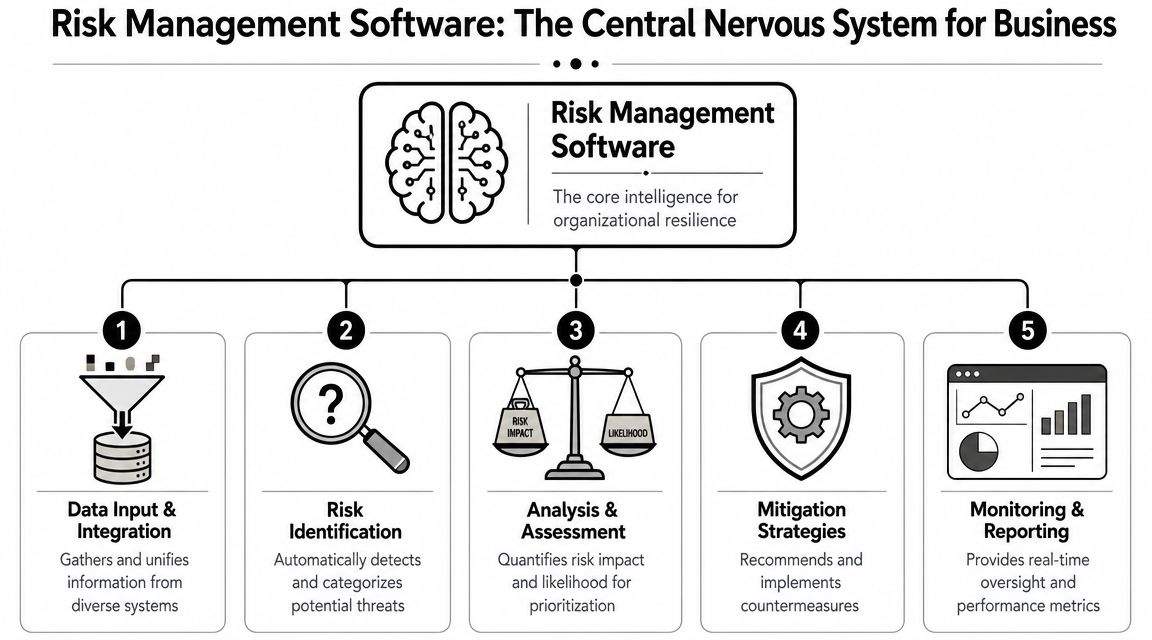
Risk management software works like an air traffic control system for uncertainty. It does not fly the plane for you. It gives teams a shared screen, common signals, and a process for deciding which issue needs attention first.
That matters far beyond compliance.
A useful platform helps an organization connect incidents, controls, owners, assessments, and follow-up actions in one place. The value is coordination. People can see the same exposure, work from the same evidence, and respond before a small problem spreads into operational loss, regulatory trouble, or reputational damage.
Risk is easier to handle when it is treated as a live operating condition, not a document prepared for an annual review.
The same logic carries into DeFi, where the clock moves faster and the margin for error is thinner. A treasury team may watch vendor concentration and access controls. A DeFi trader watches wallet behavior, liquidity movement, token concentration, and smart contract exposure. The objects are different, but the discipline is familiar. You gather signals, judge materiality, and act before the situation turns against you.
That is why tools built for on-chain monitoring increasingly resemble specialized risk management software. For a concrete example, blockchain data analytics for on-chain risk monitoring turns raw wallet and transaction activity into something a trader can use. In that setting, Wallet Finder.ai serves a role similar to enterprise risk software. It helps surface patterns, track exposure, and support faster decisions under uncertainty.
The bridge to DeFi
Enterprise teams worry about control failures, third-party dependencies, and incident response. DeFi participants worry about contract risk, wallet clusters, liquidity exits, and adversarial behavior. The speed is different. The underlying job is the same.
You need a reliable way to spot what can hurt you, estimate the likely impact, and decide what to do next before conditions change again.
Understanding the Core Concept
At its simplest, risk management software is a shared system for tracking what could go wrong, how serious it is, who owns the response, and how that judgment changes over time.
A useful analogy is a building's central alarm and control panel. Smoke detectors, door sensors, cameras, and sprinkler controls all feed signals into one hub. The panel doesn't replace human judgment, but it gives people a coordinated, current view of the building's condition and a way to respond consistently. Risk software plays a similar role for an organization.
Start tracking smart money today
Join thousands of traders using WalletFinder.ai to find profitable wallets and copy their trades.
Start Free Trial →

