
Risk Management for Traders: A Crypto & DeFi Guide
Master risk management for traders with our guide to crypto/DeFi. Learn position sizing, leverage control, and how to use Wallet Finder.ai signals safely.
You're probably here because you've already felt it. A trade starts green, your conviction grows, you size up a little more than planned, and then a fast move against you wipes out days or weeks of progress. In crypto and DeFi, that spiral happens even faster because liquidity can vanish, slippage can widen, and a wallet you're following can rotate before you've even finished thinking.
Most blown accounts don't die from a lack of ideas. They die from one oversized mistake, then a second emotional one, then a third trade placed to “make it back.”
That's why risk management for traders matters more than prediction. Good traders can survive bad reads. Undisciplined traders can't survive their own sizing. In DeFi copy-trading, that difference gets even sharper because you're not just managing market risk. You're managing signal risk, execution risk, correlation risk, and the temptation to outsource judgment to someone else's wallet.
Why Most Traders Lose Money and How You Can Avoid It
A trader catches a strong move early, books a few wins, then decides the next setup is the one to press. No stop. Size too large. Maybe trading on margin. The market snaps back, and one trade undoes everything that came before it.
That story is common because new traders usually focus on entries first and capital protection second. The order should be reversed. A major industry source reports that about 40% of day traders quit within their first month because of losses, which shows how quickly mistakes pile up when risk controls are weak (Earn2Trade on trading risk management).
The lesson isn't that markets are impossible. It's that survival is a separate skill.
The real problem isn't bad picks
You can be directionally right and still lose if your position is too large, your stop is undefined, or your trade sits inside a crowded theme that can unwind all at once. That's especially true in DeFi, where a wallet alert can create urgency and urgency often leads to sloppy execution.
New traders usually blow up in one of these ways:
- They trade too big: One idea carries enough size to damage the account.
- They move the stop: The original loss was manageable. The revised loss isn't.
- They stack similar bets: Several “different” tokens end up driven by the same narrative.
- They chase someone else's conviction: A copied trade feels safer than it is.
Small losses are workable. Large losses change behavior, and once behavior breaks, the strategy usually follows.
What professionals do differently
Professionals don't aim to avoid all losses. They aim to keep losses ordinary. That sounds simple, but it changes everything. If a bad trade is small, the next decision can still be rational. If a bad trade is large, the next decision usually comes from frustration, fear, or FOMO.
That's the core mindset behind risk management for traders. Your job isn't to win every trade. Your job is to make sure no single trade gets a vote on whether you stay in the game.
The Three Pillars of Trading Survival
A DeFi wallet you follow buys a token at 9:12 a.m. By 9:18, the chart is already stretched, Telegram is loud, and the temptation is to copy the trade at full size before it runs again. That is how traders inherit someone else's entry, someone else's timing, and often someone else's risk.
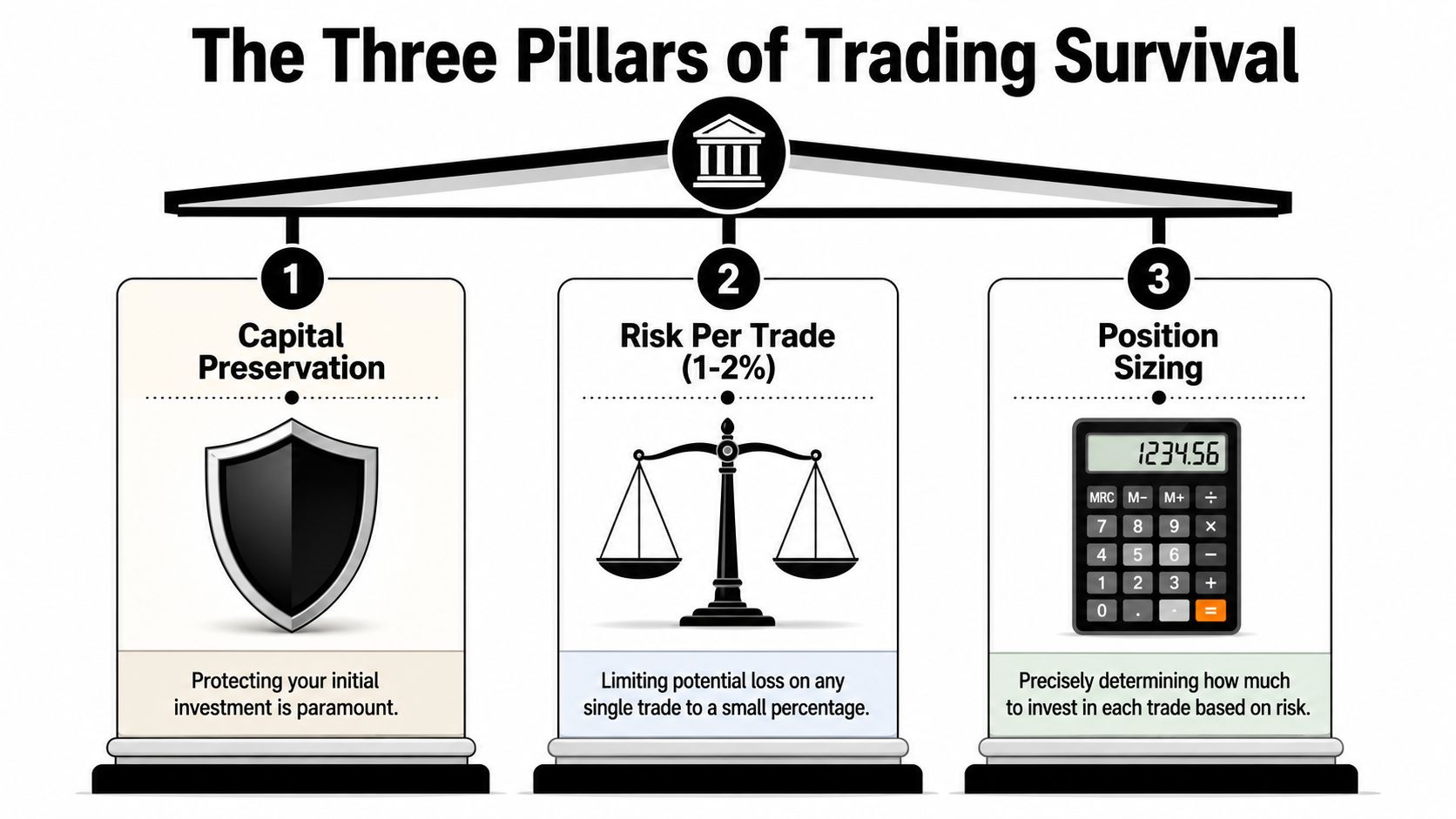
The three pillars that keep you in the game are simple: protect capital, cap risk on each trade, and size the position from the stop, not from excitement. The old 1% rule still matters. In DeFi copy-trading, it matters more because the signal can be good while the execution is worse than the wallet you are following.
The CME Group guide to managing drawdown and risk makes the point clearly. Large drawdowns require disproportionately larger gains to recover. That is why survival starts with avoiding deep damage, not with chasing upside.
Capital preservation comes first
Capital preservation is account defense. If the account takes a 30% hit, you do not just need better trades. You need a recovery phase, and recovery trading often leads to forcing setups that were easy to ignore when the account was healthy.
This gets missed in DeFi because traders focus on wallet quality, token momentum, and speed. Those matter. But none of them protect you if correlated positions unwind together, liquidity disappears, or a copied trade was already half over before you entered.
Set loss limits that assume you will be wrong sometimes, late sometimes, and trapped in noise more often than you expected.
Risk per trade keeps mistakes ordinary
Per-trade risk is the firewall between a bad idea and a bad month. Many experienced traders use the 1% rule as the starting point because it gives enough room to stay active without letting one trade dictate the account. Newer traders copying volatile on-chain moves are often better off below that until their execution is stable.
A useful test is simple. If a stopped-out trade changes your mood, your next decision, or your willingness to follow the plan, the size is too large.
That matters with Wallet Finder.ai signals. The tool can help you find smart-money activity faster, but it should never decide your dollar risk for you. The wallet may have a different entry, deeper liquidity access, a wider tolerance for drawdown, or a portfolio that offsets the trade elsewhere. You do not see all of that from the alert alone.
Position sizing is where discipline becomes real
Position sizing connects theory to execution. The process is straightforward. Decide how much of the account you are willing to lose if the trade fails. Mark the price that proves the trade is wrong. Then let those two numbers determine size.
If you want a practical framework for that math, use a position sizing calculator for crypto trades before you place the order. In fast DeFi markets, this removes the usual mistake of deciding size first and justifying it later.
Here is how the three pillars work together:
| Pillar | What it does | What breaks without it |
|---|---|---|
| Capital preservation | Limits account damage during bad streaks | Drawdown gets deep enough to change behavior |
| Risk per trade | Keeps one loss from dominating results | A single mistake distorts the month |
| Position sizing | Translates risk rules into exact exposure | Stops are arbitrary and size is emotional |
Start tracking smart money today
Join thousands of traders using WalletFinder.ai to find profitable wallets and copy their trades.
Start Free Trial →

