
Price of WETH: Your 1:1 ETH Peg Guide
A complete guide to the price of WETH. Learn what drives its value, how it relates to ETH, and where to track real-time data to inform your trading strategy.
At its core, the price of WETH is designed to mirror the price of Ether (ETH) in a 1-to-1 peg. In a perfect world, 1 WETH will always be redeemable for 1 ETH.
While you might see tiny fluctuations from time to time due to market dynamics on different exchanges, the fundamental value of WETH is directly locked to ETH. This simple fact makes it incredibly reliable for just about anything you want to do in DeFi.
What Is WETH and Why Does Its Price Matter?
The easiest way to think about Wrapped Ether (WETH) is to picture it as a casino chip for the world of decentralized finance (DeFi). Your regular ETH is like cash—it has value everywhere on the Ethereum network. But many DeFi platforms, like decentralized exchanges (DEXes) or NFT marketplaces, are built to work with a specific type of "chip." WETH is that universal chip.
Technically, WETH is an ERC-20 token, which is the gold standard for tokens on Ethereum. Native ETH was actually created before the ERC-20 standard, so it doesn't play nicely with smart contracts that are built to only accept ERC-20 tokens. Wrapping your ETH converts it into WETH, making it fully compatible with this massive ecosystem of dApps.
The Importance of the 1-to-1 Peg
The entire system falls apart without the trust that 1 WETH will always equal 1 ETH. This stability is the bedrock of DeFi for a few key reasons:
- DeFi Interoperability: It unlocks your Ether, letting you trade, lend, or borrow with it inside thousands of different applications.
- Predictable Value: You never have to guess what your WETH is worth. Its value is always anchored to ETH, so you're not speculating on a brand new, volatile asset.
- Arbitrage Opportunities: On the rare occasion the price drifts slightly, sharp traders jump in to buy the cheaper asset and sell the more expensive one. This activity quickly pulls the prices back in line, reinforcing the peg.
Market Performance and Current Value
Even though WETH holds a stable 1-to-1 relationship with ETH, its dollar value is still completely tied to Ethereum's wild market cycles. It's a large-cap asset with enormous liquidity, but its price is still fighting to get back to previous highs.
For example, recent data from Coinbase shows WETH trading around $3,827.03. That's a staggering 68% below its all-time high of $12,144.11, which was set on that exchange back in November 2021. This just goes to show how much broader market conditions affect its USD value, even while the 1 WETH = 1 ETH ratio holds strong. You can dig into more of the numbers on the official WETH price history and market capitalization page.
Getting a handle on this fundamental 1-to-1 relationship is the first and most important step to using WETH confidently. It's not a different asset in terms of value; it’s just your ETH dressed up for the DeFi party.
How the ETH to WETH Price Peg Works
So, why does the price of WETH almost perfectly mirror the price of ETH? The answer lies in a simple but brilliant mechanism coded directly into its smart contract.
At its core, WETH is just Ether locked inside an ERC-20 compliant smart contract. This design guarantees that for every single WETH token floating around in the DeFi world, there's exactly one ETH held in reserve to back it up.
Think of it like a coat check at a fancy event. You hand over your ETH (your coat), and in return, you get a WETH token (your claim ticket). You can take that ticket and use it anywhere within the DeFi ecosystem. But whenever you're ready, you can go back to the contract and exchange your ticket to get your exact coat—your ETH—back. It's a direct 1-to-1 swap, every time.
This diagram shows how WETH acts as the essential bridge connecting native ETH to the expansive world of DeFi and NFTs.
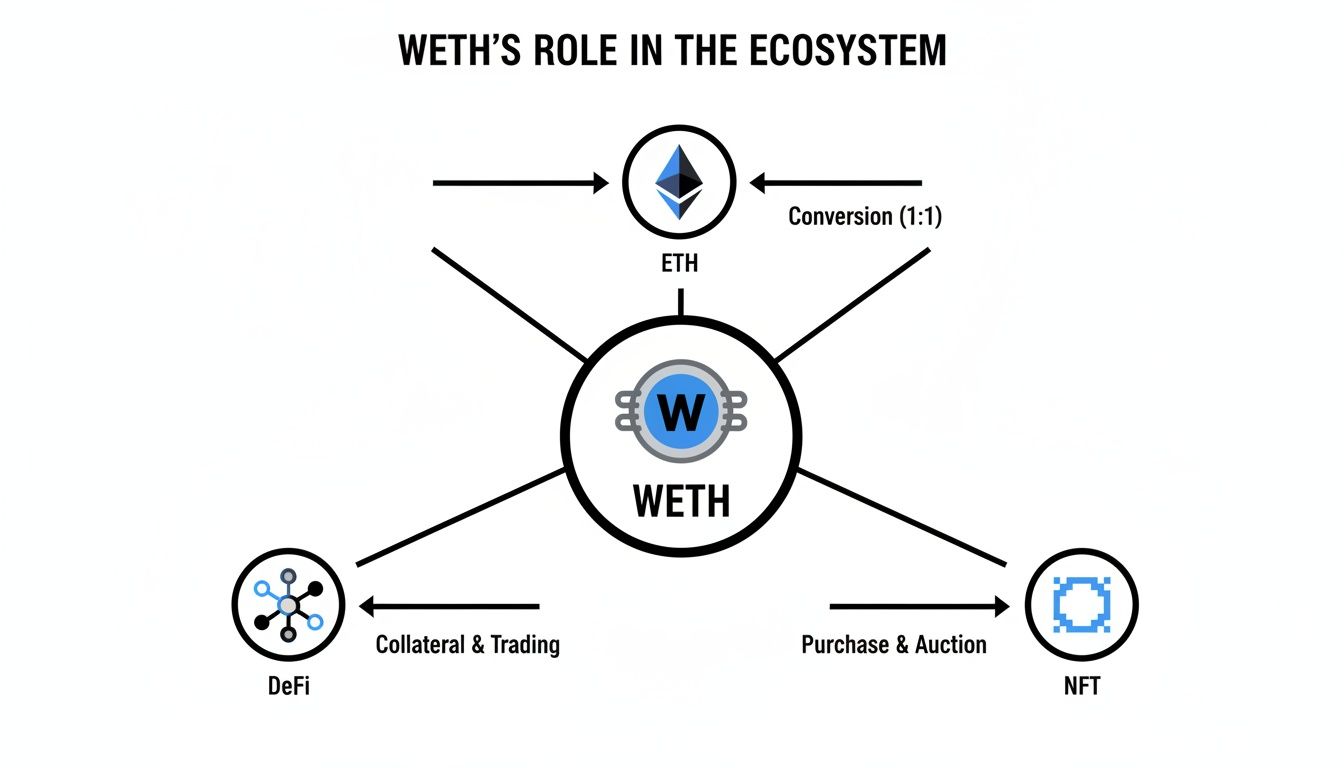
As you can see, WETH is the intermediary that makes ETH compatible with all the protocols and marketplaces that require ERC-20 tokens.
The Wrapping and Unwrapping Process
The magic that keeps the price peg so tight comes down to two simple functions that anyone can use, anytime. This creates a constant market equilibrium.
- Wrapping: You send ETH to the WETH smart contract. The contract locks your ETH and mints an identical amount of WETH back to your wallet.
- Unwrapping: You send WETH back to the same smart contract. The contract "burns" (destroys) the WETH and instantly releases the equivalent amount of locked ETH back to you.
Because this conversion is always on and always maintains a perfect 1-to-1 ratio, it creates a natural, self-correcting force. No complicated algorithms, no middlemen—the peg is guaranteed by the code itself.
The ability for anyone, at any time, to wrap ETH into WETH or unwrap WETH back into ETH is the fundamental reason their prices remain locked together. It’s a self-correcting system enforced by the open market.
When Tiny Price Differences Appear
Despite this rock-solid peg, you might occasionally spot WETH trading for a tiny fraction of a cent more or less than ETH on a decentralized exchange. Don't worry, the system isn't broken. This is just the result of temporary supply and demand dynamics on a specific trading venue.
These small deviations are usually caused by a few things:
- Sudden Demand Surges: A hyped NFT mint that only accepts WETH can trigger a rush of buyers, briefly pushing its price slightly above ETH on certain DEXes.
- Liquidity Pool Imbalances: On DEXes, prices are set by the ratio of two assets in a trading pool. A massive trade can momentarily skew this balance, causing a tiny price slip.
- High Network Fees: When Ethereum gas fees are soaring, the cost to wrap or unwrap might be too high for traders to bother closing a very small price gap.
These price differences never last long. Why? Because savvy traders, known as arbitrageurs, are always watching for these tiny mispricings.
If WETH becomes cheaper than ETH, they'll swoop in, buy up the cheaper WETH, unwrap it for ETH, and sell that ETH for an easy, risk-free profit. This buying pressure on WETH drives its price right back up to the peg. The same thing happens in reverse if WETH ever becomes more expensive. This constant activity ensures the price of WETH stays firmly anchored to ETH.
Finding the Real-Time Price of WETH
If you want to track the real-time price of WETH, you need to look beyond the numbers in your portfolio app and go straight to the source. The most accurate prices are found right where WETH is being bought, sold, and used every single second.
This means checking places like decentralized exchanges (DEXes), on-chain data oracles, and specialized APIs. Each one gives you a slightly different angle on the market, and using them together provides the clearest, most complete picture.
Checking Prices on Decentralized Exchanges
The most immediate, raw source for the price of WETH is a decentralized exchange like Uniswap or SushiSwap. These platforms are the beating heart of WETH trading, where prices are set by pure, real-time supply and demand within their liquidity pools.
How to check the live price on a DEX:
- Navigate to the DEX's swap interface.
- Set up a trade from WETH to a stablecoin like USDC or USDT.
- The platform will instantly quote you the current exchange rate. This is the live market price.
Keep in mind that the price on one DEX might be slightly different from another due to varying liquidity. For the most accurate view, check the price across two or three major DEXes.
This method gives you the most current, actionable price because it’s the exact rate you’d get if you hit the “swap” button right then and there.
Verifying Data with Oracles and APIs
While DEXes show you the live trading price, most DeFi applications get their price data from a different source: oracles. Think of an oracle as a trusted messenger that feeds real-world data, like asset prices, onto the blockchain for smart contracts to use.
Chainlink is the undisputed leader here. It pulls price data from dozens of exchanges—both centralized and decentralized—to create a single, highly reliable, and tamper-proof price feed. This is the data that lending protocols like Aave rely on to value your collateral accurately.
For developers or advanced users needing to pull price data into their own apps, crypto price APIs are the way to go. These services provide direct access to aggregated price feeds from multiple sources. If you're looking to build your own tracking tools, learning how to use a crypto price API is a fantastic next step.
WETH Price Tracking Methods Compared
So, which method is right for you? It really depends on what you're trying to do—whether you're a casual holder, an active trader, or a developer building a new tool. Each approach offers a different trade-off between speed, complexity, and reliability.
This table breaks down the best sources for WETH price data and what they're best for.
Start tracking smart money today
Join thousands of traders using WalletFinder.ai to find profitable wallets and copy their trades.
Start Free Trial →

