
Mastering DeFi Portfolio Optimization
Master DeFi portfolio optimization. Explore basics, advanced methods, and crypto risks like slippage & tail risk. Build better on-chain portfolios.
Your wallet list keeps growing. One trader nails Solana meme rotations, another catches Base launches early, a third farms DeFi yields without blowing up, and your own capital ends up scattered across positions that don't add up to a coherent strategy.
That's where most on-chain portfolios go wrong. Traders think they're diversifying, but they're often just collecting exposures. They own the same risk through different tokens, different wallets, and different chains. When stress hits, everything starts moving together, costs spike, and what looked balanced on paper turns into a pile of correlated bets.
Portfolio optimization is the discipline that fixes that. Not by promising a perfect allocation, but by forcing you to ask better questions. Which positions improve the whole portfolio? Which wallets add unique edge versus duplicated risk? Which trades still make sense after gas, slippage, and turnover?
Beyond Guesswork An Introduction to Smart Portfolio Building
A sharp DeFi user usually doesn't have an asset selection problem. They have a portfolio construction problem.
You can be good at spotting promising wallets, early narratives, and fresh liquidity. You can still end up with a weak portfolio if your capital sizing is reactive. That happens when each new trade gets added because it looks good on its own, not because it improves the full book.
On-chain markets make this worse. A trader might hold a basket that looks varied on the surface. Some ETH beta, some Solana momentum, a few governance tokens, one yield strategy, maybe a handful of copied wallets. But when volatility expands, those positions can start behaving like one trade.
Practical rule: If you can't explain why each allocation belongs next to the others, you're not managing a portfolio. You're managing a watchlist with capital attached.
Good portfolio optimization starts with a simple shift in mindset. Stop asking, “What should I buy next?” Start asking, “What mix of exposures gives me the best chance of surviving bad conditions while still participating in upside?”
That's the key difference between guessing and building. Guessing focuses on individual winners. Smart portfolio building focuses on interaction effects. A mediocre position can improve a portfolio if it diversifies the rest. A great-looking position can weaken a portfolio if it adds crowded, expensive, unstable risk.
For DeFi traders, that logic matters even more than it does in traditional markets. You're dealing with fragmented liquidity, fast regime changes, wallet-level copy risk, and execution friction that doesn't show up in textbook models. The goal isn't elegant theory. The goal is a portfolio you can hold, rebalance, and defend when the chain gets noisy.
Understanding the Foundations of Portfolio Optimization
Portfolio optimization didn't start in crypto. It traces back to Harry Markowitz's 1952 paper, which introduced mean-variance analysis and argued that investors should choose portfolios based on the trade-off between expected return and variance, rather than selecting assets one by one, as summarized in this historical review of Markowitz and Modern Portfolio Theory.
That idea still matters because it changed the unit of analysis. The important question stopped being “Is this asset good?” and became “How does this asset behave inside a portfolio?”
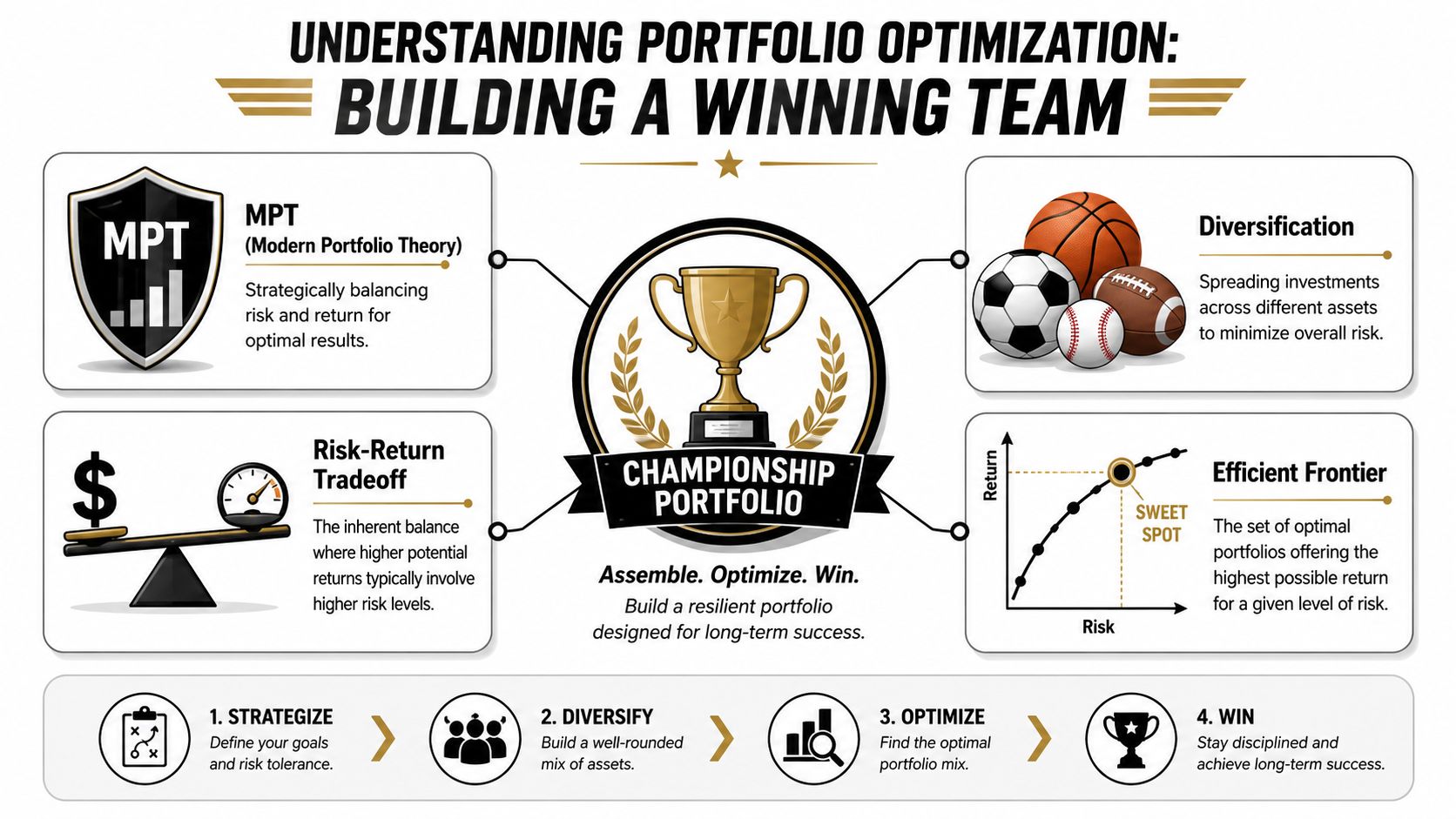
Building a team, not a highlight reel
A sports team is the easiest way to think about this. If you only recruit strikers, you'll have talent, but not balance. You still need defenders, midfield control, and a goalkeeper. A portfolio works the same way.
Owning several high-upside tokens isn't enough. If they all respond to the same macro move, the same liquidity cycle, or the same risk-on burst, you haven't diversified much. You've just repeated the same role.
That's why diversification isn't “own more things.” It's “combine things that behave differently.”
A practical portfolio usually combines exposures that don't all win and lose at the same time. In traditional markets that could mean equities, bonds, and commodities. In DeFi, it might mean a mix of trend-following wallets, mean-reversion traders, lower-turnover accumulators, and selective protocol exposure with distinct risk drivers.
Risk and return belong together
Most traders naturally focus on upside. Optimization forces you to pair upside with the path taken to get there.
Three ideas sit at the center:
- Expected return: What you think a position or strategy can earn.
- Volatility: How unstable the ride may be.
- Correlation: How much one position tends to move with another.
Those inputs combine into a portfolio-level view. A volatile asset isn't automatically bad. A lower-return asset isn't automatically useless. What matters is how each piece changes the total risk and return profile.
The whole point of portfolio optimization is that the portfolio can be better than any single component, if the pieces fit.
That's why institutional investors still organize decisions around volatility, correlation, and diversification. The framework survived because it gives people a common language for comparing very different assets and combining them deliberately.
What the efficient frontier actually means
The efficient frontier is the set of portfolios that offer the highest expected return for a given level of risk. Any portfolio below that frontier is sub-optimal because it gives up return without reducing risk enough, based on the framework described in this efficient frontier implementation walkthrough.
You don't need the math to use the concept. The practical lesson is simple: many portfolios are inefficient because they contain positions that don't improve the trade-off.
A useful way to apply that in crypto is to rank ideas by contribution, not by excitement:
| Question | Weak portfolio habit | Strong portfolio habit |
|---|---|---|
| How is capital allocated? | Added whenever a trade feels attractive | Sized based on role in the total book |
| How are positions judged? | Individually | In combination with all other positions |
| What counts as diversification? | More names | Different behavior under stress |
| What gets removed first? | Losers only | Positions that reduce portfolio efficiency |
Start tracking smart money today
Join thousands of traders using WalletFinder.ai to find profitable wallets and copy their trades.
Start Free Trial →

