
Crypto Performance Attribution: From Luck to Skill
Learn how to use performance attribution to analyze your crypto trading. Go beyond PnL to understand if your gains come from luck or skill. Guide for traders.
A green PnL screenshot feels good until you ask the only question that matters. Could you do it again on purpose?
Most active on-chain traders have lived this. You finish the week up. One wallet rotation into a meme token exploded, a few swing trades in majors worked, and several smaller positions bled. Net result: positive. Diagnosis: unclear.
That's a dangerous place to operate from.
Raw profit and loss tells you what happened after the fact. It doesn't tell you whether you sized well, picked well, managed exits well, or merely caught one violent move that covered a pile of weak decisions. A wallet can look smart in a hot tape and fragile in a flat one. Without a way to separate those effects, you can't tell the difference between a process worth scaling and noise you were lucky to survive.
This matters even more in DeFi because the path of returns is messy. You're not just trading spot tokens. You're bridging, LPing, farming, rotating narratives, paying gas, eating slippage, and sometimes carrying positions across chains where the benchmark itself is unclear. Two wallets with similar PnL can come from completely different behaviors.
One trader made money because they repeatedly entered early in strong sectors and cut losers fast. Another made money because a single low-liquidity token went vertical before its lock-up period ended. Those are not the same skill set. They shouldn't be evaluated the same way.
That's where performance attribution becomes useful. It turns your wallet from a scoreboard into a diagnostic system. If you're already thinking seriously about benchmarking wallet performance against a relevant market baseline, attribution is the next step. It tells you whether your edge came from asset choice, position sizing, timing, exposure to a narrative, or constraints that shaped the portfolio without you realizing it.
Introduction Why Your PnL Is Not the Whole Story
A trader who ends the month in profit usually asks the wrong first question. They ask, “How much did I make?” The better question is, “What exactly produced that result?”
Take a simple wallet pattern. You ran five ideas. One memecoin ripped. One ETH trade was fine. Three smaller positions lost money slowly. The wallet finished green, so the month looks good. But if the winner was a low-conviction flyer and the losers came from your normal process, the PnL report is flattering you.
PnL is a lagging outcome
PnL summarizes outcomes after market moves, liquidity conditions, and execution have already done their work. It doesn't identify skill. It doesn't tell you whether returns came from:
- Asset selection: You chose the right tokens within a theme.
- Allocation: You put enough size behind the right ideas.
- Market exposure: You were long what was already working.
- Path dependency: A few trades hit before others had time to fail.
Practical rule: If you can't explain why a profitable period worked, you don't yet know what to repeat.
That's why experienced traders treat green periods with suspicion. A positive month can hide weak sizing. A negative month can hide strong decision quality if the benchmark or factor backdrop was hostile. Attribution forces honesty.
Luck and skill leave different fingerprints
Luck tends to show up as concentrated contribution from a small number of outsized outcomes. Skill tends to show up as repeatable patterns. Better entries in the same setup. Better hold discipline in the same category. Consistent outperformance versus an appropriate benchmark.
On-chain, this distinction matters because wallet histories are public and seductive. You can find a wallet with excellent realized gains and still fail badly by copying it if you don't know what drove those gains. Was it early access to a narrative, superior sizing, one-off token access, or repeatable trade construction?
Performance attribution gives you a way to answer that with more rigor.
What Is Performance Attribution
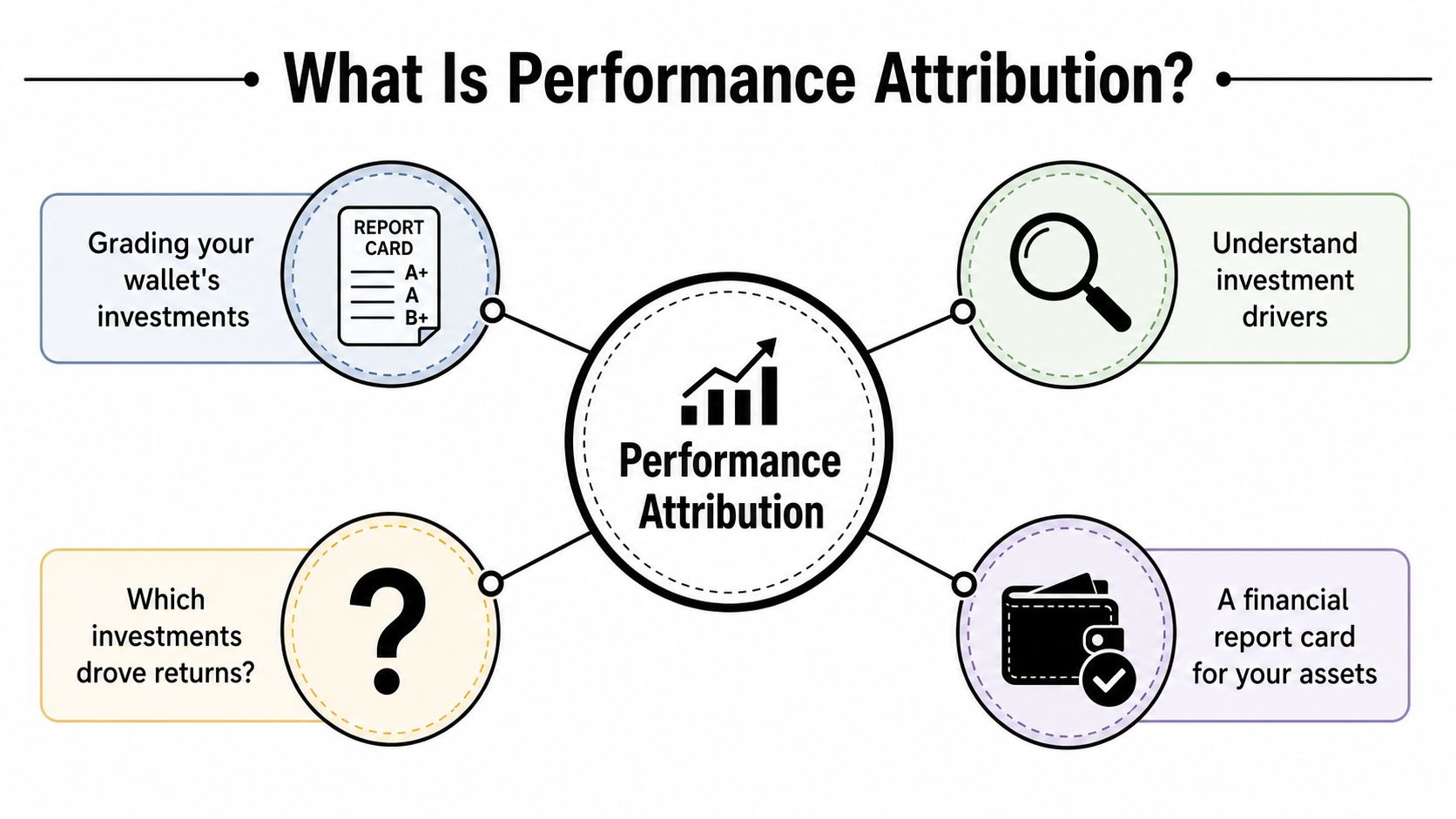
Performance attribution is a structured way to break portfolio results into decision-level drivers. For a trader, the simplest definition is this: it's a report card for your wallet.
It grades two core skills. First, did you choose the right assets? Second, did you size them correctly relative to a benchmark or alternative opportunity set?
A useful visual helps anchor the concept.
Start tracking smart money today
Join thousands of traders using WalletFinder.ai to find profitable wallets and copy their trades.
Start Free Trial →

