
Mr Beast Coin Guide: Legit Check & Trading Tactics
Is the Mr Beast Coin legit? This guide investigates the unofficial BEAST tokens, shows you how to check contract safety, and reveals tactics to trade them.
There is no officially endorsed MrBeast coin, and the tokens currently trading under that name are unofficial meme coins with conflicting market data. One BEAST listing shows a price around $0.01564 with a market cap near $155.09K and $0 in reported 24-hour volume, while a separate Mr Beast coin variant shows a price around $0.000000388855, a market cap near $3,888.55, and only $41.4793 in liquidity.
If you're here because you saw “mr beast coin” trending and you're wondering whether you're early, you're already in the danger zone. The biggest mistake traders make with celebrity meme tokens isn't buying late. It's assuming the name refers to one real asset with one market.
That assumption breaks fast on-chain. “Mr Beast coin” is a loose label attached to multiple unofficial tokens, different contracts, thin pools, and a lot of room for bad fills, fake momentum, and outright contract risk. The useful question isn't “should I buy mr beast coin?” It's “which contract am I even looking at, who controls it, and can I get out if I get in?”
The Mr Beast Coin Hype Explained
Celebrity tokens spread through the same loop every time. A name trends on social media, screenshots start circulating, someone posts a chart, and traders begin treating attention as legitimacy.
That doesn't work with mr beast coin. The name carries reach, but reach is not issuance, endorsement, or support. The available source material points the other way. There isn't evidence of an official token launch endorsed by Jimmy Donaldson, and coverage around these tokens describes them as community-created or unofficial meme coins (WEEX analysis of unofficial MrBeast meme coins).
Why traders get trapped
Most traders don't lose on the first click. They lose in the minutes before the first buy.
They open a chart aggregator, see a live price, then assume the rest of the market structure is normal. With unofficial celebrity coins, that assumption fails because the ticker, the contract, the liquidity venue, and the holder base may all be unstable at the same time.
A practical way to think about the hype:
- Attention comes first: people buy because the name is familiar.
- Verification comes last: many traders never confirm the contract.
- Liquidity is often weak: a printed price can exist without healthy trading conditions.
- Exits are harder than entries: buying a meme coin is easy. Selling at the quoted price often isn't.
Practical rule: Treat celebrity branding as a warning label until the contract, liquidity, and holder distribution prove otherwise.
What actually works
A better posture is to treat mr beast coin like a forensic exercise, not a fan trade.
That means slowing down and answering four questions before risking capital:
- Which exact token is being discussed
- Where is the deepest liquidity
- Who holds the supply
- What evidence shows you can sell
What doesn't work is chasing screenshots, trusting ticker symbols, or relying on “market cap” without checking how that figure was derived. On unofficial meme coins, the safest edge usually comes from avoiding the wrong trade, not forcing the right one.
Separating Mr Beast Coin Fact From Fiction
A trader sees "BEAST" on an aggregator, spots a live price, and assumes the market has settled on one token. That assumption causes a lot of bad entries.
"Mr beast coin" is not one asset with one accepted contract. It is a rotating label attached to multiple unofficial tokens, and the first edge is figuring out which one the crowd is trading.
One widely tracked BEAST listing showed a live price, a fully diluted valuation in the same rough range, and no reported 24 hour volume, as noted earlier. Other major platforms displayed similar pricing but different supply fields and market cap assumptions. That is enough to change how I treat the trade. If supply presentation is inconsistent across large data sites, I stop looking at the chart and go back to the contract.
A separate token tracked by CoinBrain under contract 0x617a5DBB6Ce235AcdA58b86AC496D0Dcf49835F6 showed a micro-cap profile with extremely thin pool depth and weak exit conditions (CoinBrain contract listing for a separate Mr Beast coin).
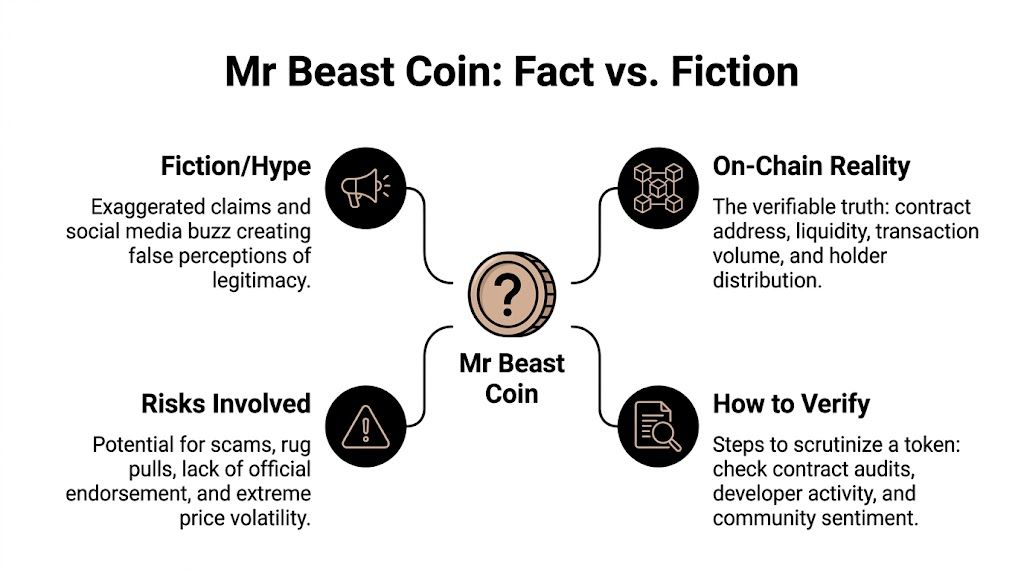
What the fragmented listings actually mean
Fragmented pricing is not a minor data issue. It usually points to one of three conditions: multiple contracts using the same branding, stale aggregator indexing, or a market so thin that small trades distort public metrics.
For a trader, the conclusion is practical. The ticker has almost no value without the contract address, the active pair, and proof that real holders can exit.
Use this as the baseline:
| Token view | What the listing shows | What it means for a trader |
|---|---|---|
| Widely tracked BEAST pages | Similar headline price ranges, but different supply and activity fields | Aggregators may be describing different market states, or different assumptions about the same token |
| Low-activity BEAST listing | Visible price with little or no recent trading activity reported | A quoted price does not guarantee executable size |
| CoinBrain Mr Beast variant | Separate contract with very low liquidity relative to headline value | Slippage and failed exits become the main risk, not just volatility |
Start tracking smart money today
Join thousands of traders using WalletFinder.ai to find profitable wallets and copy their trades.
Start Free Trial →

