
Momentum and Impulse: Trading & On-Chain Insights
Apply physics of momentum and impulse to gain an edge in momentum trading and on-chain signal analysis. Master key concepts for market insights.
You've seen this on a chart. A token drifts sideways, volume feels sleepy, and then a few wallets start buying. Price lifts. More traders notice. Slippage worsens, candles stretch, and what looked random suddenly has direction.
Most traders describe that move with loose language. “Strength.” “Narrative.” “Smart money.” Those labels aren't useless, but they often blur the fundamental question. What changed the motion?
Physics gives a cleaner way to think about it. Not as a literal market equation, and not as a promise that price behaves like a billiard ball. It's a mental model. Momentum and impulse help you separate steady movement from the event that caused the movement to change.
That distinction matters in DeFi. If you can tell the difference between ongoing trend and the shove that started it, you stop chasing every candle and start asking better questions about wallets, flows, liquidity, and timing.
Why DeFi Traders Should Understand Physics
A lot of bad trading comes from reacting to the visible move instead of the cause behind it. You see a token rip higher and assume the move itself is the signal. Often it isn't. The signal was earlier, hidden in who bought, how quickly they bought, and whether the market could absorb that pressure.
Physics is useful here because it forces clean thinking. An object in motion doesn't change course for no reason. Something acts on it. In markets, price doesn't explode upward just because a chart “looked ready.” Traders, funds, bots, token releases, liquidations, governance news, bridge flows, and whale entries create the push.
A trader's version of the problem
Say you're watching a mid-cap DeFi token. It's been quiet for days. Then buys start clustering across a short window. Liquidity on one pool thins out. Market makers reprice. Momentum builds, and now social feeds call it a breakout.
By the time most traders label the trend, the important event has already happened.
Trading lens: Don't ask only, “Is this moving?” Ask, “What applied the push, and is that push still active?”
That's where the physics analogy earns its keep. It helps you think in two layers:
- Momentum is the current state of motion.
- Impulse is the push that changes that motion.
In DeFi, that means one move can come from very different conditions. A slow grind upward might reflect broad, steady accumulation. A sharp jump might come from a concentrated burst of buying, a short squeeze, or a fast repricing after a catalyst.
Why this helps on-chain analysis
Charts show the aftermath. On-chain data often shows the shove.
If you track wallet behavior, transaction clustering, and liquidity conditions, you start spotting potential impulses before they fully show up as trend strength. That doesn't remove risk. It sharpens timing and interpretation.
Here's the practical benefit:
- You stop confusing noise with force
- You look for cause, not just effect
- You judge whether a move has enough “mass” behind it to continue
That last point matters most. In physics, a tiny object can move fast without carrying much momentum. In markets, a thin token can print dramatic candles without building durable trend. Price speed alone doesn't tell you how meaningful the move is.
Understanding Core Momentum and Impulse
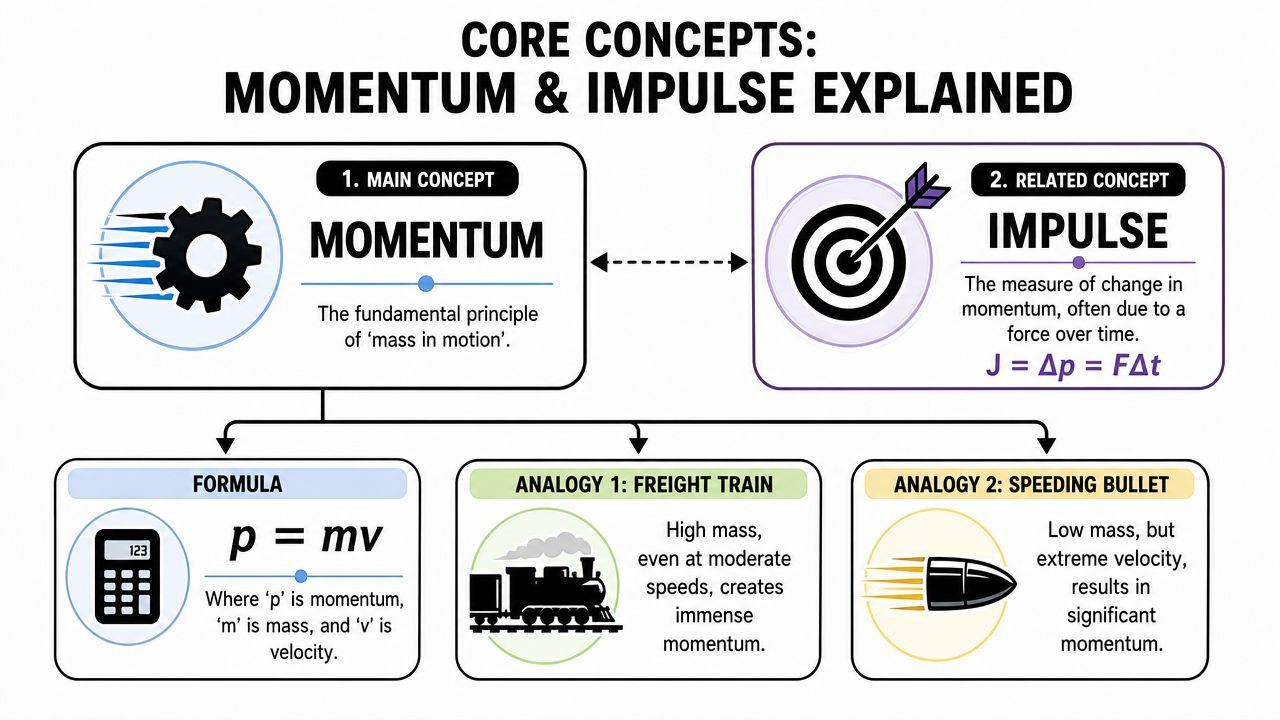
Physics defines momentum as:
p = mv
That reads as momentum equals mass times velocity. In plain language, momentum is mass in motion. The more mass something has, or the faster it moves, the harder it is to stop or redirect.
A freight train and a bicycle can both move forward. But if they're moving at the same speed, the train carries far more momentum because it has far more mass. A small object can also have meaningful momentum if it moves very fast. So momentum isn't just “big things move hard.” It combines how much stuff there is and how fast it's moving.
Start tracking smart money today
Join thousands of traders using WalletFinder.ai to find profitable wallets and copy their trades.
Start Free Trial →

