
Modern Portfolio Theory: Build Smarter Crypto Portfolios
Apply Modern Portfolio Theory to crypto & DeFi. Learn core concepts, limitations, and build a smarter, diversified strategy.
Your wallet probably didn't become a portfolio on purpose.
It became a pile. A little BTC because it felt responsible. Some ETH because everything routes through it. A few Solana names because momentum looked real. Airdrops you forgot to sell. LP positions you can't explain without opening three tabs. Then one meme coin that somehow became a meaningful percentage of your net worth.
That kind of sprawl is normal in crypto. It's also why many DeFi traders feel busy but not structured. They track entries, narratives, token release schedules, and influencer flows, yet they still can't answer a basic question: how much risk is the whole wallet taking?
Modern Portfolio Theory gives you a clean way to think about that. It came from traditional finance, but the core idea travels well to crypto. Don't judge each token in isolation. Judge each position by what it does to the whole portfolio.
Taming Portfolio Chaos with a Nobel-Winning Idea
You check your wallet after a rough week and the labels all look different. ETH staking. A Solana perp hedge. Two LP positions. A governance token you meant to sell. A meme coin that kept running, so you let it ride. Then the market drops and the whole thing starts moving like one oversized bet on crypto beta.

That is the problem Modern Portfolio Theory was built to address.
The model came out of traditional finance, but the habit it teaches fits DeFi surprisingly well. Stop asking whether a token looks good by itself. Ask whether adding it makes the whole wallet stronger, weaker, or just more crowded with the same risk. A position can have strong fundamentals, good momentum, and a clean catalyst calendar, yet still be a poor addition if it rises and falls with everything else you own.
Why the model still matters
Harry Markowitz introduced this framework in 1952, and the work later earned a Nobel Prize. The idea was simple enough to survive seven decades of market change. Portfolio risk depends on how positions move together, not just on how risky each position looks on its own.
That point matters in crypto because wallets often look diversified on the surface while remaining concentrated underneath. Five tokens across three chains can still be one trade if they all depend on the same conditions: easy liquidity, rising sentiment, and traders reaching for risk.
A useful analogy is a validator set. Ten validators do not give you much protection if they all run the same client, in the same region, behind the same infrastructure provider. Ten tokens do not give you much protection if they all break for the same reason.
What DeFi natives should take from it
You do not need to become an academic optimizer. You need a better mental model.
Start with a practical shift:
- Judge additions in context. A token is not competing for your attention. It is competing for risk budget inside an existing wallet.
- Group positions by behavior. L1s, high-beta DeFi names, small-cap governance tokens, and memes often react to the same macro impulse even when their stories sound different.
- Treat stablecoins and low-volatility positions as tools. They can lower the chance that you sell strong assets at the worst time.
- Track portfolio quality, not just token narratives. A quick check with a Sharpe ratio calculator for crypto portfolios helps you compare return against volatility at the wallet level.
That is the main lesson. Modern Portfolio Theory does not promise a portfolio that never hurts. It gives you a way to turn a pile of on-chain positions into a system with a reason behind it.
Most stock-and-bond explainers stop there. For DeFi, the more useful question is how to apply that logic when correlations jump, narratives rotate overnight, and your exposures are spread across wallets, protocols, and chains. That on-chain translation is where this framework becomes practical instead of academic.
The Core Concepts of Modern Portfolio Theory
Open a typical DeFi wallet after a strong month and the spread can look healthy. A little BTC. Some ETH. A few L1 bets. A lending token. A perp DEX name. Maybe a meme coin that got out of hand. On-chain, that feels diversified. Under stress, many of those positions can still move like one crowded trade.
That gap between how a portfolio looks and how it behaves is where Modern Portfolio Theory becomes useful for crypto.
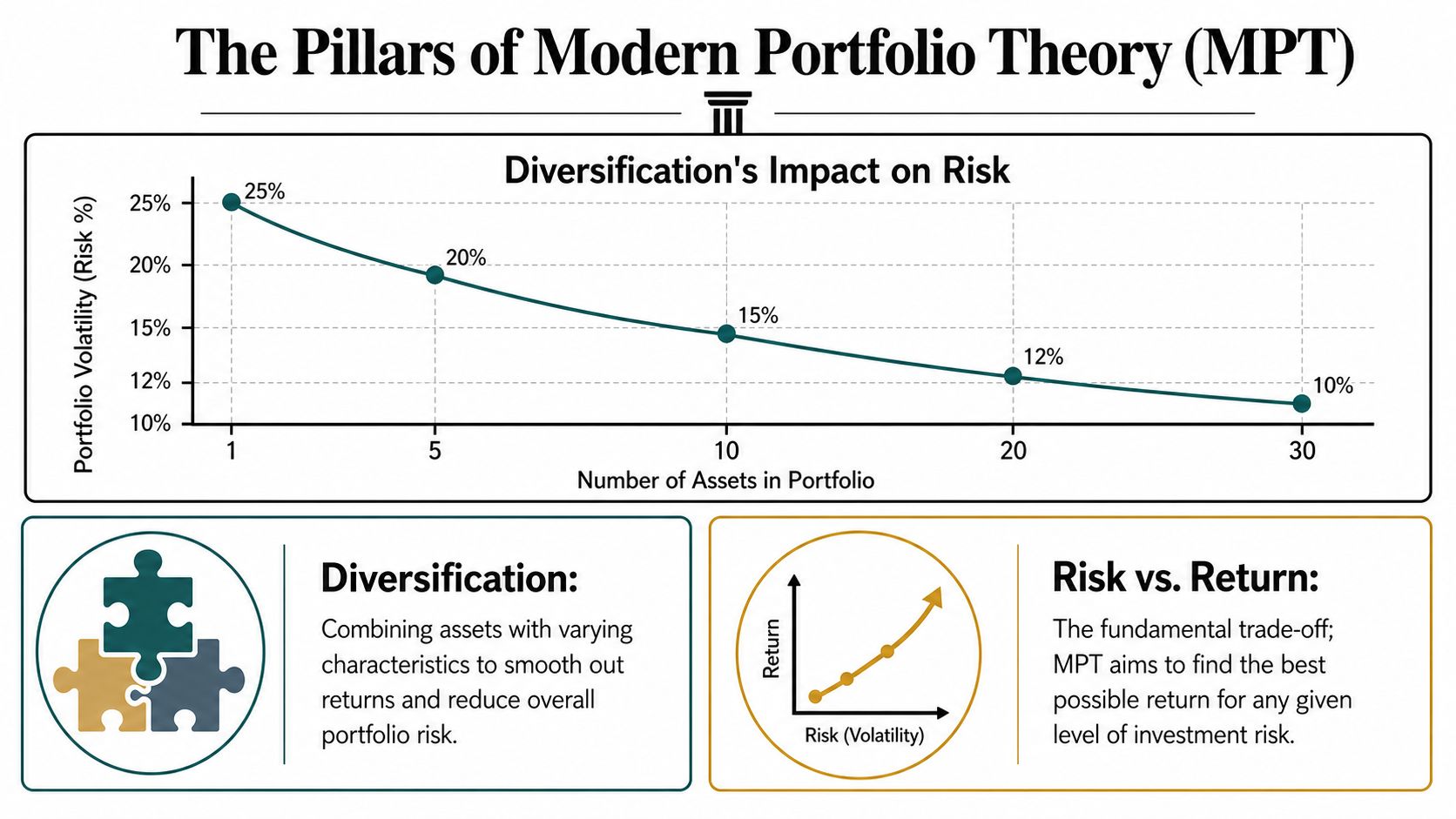
Diversification is about behavior, not ticker count
MPT starts with a simple point. Portfolio risk depends on how holdings interact, not just on how many you own.
That matters a lot more in DeFi than in stock-and-bond examples. Two tokens can live on different chains, have different communities, and still react to the same drivers. Liquidity dries up. Beta gets sold. Funding conditions tighten. A regulatory headline hits anything that smells speculative. If the same shock moves both assets, holding both does less for you than the wallet view suggests.
A better analogy is a validator set, not a bag of coin logos. If every validator depends on the same cloud provider, the count looks distributed but the failure mode is concentrated. Portfolios work the same way.
So diversification means adding exposures with meaningfully different behavior. In practice, that can include assets or strategies that respond differently to macro moves, rate expectations, on-chain activity, or volatility spikes. Sometimes the best diversifier is not another high-upside token. It is dry powder, stable yield, or a lower-volatility position that keeps you from selling risk into a drawdown.
The efficient frontier is a menu of better tradeoffs
The second core idea is the efficient frontier. It is the set of portfolios that offer the highest expected return for a given level of risk, or the lowest risk for a given expected return.
That sounds technical, but the intuition is straightforward. If Portfolio A and Portfolio B target similar returns, and A gets there with smaller swings, B is hard to defend. If two portfolios take similar risk, but one has stronger expected return, the weaker one is just an inferior mix.
The efficient frontier is useful because it shifts the conversation away from hero assets and toward combinations. A token can be attractive on its own and still make your total portfolio worse if it adds a lot of overlap with positions you already hold.
A few implications follow:
- Strong assets can still produce a weak portfolio. Good stories do not automatically combine well.
- Risk is a budget. Every new position should earn the volatility it adds.
- Portfolio decisions are relative. The question is not whether an asset is good. The question is whether it improves the whole mix.
If you want a simple way to pressure-test that tradeoff, a Sharpe ratio calculator for crypto portfolios helps compare return against volatility at the portfolio level.
Where DeFi readers usually push back
Skepticism is healthy here because MPT gets oversold. It does not promise safety. It does not tell you drawdowns disappear. It gives you a cleaner way to ask whether your current mix is taking more risk than necessary for the return you expect.
That is a narrower claim. It is also the one that survives contact with crypto.
| Common belief | What MPT actually says |
|---|---|
| More tokens means more diversification | More distinct return drivers means more diversification |
| A low-volatility asset makes the whole portfolio safer | Portfolio risk depends on how each holding moves with the others |
| The highest-conviction asset should always get the most capital | Position size depends on how that asset changes total portfolio risk |
Start tracking smart money today
Join thousands of traders using WalletFinder.ai to find profitable wallets and copy their trades.
Start Free Trial →
