
Your MetaMask Wallet ID: A Guide to Finding & Using It
Learn what a MetaMask wallet ID is, how to find it on mobile/desktop, and use it with tools like Wallet Finder.ai for analysis. Secure your assets today.
You are usually staring at one of three things in MetaMask when this question hits: a string that starts with 0x, a prompt asking you to connect a wallet, or a warning telling you never to share your recovery phrase. Most traders know one of those is safe to use and one of those can wipe them out. The problem is that many people are not fully sure which is which in the moment.
That hesitation matters. In DeFi, your metamask wallet id is not just a technical detail. It is the public identifier tied to your transfers, swaps, approvals, and trading history. If you understand how to use it correctly, you can receive funds safely, audit your own activity, track other wallets, and plug into serious on-chain research workflows without exposing control of your assets.
Why Your MetaMask Wallet ID Matters
MetaMask sits at the center of a huge share of self-custody activity. It reached approximately 30 million monthly active users by mid-2025, up about 55% from 19 million in September 2023, according to CoinLaw's MetaMask wallet statistics. That scale matters because the conventions MetaMask trains users to follow often become the conventions of the broader EVM ecosystem.
If you trade on Ethereum, Base, Arbitrum, or other EVM-compatible networks, your wallet address becomes your operating identity. It is how protocols know where to send tokens. It is how explorers display your transaction history. It is also how analysts and copy traders trace wallet behavior across time.
Why traders get confused
Most confusion comes from lumping three different things into one mental bucket:
- The wallet ID
- The private key
- The Secret Recovery Phrase
Only one of those should be routinely shared for normal activity. That is the public address.
The practical issue is simple. Many DeFi actions require you to move fast. You may be claiming an airdrop, sending funds between wallets, reviewing a whale buy, or checking whether a smart money wallet rotated into a token early. If you do not know exactly what your MetaMask wallet ID is and when to use it, you slow down or make avoidable mistakes.
What the wallet ID lets you do
A properly used public address helps you:
- Receive assets from another wallet or exchange
- Verify activity on block explorers
- Track portfolio history across supported networks
- Monitor other traders by watching public wallet behavior
- Separate identities by using different accounts for different strategies
Tip: The best traders treat wallet addresses as operational tools, not just receive-only strings. A public address is how you organize strategy, attribution, and risk visibility.
This forms the basis of an edge. Blockchain transparency means your address is not only where assets land. It is also the index key for your on-chain history. Used well, it gives you better records, cleaner wallet segmentation, and a much clearer view of what other market participants are doing.
Decoding Your Public Wallet Address
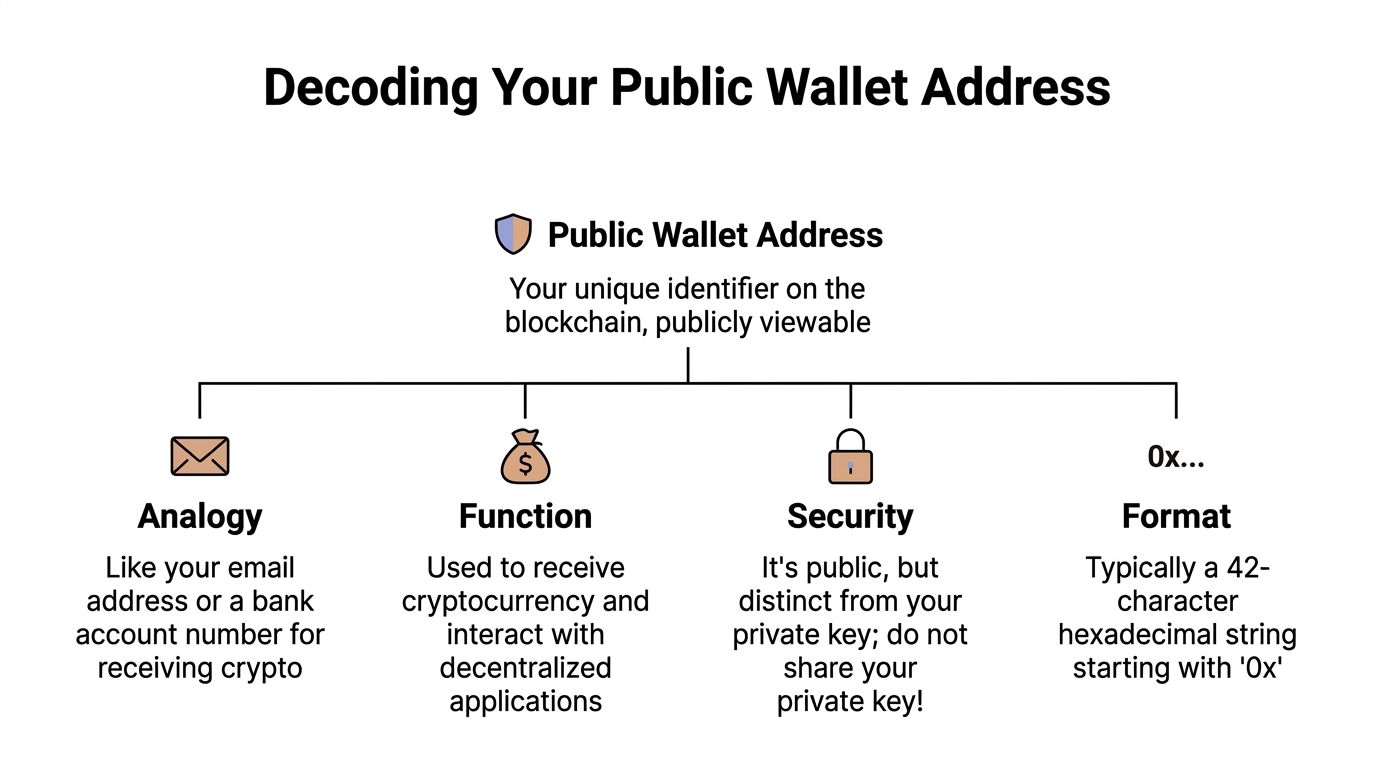
The MetaMask wallet ID is really your public wallet address. Consider it similar to an email address or bank account number for crypto. You can give it to someone so they can send you assets. What you never give them is the credential that controls it.
Technically, the MetaMask wallet ID is a 42-character hexadecimal string starting with 0x, generated deterministically from your private key, as explained in this MetaMask setup guide on nft now. That address acts as the public on-chain identifier for transactions on EVM-compatible networks.
What the format tells you
A normal EVM address has a few recognizable traits:
It starts with
0x
That prefix signals a hexadecimal format.It is 42 characters long
That includes the0xplus the rest of the address string.It is public by design
Anyone can look it up on a block explorer once they know it.
That public nature is not a flaw. It is the reason on-chain analysis works at all. When a trader says they are “watching wallets,” they are really monitoring public addresses and the transaction trails attached to them.
Why this matters for analysis
Every swap, transfer, and contract interaction associated with the address can be reviewed on-chain. That means researchers can reconstruct behavior patterns such as:
- entries into new tokens
- exits after momentum fades
- repeated use of certain DEXs
- holding periods
- wallet clustering across multiple accounts
If you want a plain-language breakdown of how Ethereum addresses work, this guide to an Ethereum wallet address is a solid companion read.
A useful mental model
Use this model when you are deciding what to paste where:
| Item | Real-world analogy | Safe to share? | Main use |
|---|---|---|---|
| Public wallet address | Email address | Yes | Receive funds, track on-chain activity |
| Private key | House key | No | Sign transactions, control funds |
| Seed phrase | Master backup to the whole property | No | Restore the wallet |
Start tracking smart money today
Join thousands of traders using WalletFinder.ai to find profitable wallets and copy their trades.
Start Free Trial →

