
Meaning of Moonshot: What It Means for Crypto Wins
Unlock the meaning of moonshot and learn how savvy traders spot crypto gems before they explode.
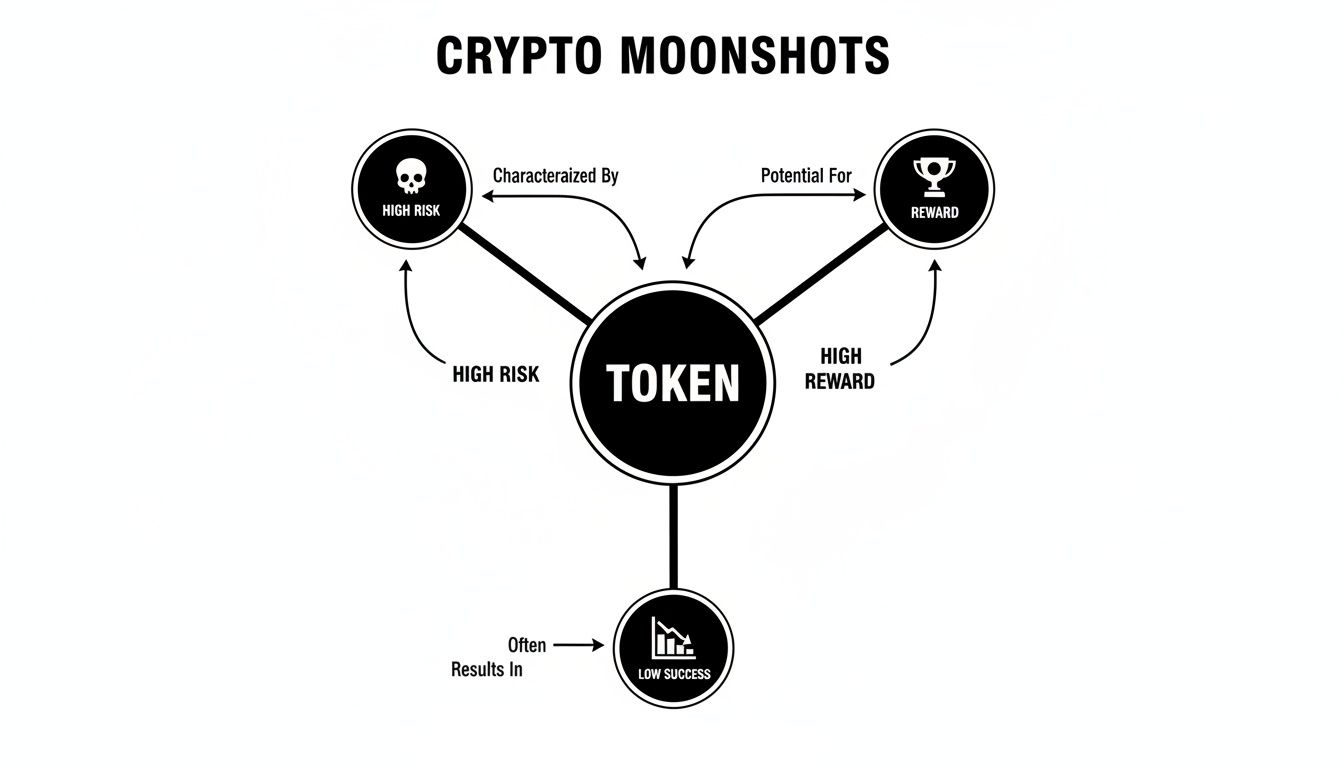
In the wild world of crypto and finance, you'll hear the term "moonshot" thrown around a lot. It describes a high-risk, high-reward investment with the potential for explosive, almost unbelievable returns. We're not talking about a small gain here; this is about a project or an asset that could deliver 100x or even 1,000x growth, completely changing the value of a portfolio practically overnight.
What a Moonshot Really Means
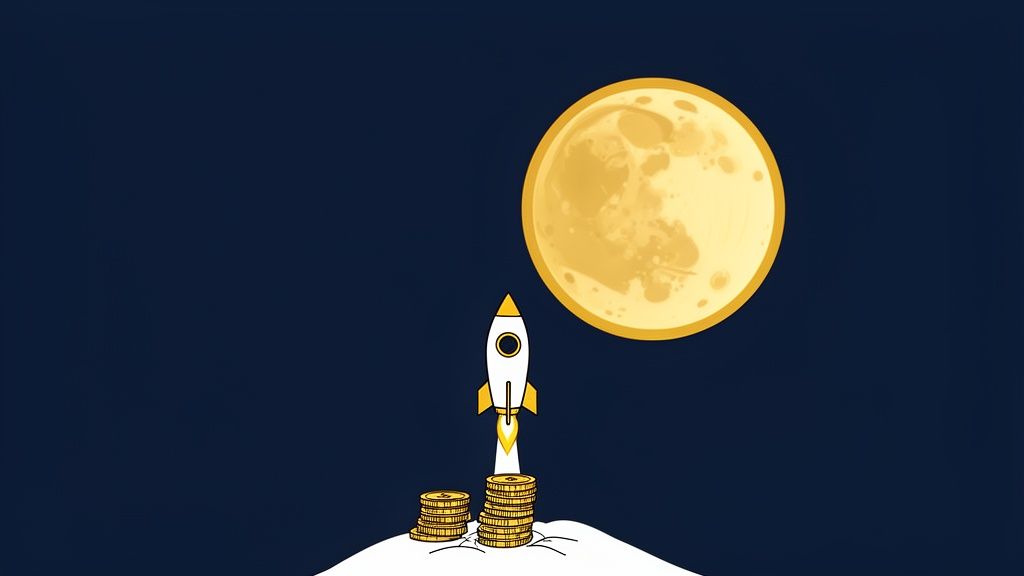
To really get what a "moonshot" is, we need to look past the trading charts and go back to where it all started. The term wasn't born in a trading pit but from one of humanity's greatest achievements: the Apollo 11 mission.
It all began on May 25, 1961, when President John F. Kennedy set a seemingly impossible goal: land a man on the Moon before the decade was out. At the time, NASA had a grand total of just 15 minutes of human spaceflight experience. This was an audacious plan, packed with risk and requiring immense resources, yet they pulled it off just eight years later. You can learn more about this ambitious goal and its legacy on how we define moonshots today.
That historical context is everything. Just like the space race, a financial moonshot is defined by three key ingredients.
The Core Elements of a Moonshot
- Extreme Ambition: The goal isn't just an incremental improvement. It's something fundamentally different and transformative.
- High Risk and Uncertainty: Let's be clear—the odds are stacked against you. Most moonshot projects, whether in tech or crypto, fail spectacularly.
- Massive Potential Payoff: If it succeeds, the returns are extraordinary, blowing conventional investments out of the water.
This whole idea is a close cousin to the popular crypto phrase "to the moon," which you can dive into in our guide on the meaning of to the moon. It’s all about that shared hope in the community that a token’s price will soar to astronomical heights.
A moonshot isn’t about making a 10% profit. It's about pursuing a 100x return that redefines what’s possible, accepting that the journey is perilous and success is never guaranteed.
Ultimately, a moonshot is more than a lucky lottery ticket. It’s a calculated chase for a breakthrough opportunity. For traders, this means finding those rare projects with the right mix of innovation, timing, and market potential—all while knowing that for every single success story, there are countless failures left behind.
How Moonshots Shape Crypto Trading Strategies
In the world of DeFi, the idea of a "moonshot" isn't just some abstract dream—it's a very real trading strategy. For traders, it means actively hunting for tokens that have the potential for explosive, portfolio-changing returns. We're not talking about a modest 10% gain here. The goal is to find the next 10x, 100x, or even 1,000x monster.
This high-stakes game completely flips the script on risk and reward. Traditional investing is all about slow and steady growth, but moonshot hunting is different. It’s built on the understanding that most of these bets will probably go to zero. The core belief is that a single massive win can be so huge it makes all the previous losses look like pocket change.
This is exactly why traders turn to specialized tools like Wallet Finder. They’re not just staring at charts all day. They're digging deep, looking for the digital breadcrumbs left by savvy early investors who seem to have a sixth sense for finding these gems before they take off.
The Statistical Reality of Moonshot Coins
Let's be real: you have to go into this with your eyes wide open. The crypto market is a graveyard of projects that promised the world but fizzled out on the launchpad. The stats are brutal—the vast majority of new tokens fail spectacularly.
So why bother? Because we’ve seen it happen before. The term "moonshot coin" became crypto slang for a reason. During the 2021 bull run, for example, we saw a wave of DeFi tokens and memecoins pull off insane 50x–100x gains right after listing. This happened even while most other new tokens were bleeding out, losing over 90% of their value within a year or so.
For a copy trader, finding a moonshot means sifting through thousands of wallets to find the tiny fraction—often less than 1–5%—that actually deliver those mind-blowing returns. If you want to go deeper into how the term evolved, there's a good primer on the meaning of moonshots in crypto on gate.com.
The goal is not to win every bet. The goal is to find one winner so powerful that the losses from other attempts become statistically irrelevant.
This kind of environment makes early detection and solid research absolutely critical. By studying past winners, traders can start to see patterns and on-chain signals that just might point to the next breakout star.
Iconic Examples Setting the Stage
Every market cycle gives us a few legendary stories that keep the dream alive. Think about the people who got into projects when they were completely unknown and watched them become household names. It wasn't always blind luck. Many of those wins came from spotting early on-chain clues, like a sudden flood of smart money or a rapidly growing army of holders.
These iconic successes give us a blueprint. When you break down their journeys, you can build a checklist of what to look for:
- Early Smart Money Accumulation: A small group of highly profitable wallets start buying up a token before anyone else is talking about it.
- Rapid Holder Growth: The number of unique wallets holding the asset starts to hockey-stick, signaling that retail interest is catching on.
- DEX Liquidity Events: Someone makes a huge addition to the liquidity pool, which helps stabilize the price and allows for bigger trading volumes.
These case studies prove that while finding a moonshot is tough, it’s not impossible. They pave the way for a more methodical hunt, where data-driven tools can help us spot similar patterns today and turn a wild guess into a structured strategy.
Spotting On-Chain Signals of a Potential Moonshot
If you want to find a moonshot, you have to look where most people aren't. While Twitter storms and Telegram hype can certainly move markets, the real alpha—the earliest, most reliable clues—is almost always buried deep within the blockchain's data.
By zeroing in on a few key crypto on-chain analysis metrics, you can start to see momentum building long before it hits the mainstream. This is about ignoring the noise and focusing on the digital breadcrumbs left by the earliest investors and the project's budding community. The goal here is to spot genuine accumulation and growing interest right from the source.
Early Accumulation by Smart Money
The most powerful early signal is often the quiet accumulation by smart money wallets. These aren't just any wallets; they're addresses with a proven history of getting into high-performing assets before anyone else. When you see several of these seasoned traders start buying up a new, obscure token, it's a huge tell that something is brewing under the surface.
They don't typically drop a huge bag at once. Instead, their initial buys are often small and methodical to avoid setting off alarms. But a clear pattern of consistent buying across several top-performing wallets strongly suggests they see massive upside potential. Think of it as the on-chain equivalent of insiders loading up on company stock right before a game-changing announcement.
Key On-Chain Moonshot Indicators
Beyond watching what smart money is doing, several other on-chain metrics can help paint a full picture of a token's potential. Each indicator tells a different part of the story, from the health of its community to the stability of its market.
You're really looking for patterns to emerge. A rising holder count is one thing, but when you see that combined with growing liquidity and a healthy token distribution, the signal becomes much, much stronger.
To make sense of it all, here's a breakdown of the on-chain metrics that matter most. Learning to read these signals gives you a solid framework for making decisions based on data, not just FOMO.
Start tracking smart money today
Join thousands of traders using WalletFinder.ai to find profitable wallets and copy their trades.
Start Free Trial →

