
Layer Two Protocols a Trader's Ultimate Guide
Unlock faster, cheaper trades. Our guide explains layer two protocols, their risks, and how DeFi traders can leverage L2s to track wallets and find alpha.
You're probably in one of two spots right now. Either you're still paying mainnet costs for trades that don't justify it, or you've moved to an L2 but you're treating every chain like it behaves the same. Both are expensive mistakes.
For traders, layer two protocols aren't just infrastructure. They change what qualifies as a viable setup. A small rotation, a fast exit, a copied wallet move, a liquidity migration play, a memecoin scalp. These can all make sense on an L2 when they'd be dead on arrival on a congested base layer. If you trade DeFi actively, understanding where execution happens matters almost as much as what you buy.
Why Layer Two Protocols Are a Trader's Best Friend
You spot a breakout, size in, trim once, then try to exit on the next candle. The read is right, but the trade still underperforms because approvals, swaps, and exits eat too much of the move. That is reality on expensive blockspace, and it is why active DeFi traders shifted to L2s early.
For trading, lower fees are only part of the edge. Faster and cheaper execution changes which setups are worth taking in the first place. Small rotations, short-hold momentum trades, wallet-following entries, and copy-trading flows all become easier to execute when every click does not need to clear mainnet-sized costs.
That shift is now visible in where onchain activity happens. As traders move to L2s, liquidity, fresh token launches, routing opportunities, and copy-trading targets move with them. If you are still treating L2s as secondary venues, you are often arriving after the flow has already formed.
Why this changes your edge
An L2 changes three parts of the trading process:
- Position sizing gets more precise. Smaller entries and test positions make sense when fees do not distort the risk-reward profile.
- Execution gets tighter. It is easier to react to wallet activity, volatility spikes, or sudden narrative rotation without having a trade sit pending at the wrong moment.
- More strategies become usable. Scaling in, scaling out, hedging, and re-entering are practical when each action does not carry a mainnet-level penalty.
Fee planning should be part of trade planning. If you are still treating gas as background noise, use a gas fee estimator for DeFi trading before you size the position.
Practical rule: If transaction costs force you to widen your target or hold longer than your setup calls for, the chain is now setting your strategy.
What works and what doesn't
What works:
- Fast rotation strategies on liquid L2 pairs
- Frequent wallet mirroring when entry timing is part of the edge
- Testing new thesis positions with smaller size before committing more capital
- Scaling in and out without turning every transaction into a major cost decision
What doesn't:
- Chasing every new L2 token just because fees are low
- Assuming cheap execution fixes bad risk management
- Ignoring bridge and withdrawal timing until you need liquidity back on another chain
- Copying traders across chains without checking where they execute
For traders, layer two protocols are part of market structure now. Understanding how they affect speed, cost, and trade selection leads to better entries, cleaner exits, and stronger copy-trading decisions.
What Exactly Are Layer Two Protocols
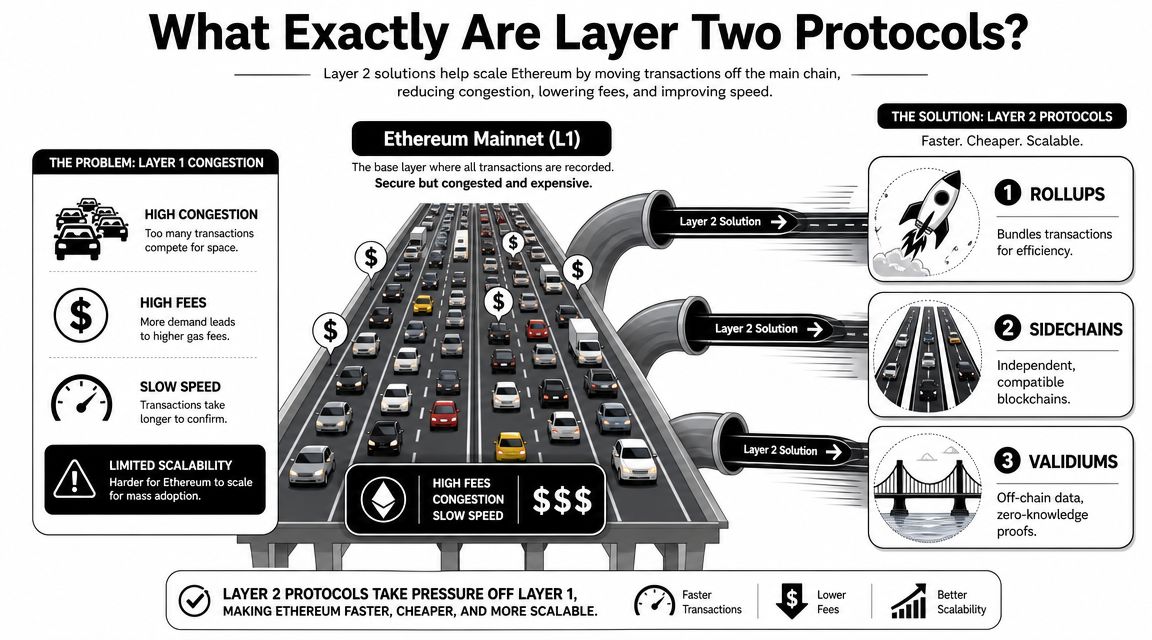
Layer two protocols sit on top of a base blockchain and handle transactions in a separate execution environment while still tying back to the main chain for settlement or security. The simplest mental model is a crowded highway with express lanes built beside it. The main road still anchors the system, but the faster lanes remove a lot of congestion from everyday traffic.
In blockchain terms, that means users transact on the L2 instead of forcing every action directly onto Layer 1. The result is usually faster execution and lower cost from the trader's point of view.
Where the term comes from
The phrase has roots in networking. In the OSI model, Layer 2 is the Data Link Layer, which sits between the physical layer and Layer 3 and handles node-to-node delivery, framing, MAC addressing, and local transfer between adjacent nodes, as described by Juniper's explanation of Layer 2.
That networking origin is useful because the idea is similar in spirit. In blockchain, a Layer 2 also exists to make communication and transfer more efficient on top of a deeper base system. It's not the same mechanism, but the naming logic makes sense.
How traders should think about the L1 and L2 relationship
For trading, the important distinction is simple:
- Layer 1 is the settlement base
- Layer 2 is the execution venue
- Your actual edge depends on how cleanly you move between them
That's why good traders don't ask only, “Is this token interesting?” They ask:
- Where is liquidity deepest
- Where are fees low enough for my setup
- How quickly can I move capital in and out
- What happens if I need to exit under stress
The right chain doesn't just reduce cost. It lets you run the trade the way you intended.
A practical mental model
Think of Ethereum mainnet as the court of final record. Think of an L2 as the trading floor next door.
You use the trading floor because it's faster and cheaper to operate there. But you still care about how strongly that floor is tied back to the court. Some systems inherit more from the base chain. Others make bigger trade-offs for usability or speed.
That distinction matters later when you're comparing rollups, sidechains, and channels, because they don't all give you the same security assumptions, exit path, or operational risk.
The Main Types of L2 Architectures
A trader sees the difference fast. One venue gives cheap, quick fills but relies on its own validator set. Another feels closer to Ethereum but may have different withdrawal rules or sequencer behavior. Those details change how aggressively you can trade, how much capital you leave on-chain, and how you manage exits if conditions turn.
For trading, three architecture buckets matter most: rollups, sidechains, and state channels. They all move activity away from the base chain in some form. They do not give you the same security assumptions, liquidity profile, or operational risk.
Rollups
For many DeFi traders, rollups are the first type of L2 they encounter. The basic model is straightforward. Transactions execute off the base chain, and the result is posted back to Layer 1 through transaction data, proofs, or both.
That design is why rollups tend to attract serious DeFi activity. They usually offer lower transaction costs than mainnet while staying closely tied to Ethereum settlement. For a trader, that often makes rollups the best place to run strategies that need frequent execution without giving up too much on security assumptions.
Two styles matter in practice:
- Optimistic rollups treat transactions as valid by default and allow challenges during a dispute window.
- ZK rollups use validity proofs to confirm state changes.
That difference affects more than architecture diagrams. It can shape withdrawal speed, app design, and the kind of markets that develop there. Some rollups are strong for perps and active trading. Others are better for spot, payments, or ecosystem-specific flows. Good execution comes from checking the actual venue, not assuming every rollup works the same way.
Sidechains
Sidechains are separate blockchains that usually connect to a larger ecosystem such as Ethereum. They are often fast, cheap, and easy to use, which makes them attractive for high-frequency speculation, testing new strategies, or trading smaller size where fees would otherwise kill the setup.
The trade-off is clear. A sidechain does not inherit Ethereum security in the same way a rollup aims to. You are taking on that chain's own validator model, bridge design, and uptime risk.
That does not make sidechains bad. It makes them situational. If the edge is speed, low fees, and access to users or apps that live there, a sidechain can be the right venue. If the position is large or the exit path matters under stress, those extra trust assumptions deserve more weight.
Sidechains often fit:
- fast speculative trading
- low-cost experimentation
- ecosystems optimized for throughput and user growth
State channels
State channels matter less for open DeFi trading, but they are still part of the architecture map. They let a fixed set of participants update balances or state off-chain and settle the final result later on the base chain.
That works best for repeated interactions between known parties. It is less useful for the kind of permissionless, always-on markets most traders care about. You are unlikely to find your next copy trade or liquidity rotation edge through channels, but understanding them helps clarify why rollups became more relevant for mainstream DeFi.
Layer 2 Architecture Comparison
| Architecture | Security Model | Typical Use Case | Example |
|---|---|---|---|
| Rollups | Anchored to a base chain with transaction data or proofs posted back to it | DeFi trading, perps, swaps, lending | Optimistic rollups, ZK rollups |
| Sidechains | Separate chain with its own validator and bridge assumptions | Fast, low-cost trading and app activity | EVM-compatible sidechains |
| State channels | Off-chain state updates between participants with later settlement | Repeated payments or interactions between known parties | Payment or app-specific channels |
Start tracking smart money today
Join thousands of traders using WalletFinder.ai to find profitable wallets and copy their trades.
Start Free Trial →

