
Inflow and Outflow: Track Smart Money in Crypto
Learn what crypto inflow and outflow signals mean. Go beyond exchange data to track smart money on-chain and find profitable trades with Wallet Finder.ai.
You know the feeling. A token starts running, CT gets loud, your alerts fire late, and by the time you look at the chart the clean entry is gone.
Most traders blame speed. The problem lies in where they look. They watch price, engagement, and headlines. Smart money leaves a trail earlier than all of that. It shows up in inflow and outflow data.
That’s the edge. Not just spotting money entering or leaving an exchange, but tracking what happens next. Did the funds go dormant in a fresh wallet. Did they bridge to Base. Did they hit Raydium or Uniswap minutes later. Did the same wallet size into a new pair with the same discipline it used on previous winners.
Why You Keep Missing Early Crypto Pumps
You usually don’t miss the move because you’re uninformed. You miss it because your signals are lagging.
Price alerts trigger after the first expansion. Social chatter explodes after early buyers are already green. “Trending” dashboards mostly show you what already happened. That’s why late entries feel cursed. You’re reading the market after the people moving size have already acted.
The earlier signal is capital movement
In traditional finance, operators care about cash flow before they care about appearances. Strong inflow means the business has room to operate, invest, and survive pressure. In the first half of FY2024, Indian businesses saw cash balances surge by 18% to nearly ₹10 trillion, the fastest growth in four years, showing how inflows exceeding outflows support stability and growth according to Recur Club’s explanation of cash inflow and outflow.
Crypto works the same way in principle, even if the terrain is different.
A wallet that keeps receiving fresh capital, then deploys it into liquid on-chain opportunities, tells you more than a token chart alone. An exchange that sees a wave of deposits tells you something else entirely. One points to positioning. The other often points to preparation for exit.
What traders get wrong
They stop the analysis too early.
They see “exchange outflow” and label it bullish. Sometimes that’s right. Sometimes it’s lazy. Outflow can mean cold storage. It can also mean a trader is about to rotate aggressively into a DEX, chase a narrative, or seed multiple wallets before entry.
That’s where most retail traders lose the thread.
Practical rule: The exchange event is the start of the investigation, not the conclusion.
If you’ve ever watched a coin rip and wondered how people got there early, start by reviewing capital routes instead of candle shapes. A good place to understand the setup is this breakdown of what tends to move a pump coin price.
A better mental model
Think less in terms of “bullish” and “bearish” labels, and more in terms of intent.
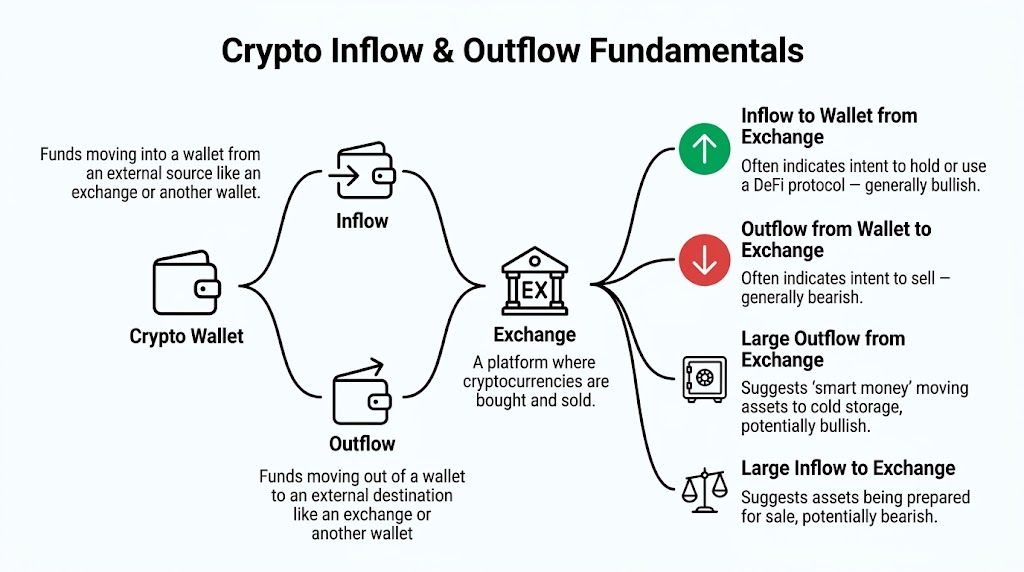
- Funds moving onto an exchange often imply readiness to sell.
- Funds leaving an exchange may imply conviction, but can also signal active deployment elsewhere.
- Funds reaching a wallet that has a history of profitable rotations matter more than isolated flow spikes.
That shift in framing is where inflow and outflow stop being trivia and start becoming tradeable information.
Understanding Crypto Inflow and Outflow Fundamentals
The cleanest way to think about crypto flows is to treat the market like connected reservoirs.
Exchanges, private wallets, bridges, and DeFi protocols all hold capital. Inflow and outflow are the pipes between them. The meaning changes based on which reservoir you’re measuring.
Exchange level flows
This is the broadest view.
An exchange inflow means coins are deposited from external wallets into exchange wallets. An exchange outflow means coins are withdrawn from exchanges to external wallets. CryptoQuant’s exchange flow guide notes that exchange inflows often signal bearish intent to sell, while outflows often reflect bullish confidence, and a surge in Bitcoin inflows on a 7-day moving average has historically marked local tops as holders move assets onto exchanges to sell according to CryptoQuant’s exchange in-outflow and netflow documentation.
That’s useful, but it’s still macro.
Exchange-level data answers questions like these:
- Is the market leaning risk-off
- Are holders preparing inventory for sale
- Is supply moving off venues where it can be sold quickly
It does not tell you whether the withdrawn funds are going inactive or getting deployed into a new trade.
Token level flows
Now narrow the lens.
At the token level, inflow and outflow tell you where a specific asset is going. If a token starts moving onto exchanges in size, traders should pay attention to potential sell pressure. If the token leaves exchanges and disperses into wallets that rarely sell quickly, that can support a stronger hold thesis.
Token-level flow works best when you pair it with context:
| Flow view | What it helps answer | What it misses |
|---|---|---|
| Exchange-wide | Market sentiment and broad supply pressure | Which token or wallet is driving the move |
| Token-specific | Asset-level demand and sell readiness | Whether the receiver is passive or active |
| Cross-venue | Whether capital is rotating between chains or venues | The exact strategy behind the move |
Start tracking smart money today
Join thousands of traders using WalletFinder.ai to find profitable wallets and copy their trades.
Start Free Trial →

