
How To Make A Trading Bot: 2026 Guide For Smart Money
Discover how to make a trading bot. Build, backtest, and deploy a bot using real-time on-chain signals & mirror smart money with Wallet Finder.ai.
You’re probably here because you’ve already hit the same wall most first-time bot builders hit. You can code, you know the market basics, you’ve tested a few indicator ideas, and yet every path seems to collapse into the same commodity logic: RSI crosses, moving average crossovers, Bollinger reactions, and bots that look clean in a notebook but fall apart when money is on the line.
That’s usually not a coding problem. It’s an edge problem.
If you want to learn how to make a trading bot that has a real shot in crypto, especially in DeFi, start with a signal source that isn’t already baked into every public chart. Price indicators are useful as filters. They’re weak as your only source of intent. On-chain wallet behavior is different. It shows who acted, when they acted, and often how they sized the trade.
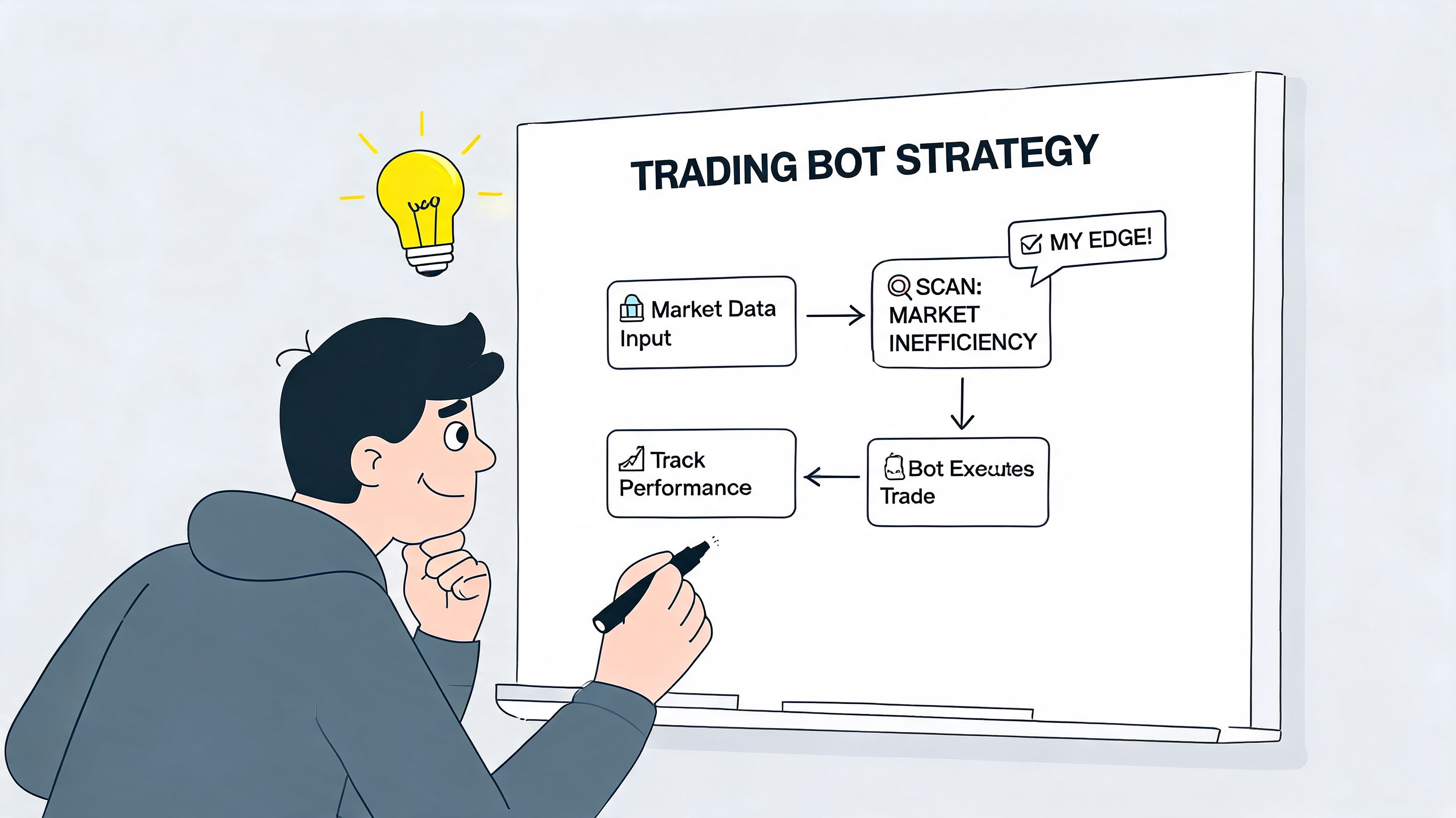
Designing Your Bot's Core Strategy and Edge
Open your wallet tracker after a sharp move and you will often see the actual sequence in plain view. A small group of wallets accumulated before the chart looked obvious, retail volume arrived later, and indicator-only bots entered after the easy part of the move was gone. That gap is where a DeFi bot can still have an edge, but only if the strategy is defined before the code.
Start with a falsifiable hypothesis
Write the trade idea in one sentence that can be proven wrong. If you cannot do that, the bot will drift into feature creep and curve-fit itself around noise.
Good hypotheses for an on-chain bot usually look like this:
- Wallet-following hypothesis. A defined group of wallets enters positions early enough that copying a filtered subset of their buys creates positive expectancy after gas, slippage, and missed fills.
- Confirmation hypothesis. A wallet action only becomes tradable when market conditions support execution, such as enough liquidity, an acceptable spread, and no immediate signs of distribution.
- Exit hypothesis. Your exit logic must stand on its own, because the source wallet may scale out across multiple transactions, hedge elsewhere, or tolerate drawdowns that do not fit your account.
That last point breaks a lot of first builds. Wallet tracking gives you intent. It does not outsource risk management.
Build around information edge, not chart familiarity
RSI, MACD, and moving averages are easy to code and easy to test. They are also visible to everyone. In DeFi, that usually makes them better as filters than as the primary reason to take a trade.
The stronger approach is to treat price as confirmation and wallet behavior as the signal source. If a tracked wallet starts building size in a token before attention reaches the chart, you are reacting to participant behavior rather than recycled price math. This is the primary advantage behind smart money wallet tracking in crypto.
I use indicators sparingly here. They help reject bad entries. They rarely create the edge by themselves.
Choose one strategy archetype and accept its trade-offs
Do not mix three bot styles into version one. Pick the job your bot will do, then accept the operational constraints that come with it.
| Strategy archetype | What drives the signal | Where it works | Common failure mode |
|---|---|---|---|
| Wallet mirroring | On-chain buys, sells, sizing, timing | Fast DeFi rotations, narrative tokens | Following weak wallets, reacting too late |
| Event reaction | Listings, contract changes, liquidity additions | Launch periods, catalyst-driven trades | Latency, spoofed momentum, poor fills |
| Mean reversion | Short-term price dislocation | Deep, liquid pairs | Standing in front of a real trend |
| Grid or DCA automation | Predefined order placement | Specific regimes with stable assumptions | Running the wrong structure in the wrong regime |
Start tracking smart money today
Join thousands of traders using WalletFinder.ai to find profitable wallets and copy their trades.
Start Free Trial →

