
10 Actionable DeFi Use Cases to Watch in 2026
Explore the top 10 actionable DeFi use cases for 2026. Discover how to leverage DEXs, yield farming, and smart money signals to find opportunities.
Decentralized Finance (DeFi) has evolved far beyond a niche concept into a robust ecosystem of powerful financial tools. While headlines often focus on volatility, the real story lies in the practical, value-generating applications available to savvy traders and investors. These DeFi use cases offer unprecedented access to lending, trading, and yield generation, all operating on transparent, permissionless blockchain networks. Forget the theoretical jargon; this guide is about real-world application.
This article moves past the surface-level explanations to provide a deep dive into the 10 most impactful DeFi strategies active today. We will dissect the mechanics behind each use case, from high-frequency arbitrage to strategic memecoin trading and sophisticated yield farming. More importantly, we'll show you how to translate on-chain data into profitable actions.
For each strategy, you will learn to identify the critical on-chain signals that precede major market moves. We'll provide a strategic breakdown of what to look for, from unusual wallet activity to shifting liquidity pools, and detail how to leverage these insights. This isn't just a list of what's possible; it's a playbook for execution. You will discover how tools like Wallet Finder.ai give you a critical edge by revealing where the smart money is moving before it becomes common knowledge. This guide is designed to equip you with replicable methods and actionable takeaways to navigate the complex world of DeFi and capitalize on its most lucrative opportunities. We will cover a comprehensive range of topics including DEX trading, yield farming, memecoin discovery, and advanced cross-chain strategies.
1. Smart Money Tracking & Copy Trading
One of the most powerful DeFi use cases is the ability to track the on-chain activity of highly profitable traders, often called "smart money," and automatically replicate their trades. This strategy merges real-time blockchain data analysis with automated execution, allowing retail investors to mirror the strategies of seasoned professionals and capitalize on opportunities they might otherwise miss.
By monitoring wallets with a proven history of high returns, you gain insight into emerging trends, new token launches, and effective portfolio management. Platforms like Wallet Finder.ai aggregate this data, making it easy to identify top-performing wallets based on metrics like profit and loss (PnL), win rate, and holding duration.
Strategic Analysis & Application
The core strategy involves identifying a wallet demonstrating consistent profitability and then using a copy trading tool to automatically mirror its buys and sells. This democratizes access to sophisticated trading techniques that were once exclusive to institutional desks. It’s particularly effective in fast-moving markets like memecoins, where early entry is critical.
Key Insight: The transparency of the blockchain is the foundation of this use case. Every transaction is public, allowing anyone with the right tools to deconstruct successful strategies and apply them. This creates a more level playing field between institutional and retail participants.
Actionable Takeaways
To effectively implement this strategy, follow a structured approach:
- Filter & Vet: Use filters to find wallets matching your risk tolerance. Look for a minimum holding duration to avoid traders who are simply lucky on a few transactions.
- Diversify: Don't put all your capital behind a single wallet. Create a watchlist of several top performers to diversify your risk and smooth out returns.
- Monitor Performance: Continuously track the PnL and win streaks of the wallets you follow. Be prepared to stop copying a wallet if its performance starts to decline.
- Adjust Sizing: Set your own position sizing rules based on your portfolio and risk management strategy, rather than blindly copying the exact trade size.
This method transforms blockchain data from a passive information source into an active, automated trading advantage, making it an essential DeFi use case. To delve deeper into how on-chain data is reshaping finance, explore this analysis of BankSocial and its role in crypto.
The Copy Trading Feedback Loop Problem
Smart money tracking works until it stops working — and the reason it stops is the tracking itself. When a wallet becomes widely followed on platforms like Wallet Finder.ai, its trades start attracting copycat capital large enough to move prices. The wallet's buys cause immediate price impact from followers, the wallet's sells get front-run by followers trying to exit first. The wallet is now trading against its own audience.
This feedback loop transforms a genuinely alpha-generating wallet into a crowded trade with deteriorating edge. The more followers a wallet accumulates, the worse its future performance tends to be — not because the trader lost their skill, but because their signal is now priced in before they can fully execute it.
Detecting Signal Decay in Followed Wallets
The clearest sign a wallet has been over-discovered is execution price deterioration. Compare the wallet's average buy price in their first 30 days of being visible in trackers versus their last 30 days. If average slippage on entries increased from 0.3% to 2.1%, copycat capital is front-running their buys. That wallet's edge has been arbitraged away.
Watch for these specific decay indicators:
- Declining win rate over rolling 30-day windows: Edge that existed 6 months ago disappearing as the wallet gets more widely tracked
- Shrinking position sizes: The wallet reducing trade size signals they're aware their entries are moving market against them
- Increased use of private mempools or MEV protection: A previously visible wallet going dark on normal mempool monitoring is protecting themselves from their own copycats
- Token selection shifting to lower liquidity assets: Moving to micro-caps where copycat capital can't follow at scale without destroying their own entry
Building a Resilient Copy Trading System
The solution isn't to abandon copy trading — it's to track wallets before they get widely discovered, then exit the signal before the crowd finds it.
- Prioritize wallets with fewer than 200 current followers on tracking platforms. These have the most intact edge and the least copycat pollution
- Monitor wallet age relative to discovery date: A wallet with 2-year track record discovered 3 months ago has more reliable signal than a wallet found 18 months ago with identical PnL
- Set automatic exit rules: If a followed wallet's 30-day rolling win rate drops below their 6-month average by more than 15%, stop copying — signal decay has begun
- Diversify into correlated but less-tracked wallets: If you find a top wallet, identify wallets that traded the same tokens at similar times but haven't been surfaced by trackers yet. These are likely the same network/group with intact edge
2. Decentralized Exchanges (DEX) and Liquidity Provision
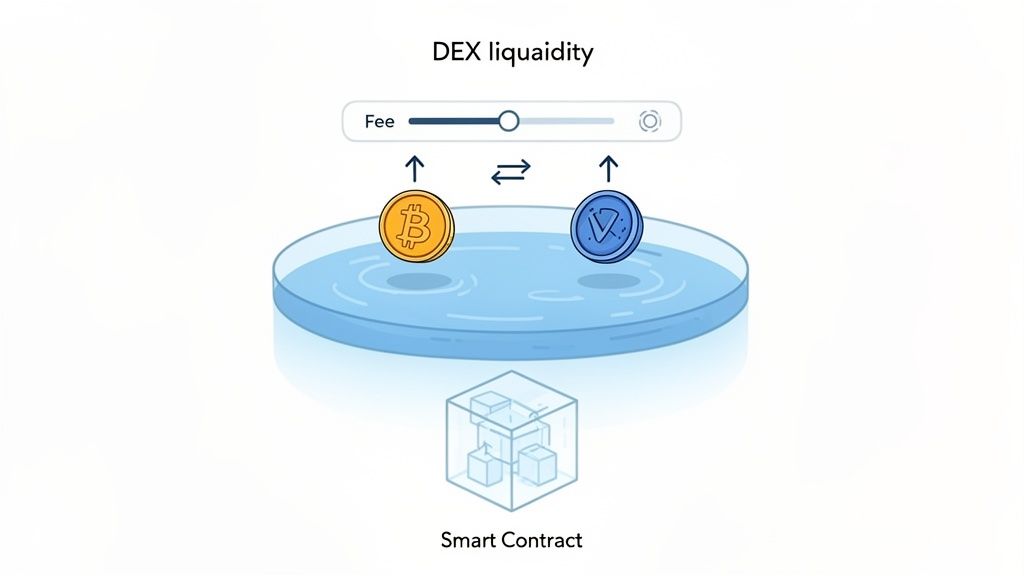
Decentralized exchanges (DEXs) are the cornerstone of DeFi, enabling peer-to-peer token swaps without the need for a central intermediary. They operate through automated smart contracts, most commonly using an Automated Market Maker (AMM) model. This system relies on liquidity providers (LPs) who deposit pairs of tokens into pools, earning trading fees in return for facilitating swaps. This is one of the most fundamental DeFi use cases, forming the bedrock for token discovery and passive income generation.
Start tracking smart money today
Join thousands of traders using WalletFinder.ai to find profitable wallets and copy their trades.
Start Free Trial →

