
DeFi Liquidity Mining: 2026 Strategy and Risk Guide
Explore DeFi liquidity mining. Learn to evaluate programs, manage impermanent loss, and find profitable opportunities with on-chain data.
DeFi didn't become a serious trading arena because people suddenly loved passive yield. It became one because token incentives proved they could pull capital into protocols at extreme speed. When Compound launched COMP in June 2020, one account says its total value locked climbed from under $100 million to over $2 billion within weeks, which helped trigger DeFi Summer, and DeFi TVL broadly expanded from under $1 billion to over $10 billion within roughly three months according to this history of DeFi.
That matters because defi liquidity mining is no longer a side strategy. It's part market making, part token distribution, part competitive intelligence. If you treat it like a static yield product, you'll usually end up holding the bag after emissions fade, volatility expands, or smarter wallets rotate out before you do.
The edge comes from management. Strong miners don't just find pools. They track fee quality, reward durability, pool depth, volatility, and wallet behavior on-chain. They enter with a thesis, monitor like a trader, and exit before a farm turns into a subsidy trap.
The Rise of DeFi Liquidity Mining
Liquidity mining changed how crypto protocols bootstrap markets. Before it, a protocol had to hope traders or lenders showed up on their own. After it, a protocol could pay users to supply the liquidity that made the product usable from day one.
The basic idea is simple. You deposit assets into a protocol, help it function, and earn two things in return. First, you receive the normal economic output of the venue, such as trading fees or lending interest. Second, you may receive governance tokens, which act a bit like early equity in the protocol.
Why the model spread so fast
Compound's COMP launch in mid-2020 gave the model its defining moment. Users weren't just earning from using the protocol. They were also accumulating ownership-linked tokens for participating. That incentive design became the template that many later protocols copied.
A useful way to think about it is this: liquidity mining is like being an early market maker who also gets startup-style upside. You provide the working capital, the protocol pays you for usage, and it may also hand you tokens that could matter if the venue grows.
Practical rule: If a protocol needs liquidity to function, token incentives are one of the fastest ways to buy that liquidity.
Why traders should still care now
The headline opportunity isn't the old mania. It's what the model still does well today:
- Bootstraps market depth: New pairs and lending markets need capital before they can attract organic activity.
- Reprices quickly: Reward programs change fast, which creates tactical entry and exit windows.
- Leaves an on-chain footprint: Good liquidity managers reveal habits you can study, including range changes, harvesting behavior, and timing around emission shifts.
For traders, the key lesson from DeFi Summer isn't nostalgia. It's that incentives can rewire capital flows very quickly. If you understand where rewards come from and how they decay, you can treat defi liquidity mining as an active strategy instead of a passive promise.
Understanding Liquidity Mining Mechanics
At the mechanical level, liquidity mining is just pooled capital plus a reward schedule. The complexity starts when traders confuse gross yield with realized yield.
According to Amberdata, DeFi total value locked increased from $601 million at the start of 2020 to $239 billion near its 2022 peak, which shows how large this incentive-driven model became across AMMs and lending markets, as described in Amberdata's DeFi primer.
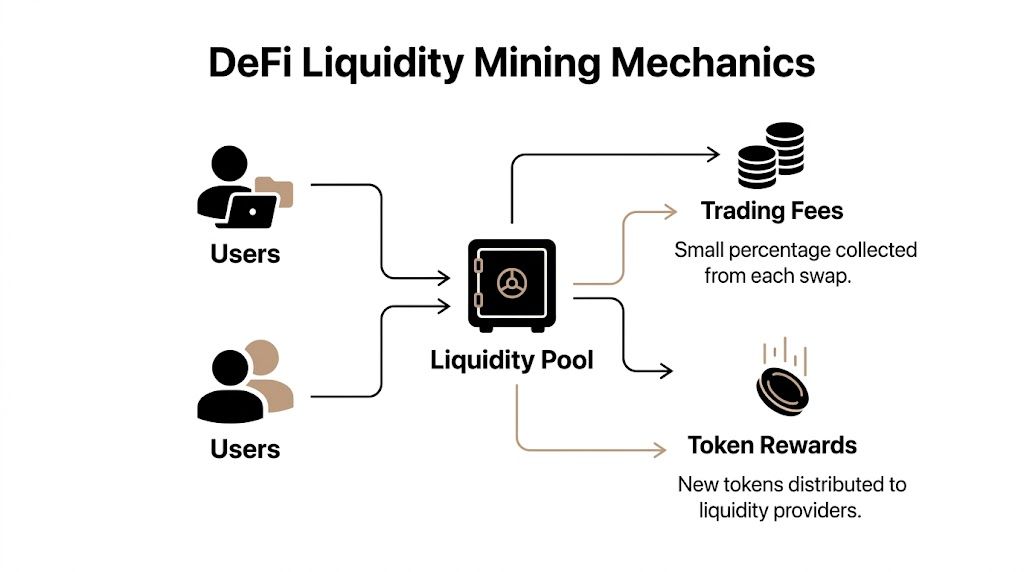
The two return streams
Most positions earn from two buckets:
Trading fees or lending interest
This is the organic part. Traders swap through the pool, or borrowers pay to access capital.Token emissions
This is the subsidized part. The protocol distributes its own token to attract liquidity.
That distinction matters because fee revenue reflects actual usage, while emissions reflect a temporary policy decision. If most of the yield comes from emissions, the position can weaken fast when incentives drop or when more capital crowds into the same pool.
For a broader primer on the pool side of the trade, this guide to crypto liquidity pools is useful background.
How TVL and APR affect your slice
Your earnings depend on your share of the pool. If more liquidity enters, your share shrinks unless volume rises enough to offset that dilution. That's why TVL is a useful context metric but never a buy signal by itself.
A practical way to read the setup:
| Metric | What it tells you | What can go wrong |
|---|---|---|
| TVL | How much capital is competing for fees and rewards | High TVL can dilute returns |
| APR/APY | Advertised reward rate | Often changes quickly |
| Fee share | Whether the pool has real usage | Can be weak even in popular pools |
| Emission share | How much subsidy supports the yield | Usually decays over time |
Start tracking smart money today
Join thousands of traders using WalletFinder.ai to find profitable wallets and copy their trades.
Start Free Trial →

