
Cryptocurrency Compound Interest Calculator & DeFi Guide
Use our cryptocurrency compound interest calculator to project earnings. Learn to account for APY vs APR, DeFi risks, and taxes for real-world returns.
You open a staking page, see a juicy APY, and your brain starts doing fast mental math. If this keeps compounding, maybe the position pays for itself. Then the doubt kicks in. Is that yield stable? Is it auto-compounding? Is the token price falling while the calculator shows a smooth upward line?
That confusion is normal. A cryptocurrency compound interest calculator gives you the clean version of the story. It shows what happens if rewards keep getting added back to your balance. What it doesn't show by default is the messy part of DeFi: changing rates, swap costs, liquidity risk, and taxes.
Used well, though, a calculator is still one of the best tools in a crypto investor's toolkit. It helps you compare staking, lending, yield farming, and savings products on the same footing. It turns abstract APY into a future token balance you can reason about.
Your Guide to Crypto Compounding
Most new DeFi investors make one of two mistakes.
Some ignore compounding and underestimate how much reinvesting can change a position over time. Others stare at a big APY number and treat it like a promise. Neither approach works for long.
Crypto compounding sits in the middle. It's powerful, but it's not magic. If you understand the math, you can model a position before you enter it. If you understand the risks, you can tell the difference between a solid yield source and a flashy trap.
A good calculator helps with three practical questions:
- What will my balance become if rewards are reinvested?
- How much does compounding frequency matter for this specific opportunity?
- What happens if the headline yield looks great but real-world frictions eat into it?
That last question matters more in crypto than in traditional finance. In DeFi, your return often depends on smart contracts, token incentives, liquidity depth, and market behavior. The advertised APY might be mathematically correct and still lead to disappointing results in your wallet.
Practical rule: Treat the calculator's output as a draft, not a verdict.
The useful mindset is simple. First, model the ideal case. Second, pressure-test it. Third, compare it with what skilled on-chain participants have achieved in similar setups.
That approach keeps you from doing two expensive things: skipping good opportunities because the math feels intimidating, or entering bad ones because the APY looked irresistible.
You'll get more value from a cryptocurrency compound interest calculator when you use it like an analyst, not like a shopper. Start with the formula. Translate APR and APY correctly. Then subtract the parts that calculators often miss, including fees, impermanent loss, and taxes. That's how a clean estimate becomes a realistic one.
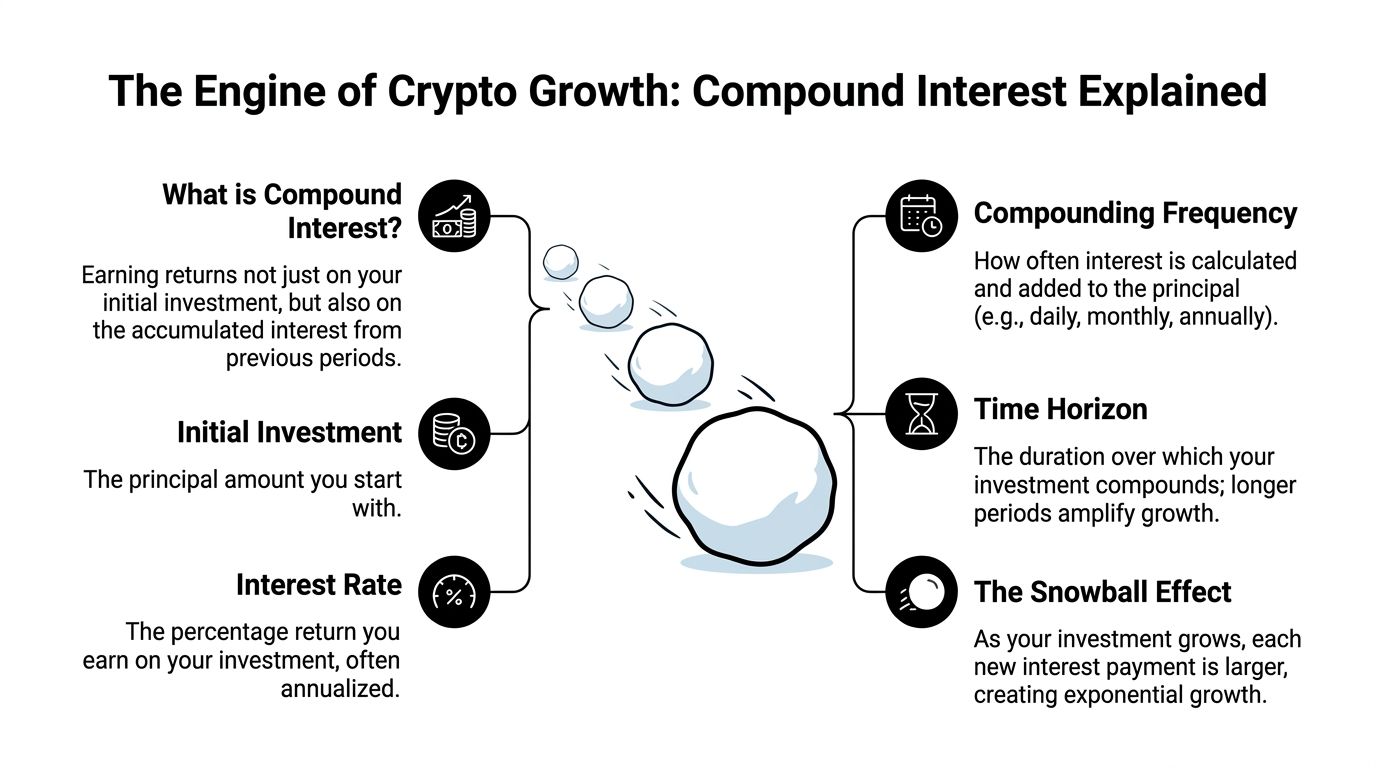
The Engine of Crypto Growth Compound Interest Explained
Compound interest is easiest to understand as a snowball rolling downhill. At the top, it's small. As it rolls, it picks up more snow. Then that bigger snowball picks up snow even faster.
Your crypto position works the same way when rewards are reinvested. You earn on your original deposit, then you earn on the rewards that were added back, then on the rewards from those rewards.
The formula behind the snowball
The core formula is A = P(1 + r/n)^nt, which has become the standard model for crypto yield calculations across staking and DeFi platforms, as explained in Pineify's overview of the crypto compound interest formula and APY examples.
The letters represent the following:
- P is your starting amount, also called principal.
- r is the annual rate.
- n is how often compounding happens in a year.
- t is the time in years.
- A is the final amount.
The formula matters because crypto platforms often pay rewards frequently. Daily, weekly, or automatically through smart contracts. That frequency changes the result.
Pineify gives a clean example. A $10,000 investment at 8% APY compounded daily grows to about $10,833 after one year, adding around $833 in compounding gains. Leave that same setup untouched for five years, and it reaches about $14,918, nearly 50% more than the original investment. That's the snowball effect in numbers, and it's why compounding gets more impressive with time.
APY and APR aren't the same thing
Many beginners misunderstand this distinction.
APR is the base annual rate without compounding built in.
APY includes the effect of reinvesting rewards.
If a platform advertises APR, you still need to ask whether rewards are being restaked or manually compounded. If it advertises APY, the compounding effect is already included in the headline figure.
| Feature | APR (Annual Percentage Rate) | APY (Annual Percentage Yield) |
|---|---|---|
| Includes compounding | No | Yes |
| Best for | Base rate comparison | Real growth comparison |
| Typical investor question | “What is the raw rate?” | “What could my balance become?” |
| Reinvestment reflected | Not automatically | Yes |
| Usefulness in DeFi | Helpful, but incomplete | Usually more practical |
Start tracking smart money today
Join thousands of traders using WalletFinder.ai to find profitable wallets and copy their trades.
Start Free Trial →

