
Crypto White Papers: A Practical Analysis Guide
Master crypto white papers with our guide. Learn how to analyze tokenomics, evaluate technology, and spot red flags to make smarter investment decisions.
Before you even think about putting capital into a new crypto project, there's one document you absolutely have to read: the white paper. This is the project's blueprint, the single most important piece of writing that lays out its vision, tech, and economic model. It's what separates a project with real potential from just another wave of speculative hype.
What Are Crypto White Papers

Think of a crypto white paper as the project's constitution, business plan, and technical manual all rolled into one. It’s the go-to document that starts by identifying a problem and then presents a detailed solution using blockchain technology. The main goal? To convince everyone—from developers to investors—that the project is solid, valuable, and worth getting behind.
But a good white paper is more than just a dry technical spec. It tells a story. It paints a clear picture of the future and provides a logical roadmap showing how its token or coin will help get there. This document is your first real chance to look under the hood before a project hits the mainstream.
The Purpose of a White Paper
At its heart, a white paper has a few critical jobs. It's the primary way a new crypto venture explains complex ideas and builds trust with an audience that's rightfully skeptical. Knowing its purpose helps you read it with the right mindset.
A white paper needs to accomplish these key things:
- Explain the Problem: It must clearly define a real-world issue or inefficiency that existing systems aren't solving well.
- Propose a Solution: It then needs to detail how the project’s unique take on blockchain offers a better way forward.
- Detail the Technology: This is where it gets into the weeds—outlining the technical architecture, consensus mechanism, network design, and security.
- Introduce the Token: It must explain the token’s role (the “tokenomics”), including its purpose, supply, and how it will be distributed over time.
A white paper isn't just a formality; it's a statement of intent. It serves as the ultimate source of truth for a project's goals, allowing the community to hold the development team accountable for their promises.
This is why the ability to properly break down a crypto white paper is such a non-negotiable skill. It gives you the power to do your own due diligence, cutting through the marketing noise and social media chatter. When you learn how to read these documents the right way, you can spot the fundamental strengths and weaknesses of any project.
This guide will give you a framework for that analysis. We’ll walk through the common sections you'll find, teach you how to pick apart technical and economic claims, and give you a checklist to identify critical red flags and trust signals. The goal is to turn you from a passive reader into an active, critical analyst who can make smart calls in the fast-moving world of DeFi.
The Evolution From Bitcoin To Modern White Papers
To really get what modern crypto white papers are all about, you have to go back to the very beginning. The whole idea kicked off with one legendary document published on Halloween, 2008, by the mysterious Satoshi Nakamoto: "Bitcoin: A Peer-to-Peer Electronic Cash System."
That nine-page paper wasn't just a concept; it was a full-blown technical blueprint. It elegantly cracked the "double-spending problem" that had stumped cryptographers for years, all without needing a bank or any central authority. Nakamoto laid out everything that is now the bedrock of the entire industry, from the proof-of-work consensus mechanism to the hard cap of 21 million coins.
That single document sparked a revolution. It’s the reason we now have over 21,000 different cryptocurrencies, with Bitcoin alone commanding a market value of around $1.14 trillion as of September 2024. The Bitcoin white paper set the gold standard with its tight focus, technical genius, and world-changing vision. If you want a deeper dive into how the market has grown from there, the 2025 State of Crypto Report is a great resource.
The Ethereum Leap Forward
For a while after Bitcoin, most new projects were basically remixes of the original. They created "altcoins" that tweaked a few things but didn't stray far from the formula. But then, in 2014, another white paper dropped that completely changed the game. Vitalik Buterin’s "Ethereum: A Next-Generation Smart Contract and Decentralized Application Platform" pitched something far bigger.
Instead of just digital cash, Ethereum was envisioned as a global, decentralized computer. The killer innovation here was the idea of programmable smart contracts—code that could automatically execute the terms of an agreement.
This was a massive pivot. The Ethereum white paper blew the doors open on what a blockchain could do, paving the way for everything from decentralized finance (DeFi) and NFTs to the thousands of decentralized apps (dApps) we see today.
Where the Bitcoin white paper was a laser-focused solution to a monetary problem, Ethereum's was a visionary manifesto for a whole new internet. It showed the world that a blockchain could be a platform for anything.
The Modern White Paper: A New Breed
The jump from Bitcoin to Ethereum pretty much defines the evolution of crypto white papers. The early ones were academic, straight to the point, and all about the tech. Today, they're a completely different beast, born out of a much bigger and more cutthroat market.
Modern white papers have morphed into complex documents that wear many hats. They’re now part business plan, part technical manual, and part marketing pitch. This shift happened because the industry exploded, and projects now have to fight for the attention of investors, developers, and users in an incredibly crowded space.
Knowing this history is key to your analysis. When you pick up a new white paper, you're looking at something that’s the product of over a decade of trial and error. Understanding its lineage—whether it comes from Bitcoin's school of technical purity or Ethereum's school of ambitious platform-building—is the first step to cutting through the noise and figuring out what a project is really about.
Deconstructing The Anatomy Of A Crypto White Paper
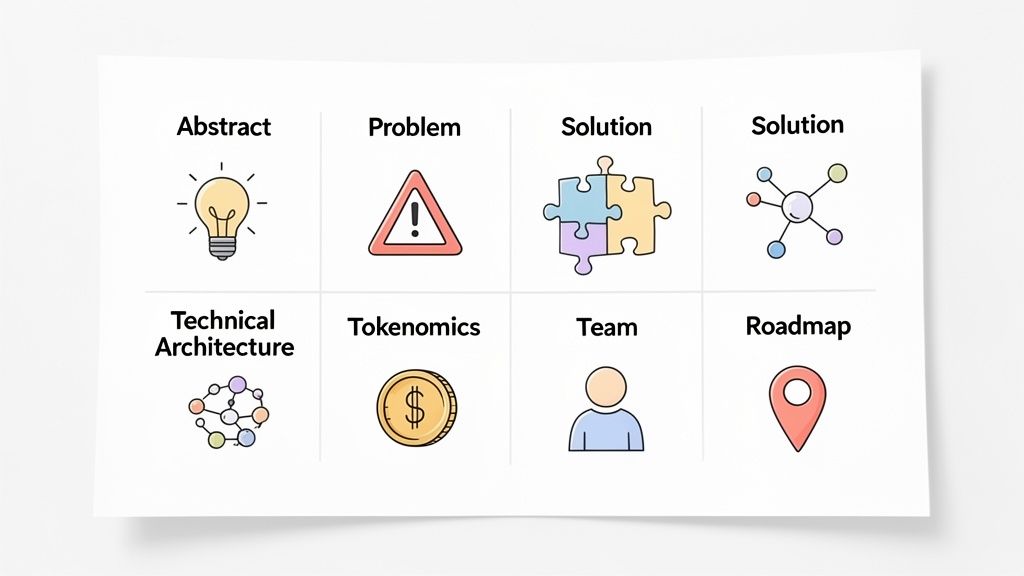
While no two crypto white papers are exactly the same, most good ones follow a familiar roadmap. Think of it less like a rigid template and more like a logical argument, built to walk you from a big-picture problem to a very specific, token-based solution. Learning to navigate this structure is your first step toward reading these documents like a pro.
It almost always starts with an Abstract or Introduction. This is the 30-second elevator pitch. It should tell you what the project is, why it exists, and how it works, all in a few short paragraphs. If you're confused or drowning in buzzwords by the end of this section, that's a serious red flag.
From there, a strong white paper moves straight to the Problem Statement. This section gets to the heart of why the project even needs to exist. It lays out the market gap, technical flaw, or user frustration it aims to fix. Without a clear and convincing problem, the entire premise of the project feels weak.
The Core Solution and Technical Design
Once the problem is on the table, the document introduces its Proposed Solution. This is where the narrative shifts from "here's what's broken" to "here's our plan to fix it." It's a high-level overview of the project's vision before diving into the nitty-gritty.
That dive happens in the Technical Architecture section—often the most dense and intimidating part of the paper. This is where the creators explain the nuts and bolts of their system. You'll typically find details on:
- Consensus Mechanism: How the network validates transactions (e.g., Proof-of-Work, Proof-of-Stake).
- Blockchain Design: Is it a new Layer 1, a Layer 2 solution, or an app built on something like Ethereum?
- Smart Contract Functionality: How the automated code that runs the ecosystem actually works.
Don't worry, you don't need a computer science degree to get through this. You're looking for logic and clarity, not a code review. Does the tech sound feasible, or are they promising magic without explaining the trick?
The Economic Engine and Project Vision
Next up is the section every on-chain analyst lives for: Tokenomics. This is the economic soul of the project. It breaks down everything about the native token—its purpose, its total supply, and how new tokens are created or destroyed over time.
A huge piece of this is the token distribution. You want to see a fair split between the community, the development team, and early investors, with transparent vesting schedules for insiders. You can even use tools like a specialized token distribution analyzer to verify their claims against what’s actually happening on-chain.
Tokenomics is where a project's real incentives are revealed. A great model gets everyone—team, users, and investors—pulling in the same direction. A bad one can sink the entire ship.
Finally, the white paper wraps up by introducing the Team and Advisors and presenting the Roadmap. The team section is your chance to do some digging. Who are these people? Do they have a track record of delivering? The roadmap lays out their plan for the future, showing key milestones and giving you a sense of their ambition and ability to execute.
To help you keep track of all this, here's a quick breakdown of what to look for in each section.
Key Sections Of A Crypto White Paper
This table outlines the essential parts of a crypto white paper, explaining what each section is for and the key questions you should be asking as you read.
Start tracking smart money today
Join thousands of traders using WalletFinder.ai to find profitable wallets and copy their trades.
Start Free Trial →

