
Crypto Limit Order: Master Precision Trading
Master crypto limit order. Avoid slippage, place orders on CEX & DeFi, and trade like a pro with advanced strategies.
You catch a wallet buy, the token starts moving, and the next decision is where most copy traders give back their edge.
Hit market buy too late and you often pay up into momentum. Wait too long and the move is gone. Place a limit order too far below the market and you get the clean price you wanted, but no position. That tension is where the crypto limit order stops being a beginner concept and starts becoming an execution tool.
For traders who act on on-chain signals, this matters more than most guides admit. A signal can be right and still lose money if your fill is bad. A wallet can buy early, absorb slippage, and ride follow-through. You arrive later, submit into thinner liquidity, and end up owning a very different trade.
The Trader's Dilemma Speed vs Price
A familiar setup. You see a respected wallet rotate into a new token. The buy is real, the size is meaningful, and the chart is already lifting. You have two choices.
The first is speed. You slam a market order because you don't want to miss the move. The order fills, but it fills wherever liquidity is available. If the book is thin or the on-chain route is messy, that can mean paying materially more than the wallet you were trying to follow.
The second is discipline. You place a limit order near a level where you'd still like the trade if price retests. If it fills, your entry is cleaner. If it doesn't, you miss the trade entirely.
That isn't an academic difference. It's the practical split between traders who react to alerts and traders who manage execution.
What usually goes wrong
Most copy traders don't fail because they picked the wrong wallet. They fail because they use the wrong order type for the situation.
- They chase a fast move with a market order. The signal may still be valid, but the fill destroys the reward-to-risk.
- They anchor to the original wallet price. By the time they act, that price may no longer be realistic.
- They place passive bids in runaway conditions. The token never retraces enough to fill them.
- They ignore venue differences. A centralized book and a DeFi route don't behave the same way.
Practical rule: If your entire edge depends on matching someone else's entry after the move has started, you don't have an analysis edge. You have an execution problem.
A limit order won't solve every one of these problems. It won't create liquidity, and it won't force the market to come back to your price. But it does one important thing. It makes your trade intentional.
That's why serious traders keep coming back to limit orders. Not because they're fancy, but because they force a decision about what price is still worth paying.
What Is a Crypto Limit Order
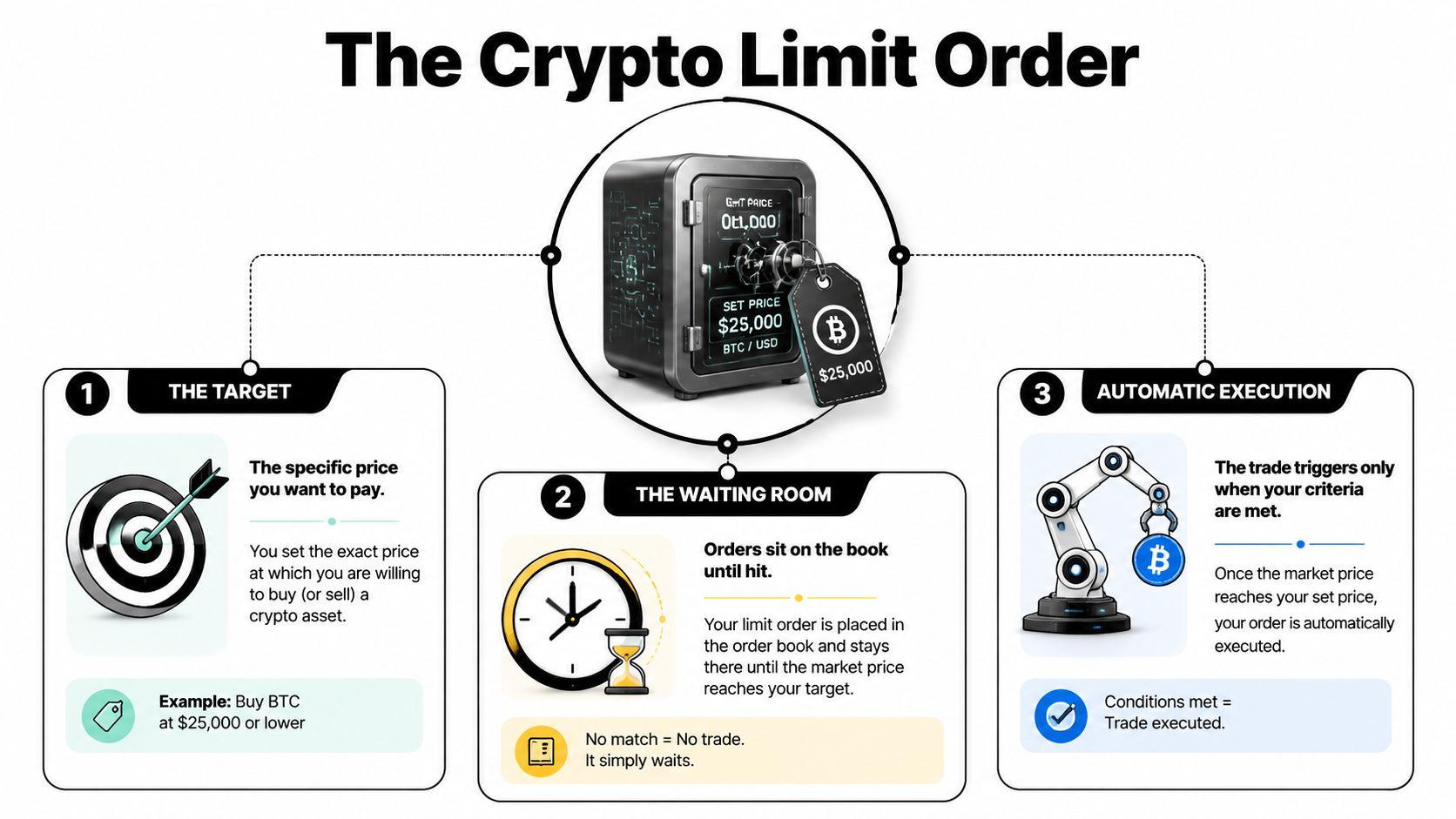
A crypto limit order is a price-controlled trade instruction. You choose the worst price you're willing to accept, then let the market come to you.
For a buy, you set a maximum price. For a sell, you set a minimum price. CoinTracker's explanation of limit orders gives the clearest basic example: if Bitcoin is trading at $29,000 and you place a buy limit order at $28,500, the order only executes if BTC trades at $28,500 or lower. If price never gets there, the order stays unfilled.
That single mechanic is the whole point. A limit order is price first, speed second.
The auction way to think about it
The easiest mental model is an auction bid. You don't tell the auctioneer, "Get me the item right now at any price." You say, "I'm willing to pay up to this amount."
Trading works the same way.
- A buy limit says you're willing to buy, but only up to your chosen price.
- A sell limit says you're willing to sell, but only down to your chosen minimum.
- Until another participant is willing to trade with you on those terms, your order just waits.
That waiting is a feature, not a flaw. It gives you control over entry quality.
Why traders use them
Limit orders are widely used to target support and resistance, reduce slippage, and avoid paying worse prices during volatile moves, as described in this walkthrough of limit buys. In practical terms, they let you say no to bad fills.
They also help form the market itself. Resting limit orders sit in the order book and advertise trading interest at specific prices. That's part of how visible liquidity gets built.
A market order asks, "Can I get in?" A limit order asks, "Can I get in at a price that still makes sense?"
The trade-off you accept
A limit order gives you better price control than a market order, but it does not guarantee execution.
And even when it does fill, it may not fill all at once. Some venues note that limit orders can be partially filled if only part of the requested size is available at your price, with the rest left resting in the book. That's normal market behavior, especially when size is larger than local liquidity.
If you're acting on a wallet signal, that trade-off matters. The cleaner your target price, the greater the chance the market never comes back for you.
A Trader's Toolkit Comparing Order Types
A limit order is useful because it solves one problem well. It doesn't solve every problem.
When traders misuse order types, they're usually asking one tool to do a different tool's job. A market order is for immediacy. A limit order is for price control. Stop orders are for reaction once price reaches a trigger.
Crypto Order Type Comparison
| Order Type | Primary Goal | Execution Guarantee | Price Guarantee | Ideal Use Case |
|---|---|---|---|---|
| Market | Speed | High immediate execution intent | No | Entering or exiting quickly when getting filled matters more than exact price |
| Limit | Price control | No | Yes, within your stated limit | Buying pullbacks, selling into strength, passive entries around planned levels |
| Stop-Limit | Triggered price control | No after trigger | Conditional | Breakout entries or protective exits where you still want control over the final price |
| Stop-Market | Triggered exit speed | Higher execution intent after trigger | No | Risk management when getting out matters more than precision |
Start tracking smart money today
Join thousands of traders using WalletFinder.ai to find profitable wallets and copy their trades.
Start Free Trial →

