
Crypto Funding Rate A Complete Trader's Guide
Master the crypto funding rate with this complete guide. Learn what it is, how it works, and how to use it for profitable crypto trading strategies.
The crypto funding rate is a small, periodic payment that traders exchange in perpetual futures markets. Its entire job is to keep the futures contract price tightly tethered to the actual spot price of a cryptocurrency.
Crucially, this is not a fee you pay to the exchange. It's a direct payment between traders holding long (buy) positions and those holding short (sell) positions.
The Engine That Powers Perpetual Futures
Think of a perpetual futures contract like a satellite that must maintain a perfect orbit around its planet—the crypto's spot price. The funding rate is the invisible force making constant, tiny adjustments to pull that satellite back into alignment whenever it drifts. Without it, the contract price could float off into space, becoming completely detached from the asset's real-world value.
This balancing act happens directly between traders. Picture a playground seesaw. If a crowd of traders jumps on one side (going long, betting the price will rise), that side gets heavy. To bring things back into balance, you need to entice some people to move to the other side. The funding rate is that incentive: the people on the heavy (long) side pay a small fee to those on the light (short) side.
Why Funding Rates Exist
At its core, the funding rate is a vital sign of the derivatives market. It serves two main purposes:
- Price Anchoring: It keeps the perpetual contract price from straying too far from the underlying asset's spot price.
- Market Balancing: It incentivizes traders to take the less popular side of a trade, preventing one-sided bets from creating too much instability.
It's important not to confuse funding rates with standard trading fees. Trading fees go to the exchange for processing your order. The funding rate, on the other hand, is a peer-to-peer payment that reflects the real-time balance of bullish versus bearish pressure. For a deeper look into market dynamics, our guide on on-chain analysis offers signals that perfectly complement what funding rates tell you.
What Positive and Negative Rates Tell You
The direction of the payment instantly reveals a story about market sentiment. This makes it one of the most direct ways to gauge the collective mood of leveraged traders.
The crypto funding rate is a real-time sentiment gauge. A positive rate signals bullish optimism, while a negative rate points to bearish pessimism, offering a clear window into the market's collective psychology.
To break it down, here’s a quick reference table to help you understand what each funding rate scenario means for your trades.
Crypto Funding Rate At a Glance
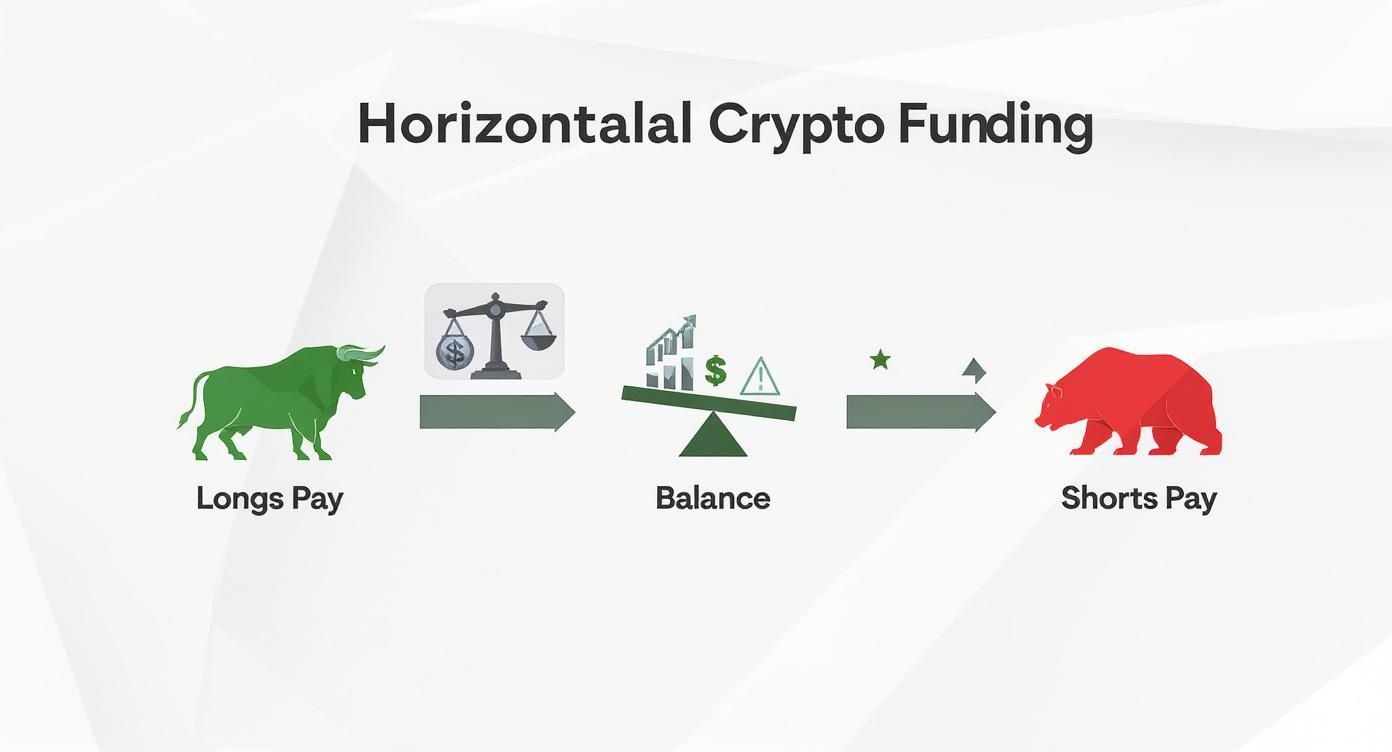
When the funding rate is positive, longs pay shorts. This reflects bullish sentiment — more traders are betting on a price increase, creating an imbalance that the funding mechanism corrects by charging the heavier side. If you're holding a long position, you'll pay a small periodic fee. If you're short, that same fee lands in your account as income.
When the rate turns negative, the dynamic reverses. Shorts pay longs, signaling that bearish sentiment has taken over and more traders are positioned for a price decline. In this environment, long holders receive a small payment each interval, while short holders bear the cost of maintaining their position.
In short, the sign of the funding rate—positive or negative—gives you a powerful clue about whether the market is feeling overly greedy or fearful.
How Crypto Funding Rates Are Calculated
To really get what's going on with the crypto funding rate, you have to look under the hood. Think of it like a recipe with two main ingredients. When they're mixed, you get the final rate that traders see on their screens. It’s not some arbitrary number; it’s a carefully calculated figure meant to mirror what’s happening in the market right now.
At its core, the funding rate formula is surprisingly simple. It’s basically the sum of the Interest Rate Component and the Premium Index. Each one has a specific job in keeping the perpetual contract price tethered to the actual spot price.
The Two Key Ingredients of the Formula
First up is the Interest Rate Component. This part is usually fixed and simply accounts for the difference in borrowing costs between the two assets in a trading pair. For a BTC/USD contract, it reflects the gap between the interest for borrowing Bitcoin versus borrowing US dollars. It’s part of the official formula, but it rarely has the biggest say in the final rate.
The second, and far more influential, ingredient is the Premium Index. This is the dynamic piece of the puzzle. It measures the price difference—or spread—between the perpetual contract and the asset's spot price. When the contract is trading at a premium (higher than spot), this index goes positive, pushing the funding rate up. If it's trading at a discount (lower than spot), the index turns negative, dragging the rate down with it.
The Core Formula: Funding Rate = Premium Index + clamp(Interest Rate - Premium Index, 0.05%, -0.05%)
This formula is set up so that the premium index is always the main driver. The interest rate just provides a baseline, and that "clamp" function is there to stop the rate from getting too wild in either direction. The result is a number that gives you a clean read on the tug-of-war between buyers and sellers.
A Practical Calculation Example
Let's walk through a quick, hypothetical scenario to see how this all clicks together.
Picture this market setup for a BTC/USD perpetual contract:
- Interest Rate: The exchange sets a daily interest rate of 0.03%. Since funding happens every 8 hours, that works out to 0.01% per funding period.
- Premium Index: The perpetual contract is hot, trading at $50,250 while the actual spot price of BTC is $50,000. This premium creates a positive spread, which the exchange calculates as a Premium Index of 0.04%.
- Calculation: The exchange then plugs these numbers into its formula. After adjusting the premium with the interest rate, the final crypto funding rate comes out to about +0.05%.
Because the rate is positive, traders holding long positions will pay a small fee to those holding short positions. It’s the market’s way of nudging things back toward balance. This infographic gives a great visual of how those payments flow depending on market sentiment.
Start tracking smart money today
Join thousands of traders using WalletFinder.ai to find profitable wallets and copy their trades.
Start Free Trial →

