
Build a Crypto Arbitrage Scanner That Actually Works
Go beyond theory and build a crypto arbitrage scanner that finds real opportunities. This guide covers data pipelines, algorithms, and risk management.
A crypto arbitrage scanner is your secret weapon for hunting down fleeting price differences across multiple exchanges. Think of it as an automated tool that constantly scours the market, looking for chances to buy a crypto asset low on one platform and sell it high on another. It does this thousands of times per second—a speed no human could ever match.
Laying The Groundwork For Your Scanner
Before you even think about writing code, you need to get your head around why these opportunities exist in the first place. Price gaps in crypto aren't just random glitches. They're a natural byproduct of a fragmented and wild market. When you build a scanner, you're essentially building a system to systematically cash in on these temporary inefficiencies.
So, what causes them? Here are the primary drivers:
- Liquidity Levels: A huge market order on a small, low-liquidity exchange can tank or pump the price in an instant. That same order on a giant like Binance would barely cause a ripple. This creates a temporary price gap between the two.
- Trading Volume: Exchanges with lower volume update their order books less frequently, causing prices to lag behind more active markets.
- Regional Demand: Different geographic regions can have varying demand for specific assets, leading to price discrepancies.
- Exchange Update Speeds: The technical infrastructure of exchanges varies, meaning some update their price feeds faster than others.
Core Arbitrage Strategies to Target
Your scanner's logic needs to be laser-focused on specific types of opportunities. While there are tons of complex strategies out there, most arbitrage plays fall into a few key buckets. It's best to start with the fundamentals.
Let's break down the most common arbitrage strategies your scanner will be designed to find. Each has a unique mechanism and presents a different kind of opportunity in the market.
Core Types of Crypto Arbitrage Opportunities
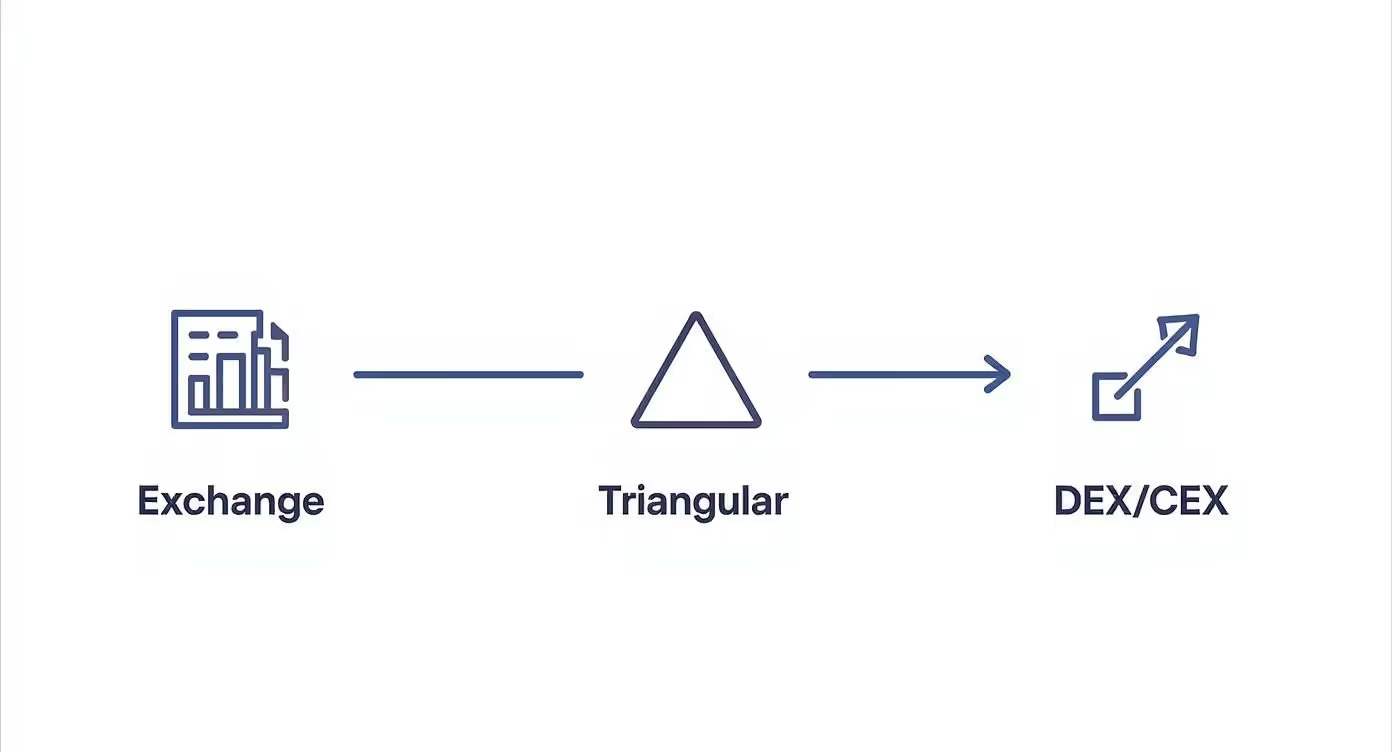
Arbitrage TypeMechanismExample ScenarioSimple Cross-ExchangeBuying an asset on Exchange A and immediately selling it for a higher price on Exchange B.Your scanner finds BTC is priced at $60,000 on Coinbase but is trading for $60,050 on Kraken. The play is to buy on Coinbase and sell on Kraken.Triangular ArbitrageExploiting a price discrepancy between three assets on a single exchange to make a profit through a circular trade.On a single exchange, you trade BTC for ETH, then that ETH for ADA, and finally trade the ADA back to BTC, ending up with more BTC than you started with.DEX-to-CEX ArbitrageCapitalizing on price differences between a decentralized exchange (DEX) and a centralized exchange (CEX).The price of LINK on Uniswap (a DEX) might temporarily lag behind the price on KuCoin (a CEX), creating a gap you can exploit.
These are the foundational plays. Mastering their detection is the first major step in building a profitable scanner.
The bottom line is that trying to find these opportunities manually is a losing game. The profit windows can last for just a few seconds, sometimes even milliseconds. A well-built scanner is the only way to spot these fleeting chances that are completely invisible to the naked eye.
Why Automation Is No longer Optional
In today's market, speed is everything. Crypto arbitrage is still a perfectly viable strategy in 2025, but the market has gotten way more efficient, squeezing profit margins down to the bone. This has made manual trading for most of these strategies flat-out impossible.
You’re not just competing against other traders; you're competing against their bots. Sophisticated tools can scan dozens of exchanges across multiple blockchains at once, and that's the level you need to be at. As this trader's guide for 2025 explains, managing fees and execution speed is now critical. An automated scanner isn't just a "nice-to-have"—it's the only way to get the edge you need to compete.
Architecting a High-Speed Data Pipeline
A crypto arbitrage scanner is only as good as the data it eats. Your algorithm can be a work of art, but if it's fed slow, unreliable information, you’re building on a foundation of sand. Designing a high-speed data pipeline isn't just a technical exercise—it's the first real step in turning a theoretical strategy into a system that actually hunts for profit. To understand how to safely manage funds and interact with decentralized platforms, What Is a DeFi Wallet? Your Guide to Web3 Finance provides a clear, beginner-friendly overview.
Think of this architecture as the central nervous system for your entire trading operation. Its job is to take the chaotic, noisy world of crypto markets and translate it into a structured format your scanner can act on in milliseconds.
Choosing Your Data Sources
Your first big decision is where to get your price data. This choice has massive ripple effects on the speed and reliability of your whole setup. You've got a few options, each with its own set of trade-offs.
WebSocket APIs are the gold standard for real-time CEX price feeds. Data is pushed directly to your scanner the instant a price changes, giving you ultra-low latency that polling methods simply cannot match. The catch is that managing persistent WebSocket connections takes real engineering effort — you need robust reconnection logic, heartbeat monitoring, and the ability to handle sudden bursts of data without your pipeline backing up. For any live arbitrage strategy, though, this complexity is non-negotiable. WebSockets are how you stay competitive.
REST APIs are the simpler option, and that simplicity comes at a cost. You send a request, you get a response, and then you wait before you can ask again — which means your data is always slightly stale, and exchange rate limits put a hard ceiling on how frequently you can refresh it. This makes REST perfectly adequate for pulling historical trade data, order book snapshots for backtesting, and non-urgent reference data like fee schedules. What it is not suited for is live signal generation. If you're relying on REST for real-time price comparisons, you're already behind.
Direct Node Access is the most powerful option and the most demanding to build. By running your own node — or connecting directly to a provider with raw mempool access — you can see pending transactions before they are confirmed on-chain. For DEX arbitrage in particular, this is the ultimate speed advantage: you can detect a large incoming swap that will shift a pool's price before that transaction lands in a block, giving you time to position your own trade to capture the spread it creates. The trade-off is significant hardware and infrastructure overhead, plus the engineering complexity of parsing raw transaction data in real time. If you want to dig deeper into how latency affects your bottom line at this level, it's worth analyzing latency in crypto trading patterns before committing to this path.
In practice, a production scanner uses all three in combination. WebSockets handle your live CEX price feeds. REST handles periodic reference data. Direct node access powers your on-chain DEX monitoring. The data pipeline you build needs to be flexible enough to ingest all three formats and normalize them into a single, consistent stream your detection logic can act on without caring where the data came from.
The visual below breaks down the different kinds of arbitrage opportunities your data pipeline needs to be able to feed.
Start tracking smart money today
Join thousands of traders using WalletFinder.ai to find profitable wallets and copy their trades.
Start Free Trial →

