
8 DeFi Copy Trading Strategies for 2026
Discover 8 powerful copy trading strategies for DeFi in 2026. Learn to mirror smart money, find new tokens, and manage risk with actionable steps & examples.
You're probably doing what most DeFi traders do at some point. You open a block explorer, watch a few wallets that seem smart, catch one good trade, then spend the next week wondering whether you found signal or just got lucky. That's the hard part with copy trading strategies in DeFi. The chain gives you everything and nothing at the same time.
The useful edge isn't “watch whales” as a vague idea. The edge comes from building repeatable rules around who you track, when you act, how you size, and when you stop. Modern copy trading already runs on a master-follower model where a lead trader's positions are mirrored automatically, and major platforms commonly show leader performance over 7-day, 30-day, and 90-day windows so users can judge recent consistency instead of chasing a single hot streak, as described in Binance Square's overview of copy trading mechanics. That same mindset works on-chain. You don't want random winners. You want observable behavior you can repeat.
What follows is the practical version. Not theory. These are eight copy trading strategies I would use, with clear setups, alert logic, and risk rules. Some are slower and steadier. Some are fast and unforgiving. All of them work better when you treat wallet tracking like portfolio management, not social media.
1. Smart Money Wallet Tracking & Mirroring
This is the core play. Find wallets that repeatedly enter strong trades early, then mirror them with smaller size and stricter exits than the lead wallet uses.
A lot of traders overcomplicate this. They build giant watchlists full of “interesting” addresses. That usually leads to noise. A better approach is to track a small group of wallets with visible trade history, consistent positioning, and behavior you can understand. One wallet might be good at swing entries in Ethereum ecosystem tokens. Another might be an early accumulator during market fear. A third might specialize in rotating into DeFi majors before incentive changes.
The implementation matters more than the idea.
How to set it up
In Wallet Finder.ai, build separate watchlists by style instead of keeping everything in one feed. Split them into categories like swing traders, long-hold accumulators, DeFi specialists, and event-driven traders. Then filter for wallets with transparent trading history, visible PnL trends, and repeatable entries rather than one giant outlier win.
Use alerts for buys, swaps, and sells, but only for wallets that pass your review. If a wallet trades too often, mute instant mirroring and move it into manual review. That keeps you from copying every touch of the market.
A simple setup looks like this:
- Primary watchlist: Wallets with long, readable histories and steady behavior.
- Secondary watchlist: Experimental wallets you're still evaluating.
- Alert channel: Telegram or push alerts for confirmed wallets only.
- Execution rule: Mirror only first entries and meaningful adds, not every rebalance.
For behavior review, Wallet Finder.ai's guide to behavior pattern recognition for on-chain traders is useful because it pushes you to classify wallet habits instead of reacting to isolated trades.
Practical rule: Don't copy a wallet until you can describe its edge in one sentence.
What works is mirroring traders whose style survives normal market conditions. What usually fails is blindly following wallets with flashy gains but no clear process. Educational guidance across the industry consistently stresses reviewing track record length, with some brokers advising at least 6 months to 1 year of documented performance and focusing on metrics like maximum drawdown, win rate, and month-to-month consistency, as outlined in PU Prime's guide to identifying traders to copy.
2. Token Launch Early Detection & Position Entry
Fresh launches are where copy trading feels most powerful and most dangerous. You see a strong wallet buying early, conviction spikes, and the temptation is to ape in fast. That's exactly where discipline matters.
Use this strategy only if you accept that execution quality can make or break the result.
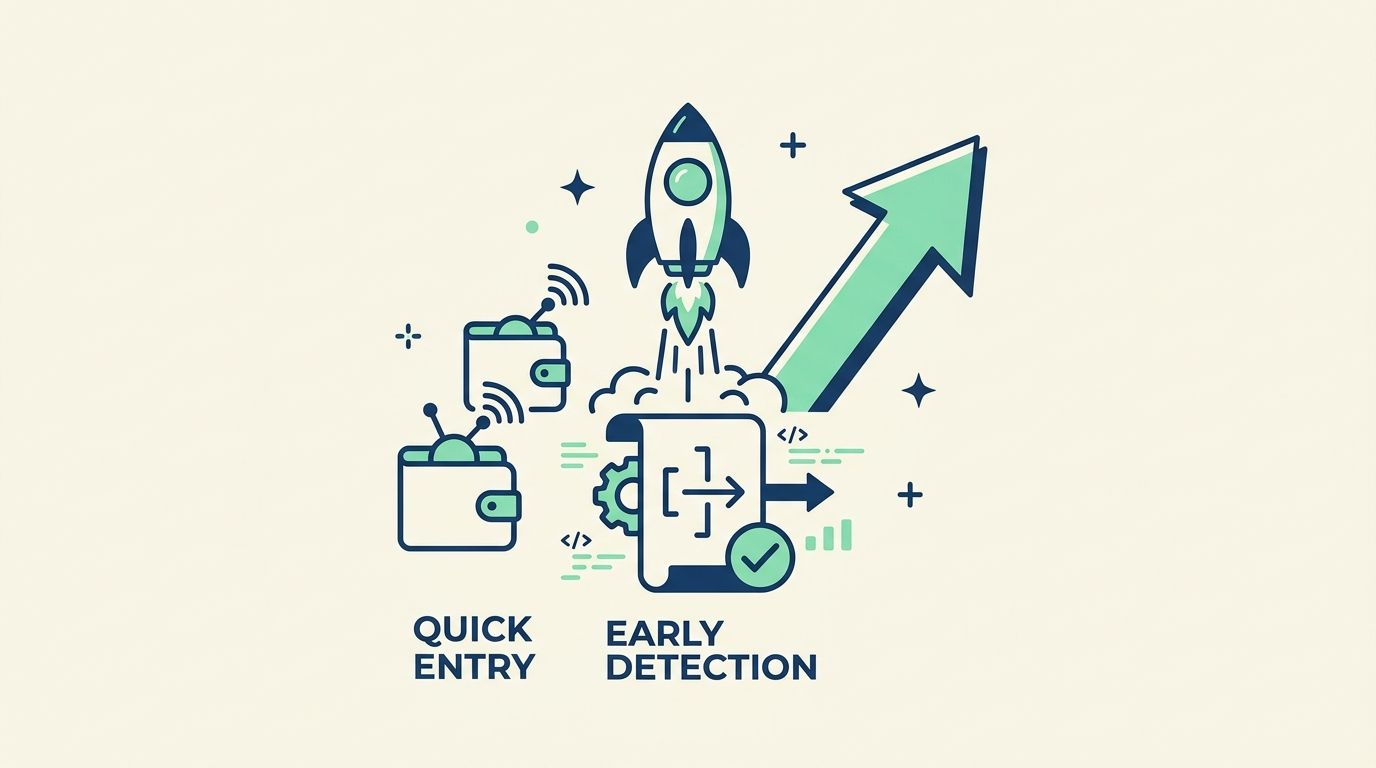
A practical starting point is to track wallets that have a history of entering new tokens early without constantly farming every launch. You want selective buyers, not wallets that spray capital across every new pair. The best signal is often repeat participation from unrelated wallets entering the same token around the same phase of discovery.
Here's a visual summary before the detailed workflow:
Launch entry rules that keep you alive
Start with contract review. Check the token on Etherscan or the relevant chain explorer before you mirror anything. Then confirm that more than one tracked wallet entered and that their buys weren't just tiny test fills.
My default operating rules for launch copying are:
- Use reduced size: Treat every new launch as a low-confidence position until liquidity proves stable.
- Wait for confirmation: If only one wallet bought, tag it. If several unrelated wallets bought, that's stronger.
- Avoid forced chasing: If the token already ran hard before your fill, skip it.
- Use hard exits: New launches need predefined exits because they can unwind fast.
The biggest trap is assuming copied performance will match the lead trader. It often won't. Above the Green Line points out that beginner content rarely explains how copied results can diverge because of order delays, rejected orders, outages, spreads, commissions, and slippage. It also notes this problem is worse for fast strategies like scalping, where tiny timing differences can erase the edge, in its discussion of copy trading execution quality and slippage.
That's why I prefer launch wallets that buy and hold through the first discovery phase rather than hyperactive snipers.
A quick walkthrough can help if you want to see launch-copy mechanics in action:
Start tracking smart money today
Join thousands of traders using WalletFinder.ai to find profitable wallets and copy their trades.
Start Free Trial →.avif&w=3840&q=75)

