
Copy Trading for Beginners: Your On-Chain Starter Guide
New to crypto? Our guide to copy trading for beginners walks you through on-chain strategies, vetting wallets with Wallet Finder.ai, and managing risk.
As of Q1 2025, DeFi held about $156 billion in total value locked, according to DefiLlama. That matters because copy trading is shifting with the market. Beginners used to start on centralized exchanges, where trader rankings, execution, and custody all sat inside one app. More of that activity now starts on-chain, where anyone can inspect wallet behavior directly and decide what to mirror from their own wallet.
That shift changes the job.
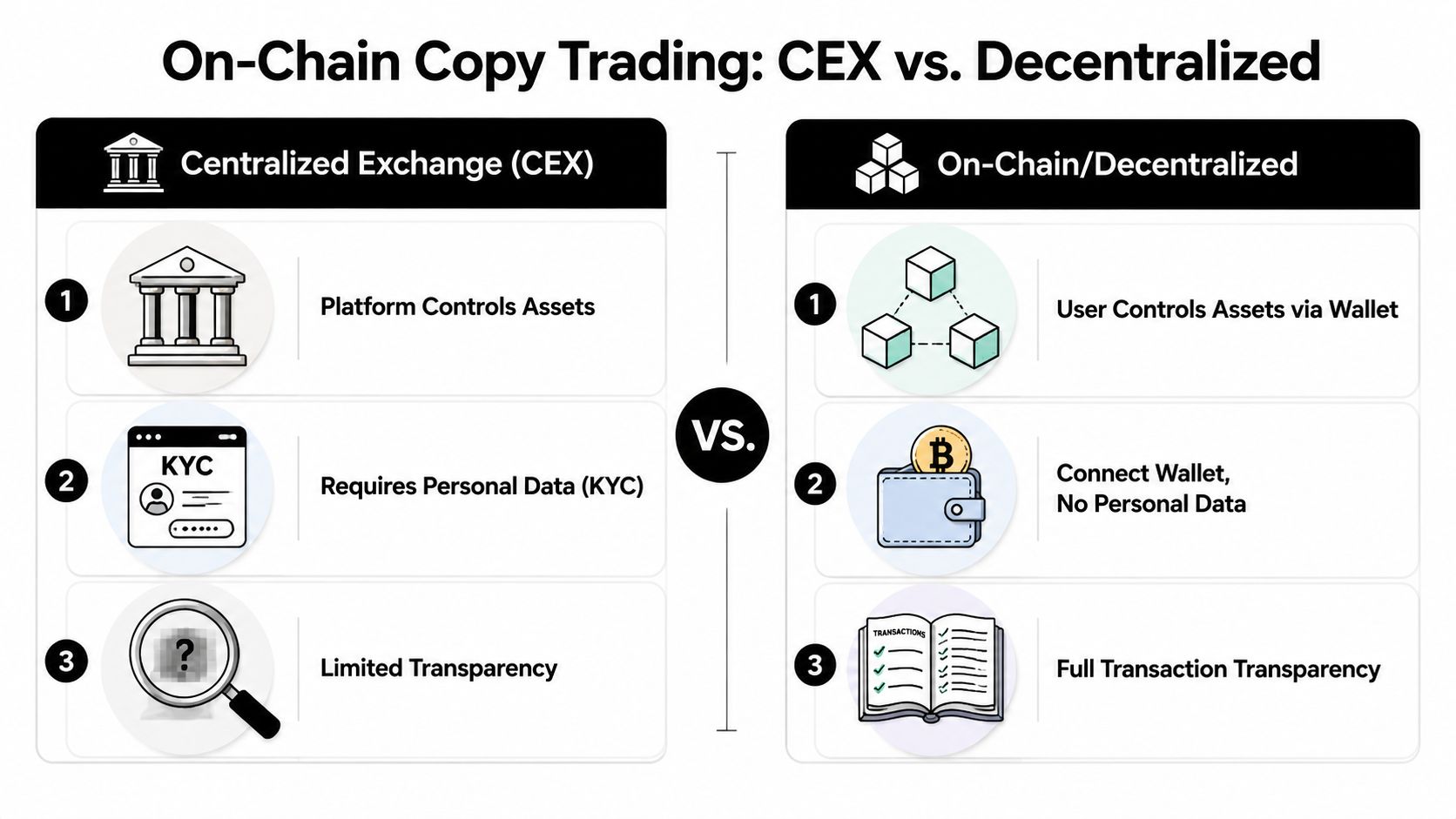
On a CEX, the platform does a lot of the work for you. On-chain, you handle wallet setup, approvals, execution, slippage, and gas. You also get a level of transparency centralized copy trading rarely gives you. You can study entries, exits, position sizing, and trading cadence before risking capital. If you want to get better at reading that behavior, Wallet Finder.ai's guide to on-chain wallet analysis and trader behavior is a useful place to start.
The upside is real, especially in fast-moving DeFi sectors like memecoins where good wallets often spot momentum before a CEX listing puts the trade on everyone's radar. The downside is just as real. Transactions are irreversible, fees can erase small edges, and copying a wallet without understanding its style usually ends with late entries and poor sizing.
Treat on-chain copy trading as a risk management exercise first. Wallet Finder.ai can help you find wallets worth tracking and act on them faster, but the beginner edge comes from filtering hard, sizing small, and accepting that you do not need to mirror every trade to make progress.
CEX Copy Trading vs On-Chain Wallet Mirroring — Which One Should a Beginner Start With
Most people searching for a copy trading beginner guide are not yet on-chain. They have a Coinbase or Binance account, they have heard that smarter traders are making money by following other traders, and they want to understand what that looks like before they decide how to participate. Starting with on-chain wallet mirroring is not always the right first step — and understanding why helps you make a better decision about where to begin.
Centralized exchange copy trading is the version that most beginners encounter first. Platforms like Bitget, eToro, and Bybit each run their own social or copy trading features where top performers are ranked, their statistics are displayed, and a beginner can allocate capital to mirror a selected trader with a single tap. The platform handles custody, execution, and proportional scaling — when the followed trader opens a position sized at 10% of their account, your account opens a proportionally equivalent position. The beginner's job is wallet funding, trader selection, and setting a stop-loss on the copy allocation itself in case the trader underperforms.
The core advantages for an absolute beginner are real: no wallet setup, no gas management, no slippage decisions, no token approval risk, and no irreversible transaction mistakes. The entry cost on most platforms starts at $10 to $50 for a minimum copy allocation. Execution is automatic. For someone who has never traded before and wants to understand how another trader's strategy performs in live conditions, CEX copy trading provides that experience with significantly less operational complexity than on-chain mirroring.
Where CEX copy trading falls short and why on-chain is different
The limitations become visible once you understand what CEX copy trading hides. The trader statistics displayed are curated by the platform — usually showing the timeframe and metrics that make the trader look attractive rather than a complete picture of risk. Drawdowns may be underemphasized. The trader's full history may be shorter than the headline suggests. And because execution is automated and custody sits inside the exchange, you never develop the habit of reading a trade directly, questioning whether it still makes sense at your fill price, or sizing based on pool depth rather than a fixed percentage.
On-chain wallet mirroring solves the transparency problem. Every trade the wallet has ever made is permanently visible, verifiable, and timestamped on the blockchain. There is no platform curation. A wallet with a 78% win rate across 200 trades in multiple market conditions is a meaningfully different claim than a leaderboard showing a 3-month return during a bull phase. The trade-off is operational complexity — you handle your own wallet, approve transactions, manage gas, and make real-time execution decisions that CEX copy trading makes invisible.
For an absolute beginner with no on-chain experience, the practical path is often to start with a small CEX copy allocation to understand the basic experience, run it alongside learning wallet analysis skills, and transition to on-chain mirroring once the mechanics are familiar. The two approaches are not mutually exclusive, and starting with one does not prevent you from building toward the other. The on-chain analysis guide covers the wallet reading skills that make the transition from CEX copy trading to on-chain mirroring a logical progression rather than a disorienting jump.
What Is On-Chain Copy Trading
Roughly speaking, copy trading used to mean picking a ranked trader inside a centralized exchange and letting the platform handle the rest. On-chain copy trading changes that model. You mirror the actions of public wallets from your own wallet, with every entry, exit, size change, and transfer visible on the blockchain.
That shift matters because the source of truth changes. On a CEX, you mostly see a profile, a return chart, and whatever the platform chooses to show. On-chain, you can inspect actual behavior. You can see whether a wallet buys early, scales in, takes partial profits, rotates fast between pairs, or apes into every trending token. For a beginner, that transparency is the primary advantage.
Start tracking smart money today
Join thousands of traders using WalletFinder.ai to find profitable wallets and copy their trades.
Start Free Trial →.avif&w=3840&q=75)

