
Coin Market Cap ADA Explained for Traders
Decode the Coin Market Cap ADA page. Learn what ADA's market cap means, how to read the data, and combine it with on-chain wallet tracking for smarter trades.
You open CoinMarketCap, type in ADA, and see a market cap in the billions. The number looks important. It is important. But if you're trying to trade, that single figure rarely answers the actual question.
The main question is usually this: what is the market doing around ADA right now, and who is driving it?
That’s where many traders stall. They can read the public dashboard, but they can’t turn public data into a usable edge. They see price, rank, supply, and volume. They still don’t know whether ADA is attracting conviction, drifting on momentum, or sitting at a level where larger players might be active.
A strong coin market cap ada workflow starts with the basics, then moves into interpretation. Public market data gives you the broad map. On-chain analysis helps you look for footprints inside that map.
Beyond the Big Number What ADA's Market Cap Really Means
Open ADA on CoinMarketCap and the first figure pulling your eye is usually market cap. That is normal. It is the headline number, the one that signals size, rank, and broad market relevance in a single glance.
For traders, though, market cap works more like a map than a trade trigger. It shows the territory. It does not show which wallets are entering, which holders are selling into strength, or whether a price move is being pushed by broad participation or a few large players.
That is the key distinction with coin market cap ada analysis. Market cap is a valuation snapshot built from price and circulating supply. Useful, yes. Actionable on its own, rarely.
ADA has gone through strong expansions and painful reversals before. A large market cap can make an asset look stable, even when positioning underneath that number is changing fast. That is why experienced traders treat CoinMarketCap as the starting screen, then look deeper for order flow clues and wallet behavior.
A simple analogy helps. Market cap is the size of the stadium. It does not tell you who just walked onto the field, who is heading for the exit, or which side controls the pace of the game.
What market cap helps you answer
Market cap is useful for framing the bigger picture:
- How large ADA is relative to other crypto assets
- Whether ADA still sits in the top tier of the market
- How current valuation compares with earlier cycle extremes
- How much headline attention ADA is likely to attract from funds, exchanges, and retail traders
Where market cap falls short for active trading
Short-term decisions need more than a large headline figure:
- It does not identify which wallets are buying or selling
- It cannot separate real demand from rotational volume
- It does not explain whether support is being defended by size
- It will not show accumulation patterns before the crowd notices them
That gap is where many traders lose their edge. They stop at public data. Smarter operators use public data as the first layer, then confirm it with on-chain tools that track wallet behavior. Wallet Finder.ai is useful here because it helps connect the broad CoinMarketCap picture with the addresses that may be driving the move.
If you want a cleaner framework for how price and supply combine into valuation, this guide on how to calculate coin value gives the math in plain English without turning it into theory for theory's sake.
Deconstructing ADA's Core Metrics on CoinMarketCap
A trader pulls up ADA on CoinMarketCap, sees the price ticking, notices the market cap, and assumes the job is done. It is not. The useful read starts when you connect those surface numbers to the mechanics underneath them, then ask which wallets may be acting on that setup before the crowd does.
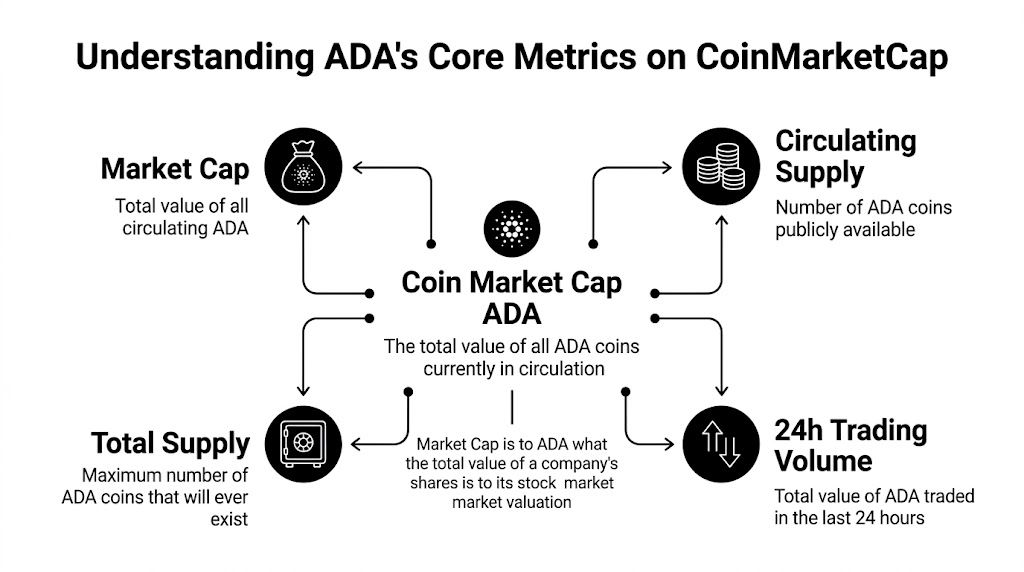
CoinMarketCap gives you the public scoreboard for ADA. Price shows where the token changes hands right now. Supply figures show how many units the market is valuing. Volume shows how active that market has been. Together, those numbers form the base layer of analysis.
The mistake many traders make is stopping at the headline.
For ADA, supply context matters more than it does for many newer tokens because Cardano has a known maximum supply. That gives you a cleaner way to judge valuation pressure. If price rises while the supply picture stays stable, the move is mostly demand-driven. If traders start discussing valuation without checking supply, they are reading only half the page.
What belongs in your first pass
Start with four fields on the ADA page:
- Price
- Market cap
- Circulating supply
- Volume
That order matters. Price gets attention, but market cap tells you how much value the market is assigning to the circulating ADA base. Circulating supply tells you what that valuation is built on. Volume helps you judge whether the move has real participation behind it or is drifting on thin activity.
A simple analogy helps here. Price is the price tag on one unit. Market cap is the price of the whole shelf that is already available for sale. Volume shows how much of that shelf traders touched today.
Why this matters for active traders
These metrics are not just labels. They shape trade selection.
If ADA is rising but volume is weak, the move may lack conviction. If ADA is flat while volume expands, larger positioning may be building under the surface. If market cap holds steady relative to peers while wallet activity shifts on-chain, that is often where the more interesting signal appears.
That is the jump from public data to smart-money tracking.
CoinMarketCap helps you identify the setup. On-chain tools such as Wallet Finder.ai help you test whether large wallets are accumulating, distributing, or rotating between addresses. Public metrics show the stage. Wallet behavior shows who may be directing the play.
A cleaner way to use the ADA page
Use this quick filter before you make any judgment:
- Check price in context. A move means little by itself.
- Check market cap relative to the move. Is valuation expanding in a meaningful way?
- Check circulating supply. Make sure your valuation read is based on the right supply base.
- Check volume. Ask whether participation confirms the move.
That process keeps you from treating CoinMarketCap like a definitions page. For traders, it works better as a screening tool. Once the screen identifies an unusual shift in ADA, the next question is the one public dashboards cannot answer on their own: which wallets are behind it?
Reading the Full Story Key Data Points on the ADA Page
You open the ADA page after a sharp price move. At first glance, the screen looks clear enough. Green candles, a large valuation, active trading. Then the harder question shows up. Is this broad market interest, or a move driven by a smaller set of aggressive participants?
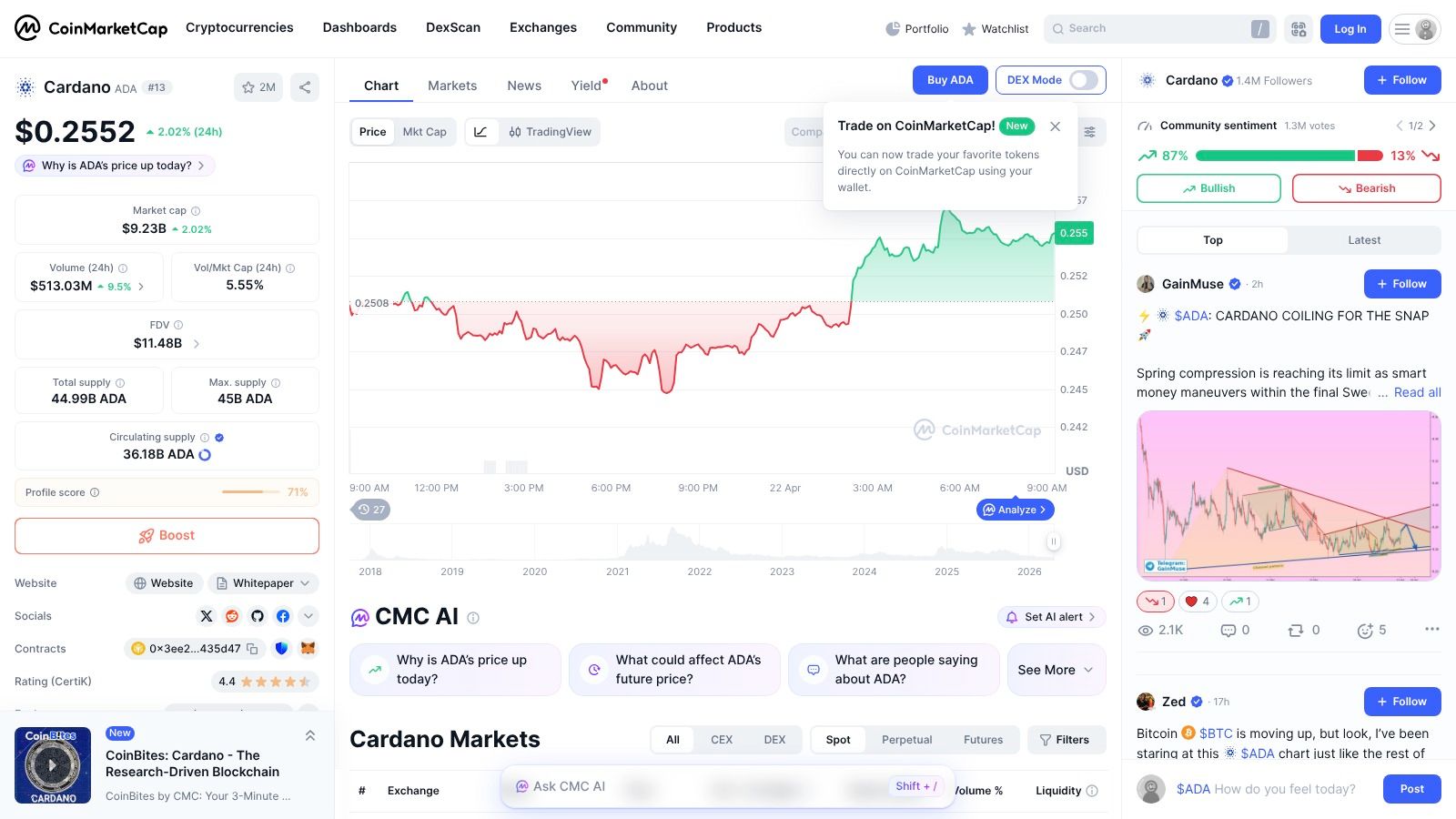
That is why the ADA page matters. CoinMarketCap gives the public scoreboard. Traders still need to read the pace of the game.
The metrics that deserve your attention
The most useful fields here are not the ones that define ADA. They are the ones that show whether current trading activity supports the move you are seeing.
| Metric | Why It Matters | What to Watch For |
|---|---|---|
| 24h Trading Volume | Shows how much capital actually changed hands in the last day | A price move with rising volume usually carries more conviction than a move on thin activity |
| Volume / Market Cap | Compares current trading activity with ADA’s overall size | A higher ratio can signal unusual participation, while a lower ratio can point to a quieter session |
| Total Supply | Adds long-range supply context beyond the tokens already circulating | Useful when traders want to frame valuation discussions more carefully |
| Rank | Places ADA against the rest of the crypto market | Helps you judge whether ADA is holding leadership status or slipping relative to peers |
Start tracking smart money today
Join thousands of traders using WalletFinder.ai to find profitable wallets and copy their trades.
Start Free Trial →

