
Bubble Netting Whales: From Ocean to On-Chain Signals
Learn about bubble netting whales and how this hunting strategy mirrors on-chain crypto whale behavior. Find actionable signals to improve your trading.
A humpback circles below a bait ball, releases a rising wall of bubbles, and then surges straight through the opening it created. Traders see a version of that pattern on-chain all the time. They just usually notice it after the move.
What Whales Can Teach Us About Crypto
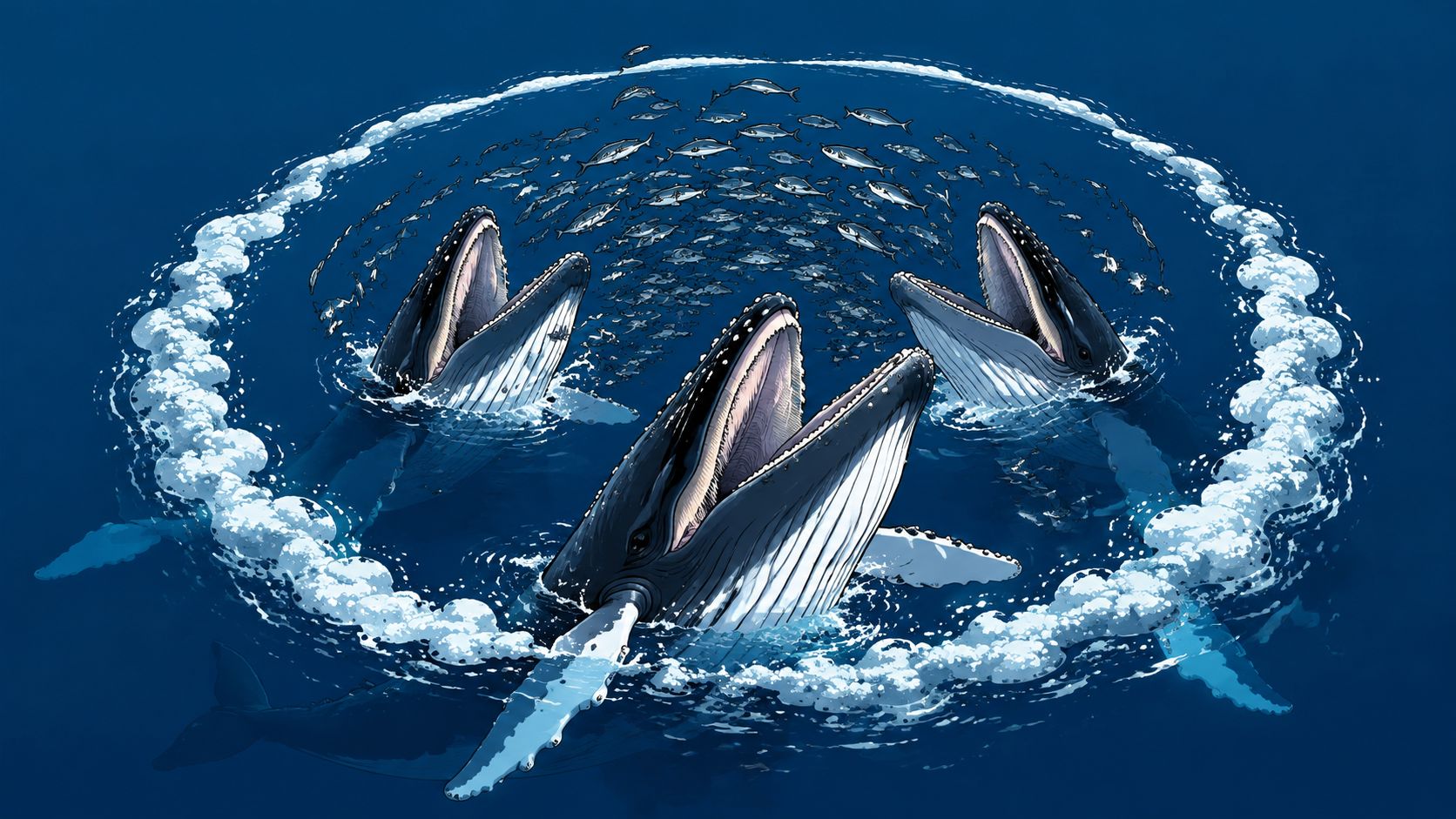
In the ocean, bubble netting whales don't chase every fish one by one. They shape the environment first. They confine prey, control direction, reduce escape routes, and only then make the decisive feeding move. That sequence matters more than the final lunge.
On-chain, strong wallets often behave the same way. They rarely announce intent with one obvious buy. They build conditions. A few wallets accumulate discretely. Liquidity gets framed. Attention starts to rise. Then the visible move arrives, and late traders mistake the climax for the beginning.
That mistake is expensive.
Most retail traders still trade the surface. They watch candles, trending posts, and volume spikes. But coordinated activity usually leaves traces before price fully reacts. When you study the market like a field observer studies whale behavior, you stop asking, "Why did this pump?" and start asking, "What contained liquidity before the pump?"
The useful part of the metaphor
The whale analogy works because it isn't just poetic. It's operational.
- The pod becomes a cluster of wallets that act in a related sequence.
- The bubble ring becomes controlled accumulation and liquidity shaping.
- The trapped prey becomes reactive order flow from late participants.
- The lunge becomes the explosive repricing phase, or the exit into demand.
Practical rule: Don't anchor on the final candle. Track the structure that made the candle possible.
A lot of traders want a single wallet to follow. In practice, the better edge often comes from identifying a pattern of coordination. One wallet can be noise. A group of wallets funding, buying, rotating, and sizing in similar ways starts to look like intent.
That's where the nature model helps. Whale behavior looks chaotic from the surface. Underwater, it's structured. Crypto feels the same until you start reading wallet relationships instead of isolated transactions.
Inside a Humpback Whale's Perfect Hunt
Bubble-net feeding is one of the clearest examples of a learned hunting system in the wild. Research reported by the University of St Andrews in January 2026 found that the recovery of humpback whales in the northeastern Pacific depended not only on population growth, but also on the spread of this culturally learned feeding behavior through social networks, with immigrant whales helping introduce the technique into the recovering Canadian Pacific population, according to the University of St Andrews report on bubble-net knowledge spread.
That point is easy to miss. This isn't just an animal doing a clever trick. It's a socially transmitted method with population-level consequences. In plain terms, the whales that know the technique don't just eat differently. They change what the whole group can do over time.
How the hunt actually works
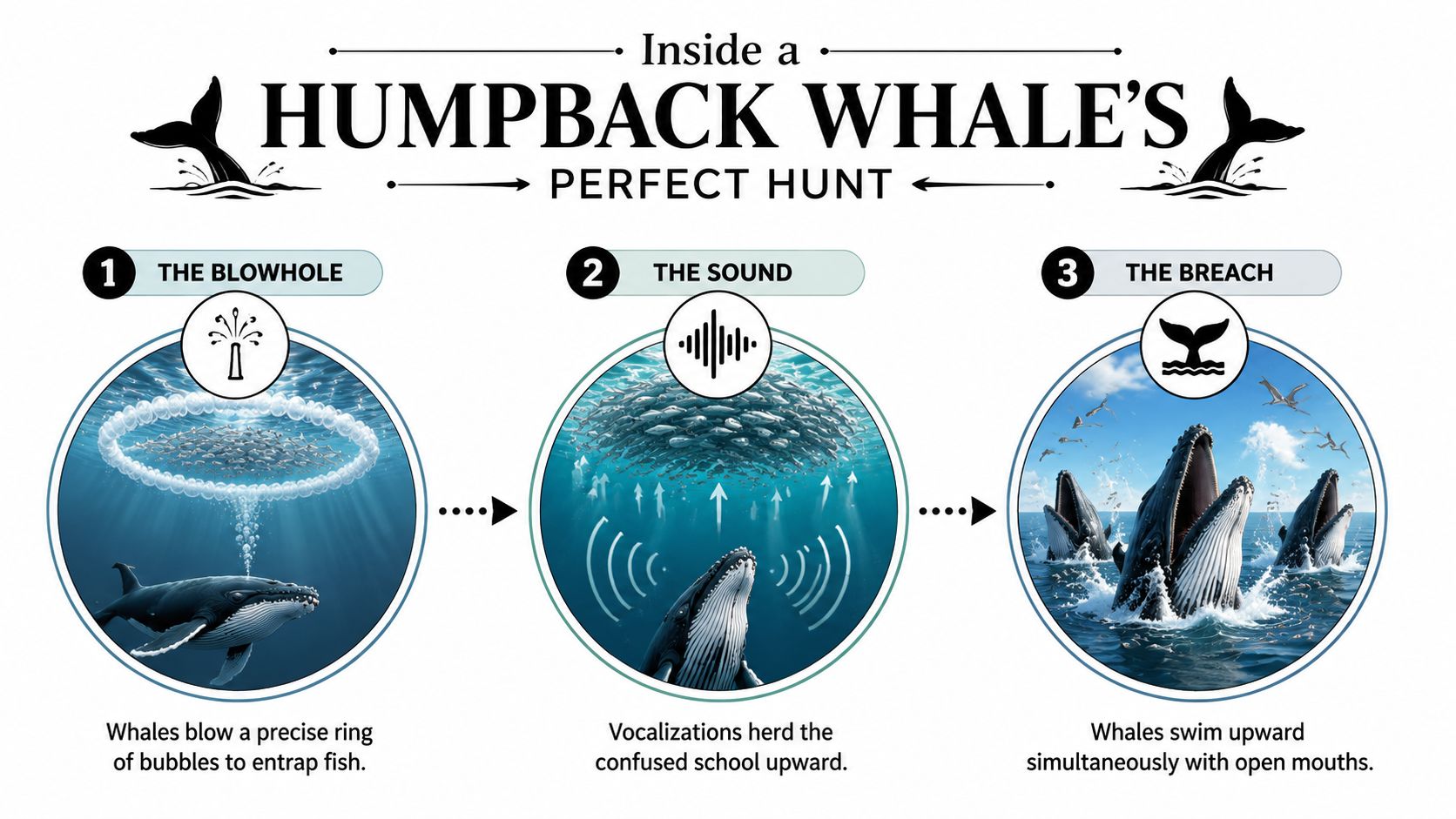
A bubble-net feed isn't random froth on the water. The sequence is deliberate.
Positioning below prey
The whale, or group, gets under a school of fish and starts setting the geometry of the trap.Bubble release and containment
Bubbles rise in a structured ring or spiral. Recent underwater imaging showed solitary humpbacks creating structured bubble-nets with internally tangential rings and tuning the number of rings, net depth, and bubble spacing to shape prey capture geometry, as described in the PMC study on solitary humpback bubble-net structure.The upward lunge
Once the prey is compacted and disoriented, the whale drives upward through the concentrated patch with its mouth open.
The public version of this behavior is dramatic. The useful version is mechanical. The whales don't win because they move harder. They win because they shape the target first.
Why humpbacks can do it
Not every baleen whale can execute this maneuver. A University of Hawaiʻi study reported in 2025 found that among seven baleen whale species, only the humpback whale was capable of the high-performance turns required for bubble-net feeding, with humpbacks using their large pectoral flippers to generate nearly half of the force needed to turn, according to the University of Hawaiʻi report on humpback turning performance.
That specialization matters for traders because it maps cleanly to market structure. A strategy can look simple after the fact, but the edge often depends on capabilities most participants don't have. In whales, that's maneuverability. In crypto, it's visibility into coordinated wallet behavior before the crowd notices.
A related field summary notes that humpbacks were observed making tight, high-speed turns with outer and inner bubble rings averaging about 15.7 m and 9.9 m, with the tightest turn at 6.5 m, and older dive work identified an approximate 20 m depth limit for effective bubble-net use, based on the Whale Scientists summary of bubble-net biomechanics. Good setups have physical constraints. Market setups do too.
Efficiency, not spectacle
The hunt works because it increases density at the point of attack. That's the whole game.
If you want more context on how whales are categorized and why humpbacks stand out physically, this overview of the largest whales in order is a useful companion read.
Here's footage worth watching before applying the metaphor to markets.
Start tracking smart money today
Join thousands of traders using WalletFinder.ai to find profitable wallets and copy their trades.
Start Free Trial →

