
10 Best Free Analytics Tools for 2026
Discover the 10 best free analytics tools for crypto and DeFi. Our 2026 guide covers on-chain data, market metrics, and how to use them for smarter trading.
Turn On-Chain Noise Into Actionable Signals
In crypto, the edge usually isn't missing. It's fragmented. One signal sits in a DEX feed, another in wallet flows, another in protocol fundamentals, and by the time you've stitched them together manually, the trade is gone.
That's why most traders end up with a messy stack of tabs, screenshots, and half-finished spreadsheets. You can find good free tools, but using them well is the hard part. Some are great for macro context. Some are great for raw chain data. Some are great for watching wallets move in real time. Very few do all three.
The best free analytics setup isn't one tool. It's a small stack where each tool has a clear job. That matters even more now because analytics has moved beyond simple traffic counting into privacy-first measurement and behavior-level insight, as noted in SiteBehaviour's 2024 overview of free web analytics tools. In practice, crypto researchers need the same mindset. Separate broad monitoring, behavioral observation, and decision-ready analysis.
This list gets straight to the tools. Each one solves a different problem in a wallet discovery and copy-trading workflow, and each one pairs well with Wallet Finder.ai when you want to turn raw on-chain data into trades you can act on.
1. Dune
Dune is where a lot of serious on-chain research starts. If you like proving a thesis with data instead of vibes, this is the free tool that gives you the most room to think. It works best when you already know what you're trying to test, such as which wallets accumulated before a token moved, which protocols are pulling users, or how activity changed across chains.
The biggest strength is speed to insight. You can use community dashboards first, then move into your own SQL when the public dashboards stop answering the exact question you care about.
Why Dune earns a place in the stack
- Best use case: Community dashboards, custom SQL, and repeatable wallet research.
- What works well: Fast prototyping, sharing dashboards with a team, and turning messy questions into saved queries.
- Where it breaks: Long, heavy queries can eat through free usage quickly, and free-tier limits force discipline.
If you're comparing data tools for crypto research, this Wallet Finder.ai breakdown of Nansen vs Dune vs DeBank is a useful read because it frames Dune in the context of actual trading workflows instead of generic feature lists.
Practical rule: Use Dune for hypothesis testing, not for constant monitoring. Build the logic there, then move recurring wallet alerts into Wallet Finder.ai.
For copy traders, Dune is strongest before the trade. Use it to identify patterns. Which wallet cohorts buy early. Which contracts attract repeat winners. Which chains are seeing unusual user migration. Then use Wallet Finder.ai to operationalize that research by tracking the wallets you uncover.
Dune is less useful when you need instant action. It's an analysis bench, not your fastest execution radar.
Use Dune when you want a free analytics tool that rewards curiosity and SQL fluency.
2. DeFiLlama
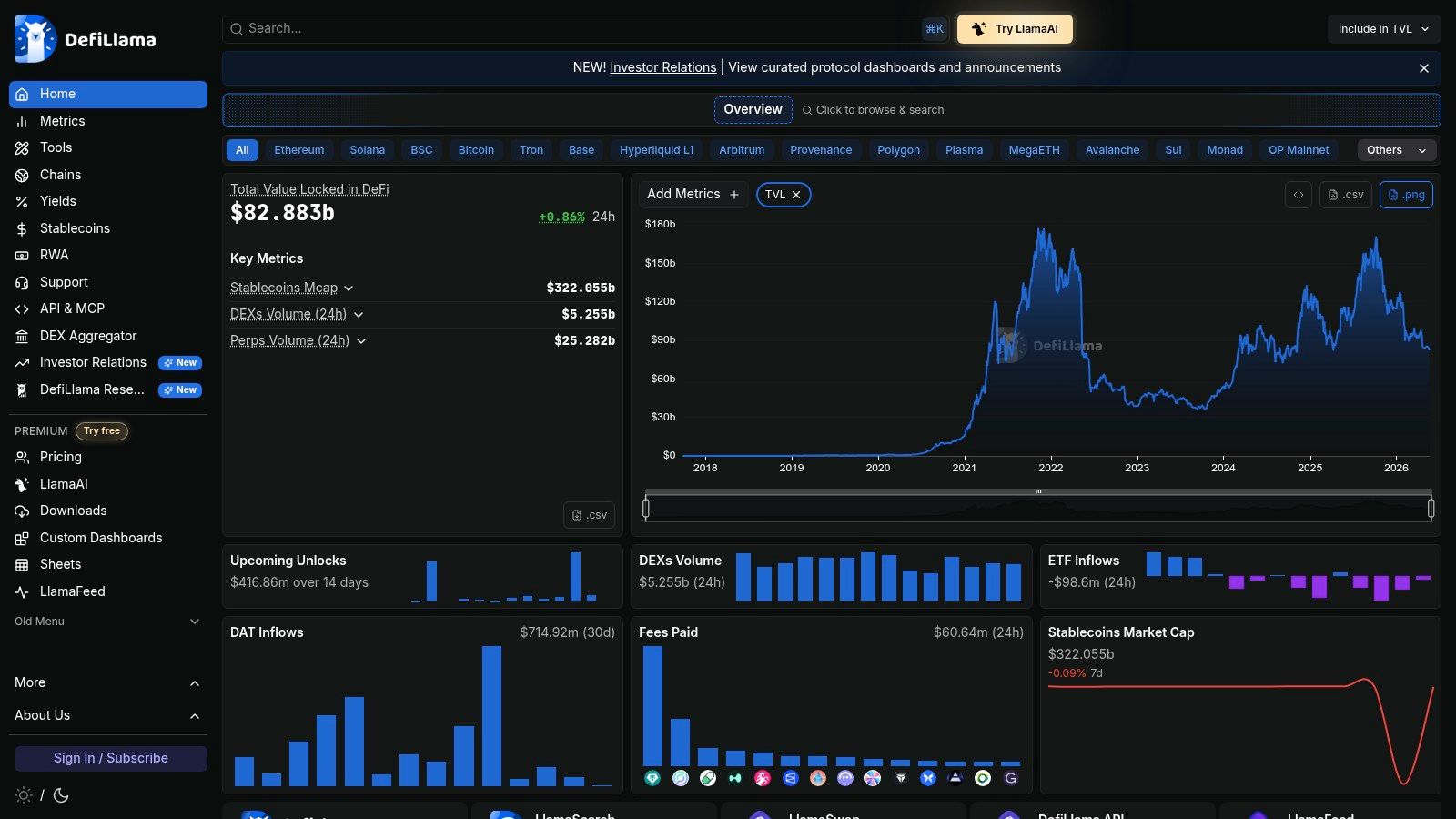
If Dune is your lab, DeFiLlama is your market map. It's one of the fastest ways to understand where money and attention are moving across DeFi without writing a query or cleaning a dataset first.
That matters when you're scanning sectors, not individual wallets. Before you go hunting for traders to follow, you need to know where the opportunity is likely to emerge. DeFiLlama helps narrow that field fast.
Here is the typical dashboard view:
Start tracking smart money today
Join thousands of traders using WalletFinder.ai to find profitable wallets and copy their trades.
Start Free Trial →

