
Backtesting Framework A Guide for Crypto Traders
Build a backtesting framework that works for DeFi. Learn core components, on-chain challenges like gas and MEV, and how to test strategies before you trade.
You've probably done this already. You find a wallet with a ridiculous run on a new token, inspect the trade history, and think the edge is obvious. Copy the buys, copy the sells, size the positions conservatively, and let the wallet do the hard part.
That's how a lot of DeFi traders end up backtesting far too late, usually after the live results don't resemble the wallet history at all.
A real backtesting framework is what separates “this wallet made money” from “this strategy is reproducible under my conditions.” In DeFi, that distinction matters more than in most markets because your outcome depends on execution details that price-only testing ignores. Gas changes the entry. Latency changes the fill. Liquidity changes the slippage. MEV changes whether the trade was even copyable in the first place.
If you're building systems around wallet mirroring, smart money tracking, or token rotation, your framework can't be a spreadsheet with a few historical candles and optimistic assumptions. It has to behave like a trading engine and it has to be skeptical by default.
Why Most Winning Strategies Secretly Fail
Block 18,542,901 looks perfect in hindsight. A wallet buys into a fresh pool before the chart goes vertical, trims into strength, and closes the position before liquidity disappears. The trade history looks clean. The copy trade usually does not.
What failed was not the idea. It was the assumption that the observed trade was reproducible. On-chain strategies break at the point where research meets execution. The entry price in the wallet history may have depended on lower gas, less competition in the mempool, faster routing, or a pool depth that vanished once others noticed the move. A backtest that ignores those constraints turns a hard trade into an easy one.
The fill you recorded is not the fill you would have received
Wallet histories are seductive because they compress a messy process into a single line item. Buy here. Sell there. Profit. That format hides the mechanics that decide whether you could have taken the same trade under your own conditions.
In DeFi, those mechanics are often the strategy.
A profitable wallet might be trading sizes that fit inside thin liquidity better than yours. It might be using private order flow that reduces MEV exposure. It might react within seconds to a contract event that your pipeline only sees after indexing lag. If your framework replays the transaction at the printed swap price, it is grading the strategy on terms you never had access to.
This gets harsher in memecoins, micro-cap pools, and newly launched pairs. One buy shifts the curve. One failed transaction burns gas and leaves you chasing a worse entry. One sandwich attack can convert an attractive setup into a trade you would have rejected if the backtest had modeled execution realistically.
Historical PnL often bundles edge with luck, access, and artifacts
A winning wallet can reflect skill. It can also reflect conditions you cannot repeat. Early allocations, favorable block placement, one extreme outlier winner, survivorship bias in the wallet sample, or incomplete data around failed transactions can all make a strategy look cleaner than it was.
Data quality is part of the problem, not an implementation detail. Missing swaps, inconsistent timestamps across indexers, token metadata errors, and silent gaps in pool history can change the result enough to approve a strategy that should have been discarded. Good research starts with filtered, replayable on-chain datasets for scalable backtesting, not a raw export and a few optimistic joins.
A useful test is simple. Remove the assumptions that flatter the result and see what survives.
- Later detection: Your system sees the wallet after the first move, not before it.
- Worse execution: You pay higher gas, accept more slippage, or miss the trade during congestion.
- Liquidity limits: Your position size is capped by pool depth, not by portfolio preference.
- MEV and failed transactions: Some opportunities are degraded or lost before confirmation.
- Longer history: The edge has to hold outside one hot regime or one lucky streak.
A professional backtest answers a narrower, harder question
The question is not whether a wallet made money.
The question is whether your system, with your latency, capital, chain coverage, and execution path, could have captured enough of that edge after costs and frictions. That is a much stricter standard, and it should be. Many DeFi traders only start asking it after live copy trading underperforms the backtest.
A professional backtesting framework exists to reject strategies that only work on screenshots. If it handles gas, slippage, liquidity decay, ordering, failed transactions, and MEV exposure with enough realism, fewer strategies will pass. That is a feature, not a bug.
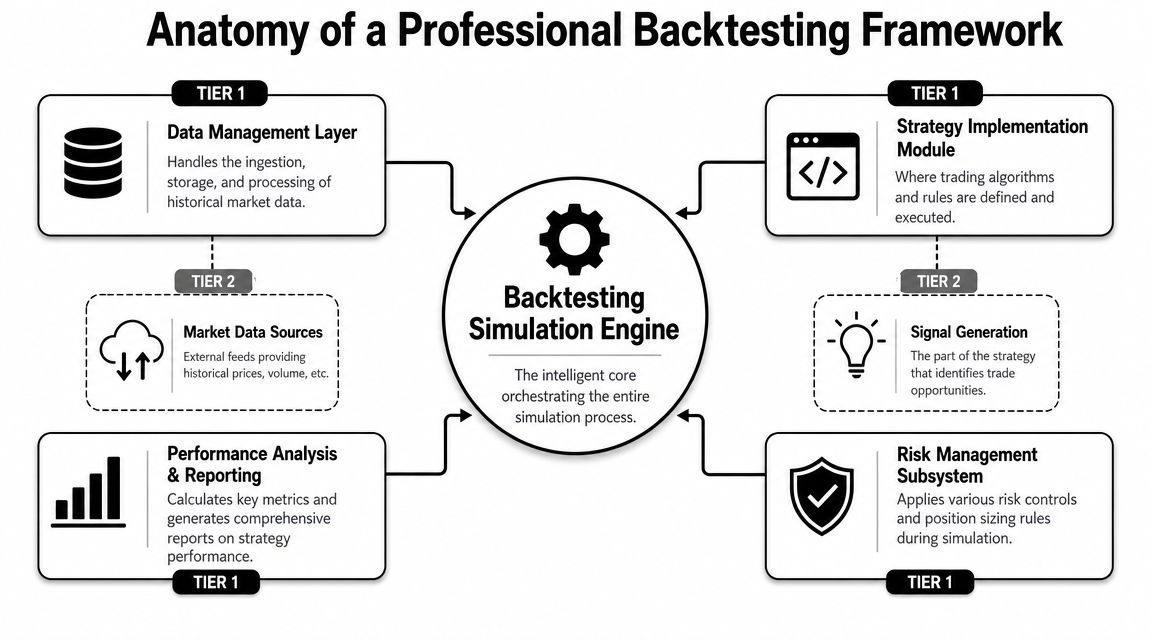
Anatomy of a Professional Backtesting Framework
At 2:07 p.m., a target wallet buys into a thin pool on Base. Your system catches the swap a few seconds later, routes a copy order, and gets a worse fill after gas spikes. The wallet's trade still looks brilliant in hindsight. Your copy does not. A professional backtesting framework has to model that gap, because that gap is where paper alpha disappears.
Start tracking smart money today
Join thousands of traders using WalletFinder.ai to find profitable wallets and copy their trades.
Start Free Trial →
