
Secure AWS Cognito Authentication for DeFi 2026
Master AWS Cognito authentication for DeFi & trading apps. Plan, configure, handle JWTs, and harden security with code examples. Your 2026 guide.
You're probably in the same spot most DeFi teams hit once the product starts feeling real. The trading logic is moving, the frontend works, users are coming in, and suddenly authentication stops being a boring setup task and becomes part of your threat model.
That shift matters more in DeFi than in most SaaS products. A weak login flow doesn't just expose profile data. It can expose portfolio views, trading signals, API actions, withdrawal workflows, and support pathways that attackers use to take over accounts. If your app influences user funds or reveals sensitive trading behavior, your authentication layer has to hold up under abuse, not just demos.
AWS Cognito is a practical choice for that job. AWS says Cognito processes more than 100 billion authentications per month and supports both human users and machine identities such as services and AI agents, which is a useful signal that the platform is built for serious scale, not hobby traffic (Amazon Cognito product page). The value isn't just scale. It's that you can use a managed identity layer for sign-in, access control, and token issuance instead of building account infrastructure from scratch.
Securing Your DeFi App with AWS Cognito
If you're building a trading product, a wallet analytics dashboard, or anything adjacent to copy trading, auth decisions show up everywhere. They shape onboarding friction, session length, account recovery, support load, and how easily an attacker can move from a compromised browser session to API abuse. Teams exploring DeFi app development patterns usually spend a lot of time on contracts and indexing, but authentication deserves the same engineering discipline.
The good news is that Cognito gives you the raw pieces you need. AWS positions it as a managed service that can implement secure sign-in and access control in minutes (Amazon Cognito product page). The bad news is that production-grade AWS Cognito authentication still requires strong decisions around architecture, token handling, backend verification, and recovery flows.
Practical rule: In a DeFi app, treat authentication as part of funds protection, even if Cognito never touches a private key.
What works is straightforward:
- Use Cognito for identity, not as a substitute for authorization. Authentication proves who the user is. Your backend still decides what they can do.
- Keep token handling server-aware. The browser is a hostile environment. Build around that assumption.
- Design for failure paths early. Device loss, MFA fallback, lockouts, and support escalation matter as much as login success.
- Automate your configuration. Click-ops drift. Infrastructure as code doesn't.
What doesn't work is the common shortcut stack. Long-lived sessions with weak refresh-token controls. Frontend-only token checks. User attributes treated as trusted business logic. Recovery handled later. Those decisions usually survive until the first incident.
Cognito Authentication Architecture Planning
The first architectural mistake usually happens before the first login screen exists. Teams treat Cognito like one thing. It isn't. It gives you two distinct layers, and mixing them up creates security gaps.
Know the split
User Pools handle sign-up and sign-in. They are your user directory.
Identity Pools handle temporary AWS credentials. They are how an authenticated identity can access AWS resources under controlled permissions.
That split sounds clean on paper. In real systems, it creates one of the biggest tripwires in AWS Cognito authentication. AWS documentation separates these concerns, but there's no native mapping between user-pool identities and identity-pool identities, so teams often have to build and maintain the linkage themselves (AWS Cognito scenarios documentation).
That gap matters in a trading app. If your backend trusts a loose relationship between app identity and AWS identity, misconfigurations can become authorization bugs. In the worst cases, weak checks let attackers abuse sign-up flows or manipulate user-related state after getting a valid JWT.
Cognito User Pools vs. Identity Pools
CriterionUser PoolsIdentity PoolsPrimary roleUser registration and authenticationTemporary AWS credential deliveryMain outputApplication tokens after sign-inAWS credentials for AWS resource accessBest fitLogin, session establishment, account managementControlled access to AWS servicesTypical DeFi useTrader logs into web or mobile appApp gets scoped AWS access for user-specific resourcesSecurity focusAuthentication flow, MFA, token claimsIAM scoping, resource authorizationCommon mistakeTreating pool claims as full authorization logicAssuming identity linkage is automatic
A practical decision rule
Use User Pools if your main need is application authentication.
Add Identity Pools only if users must access AWS resources through temporary AWS credentials.
That means many DeFi products can stay simpler than they think. If your backend proxies data access, signs requests, and mediates sensitive operations, User Pools may be enough. If your architecture requires direct client interaction with AWS resources, Identity Pools become relevant, but the identity-linking problem becomes your problem too.
Don't let Cognito's service boundaries become your security blind spot. The dangerous bugs usually live in the glue code between authentication and authorization.
What I'd choose for a trading app
For most high-stakes trading products:
- Authenticate with User Pools
- Authorize in your backend
- Avoid direct AWS credential exposure unless there's a clear need
- Model user-to-resource relationships in your own application layer
That design is easier to audit. It also reduces the chance that an attacker can turn a valid login into excessive infrastructure access through a bad IAM mapping.
Wallet Signature Authentication as a Custom Challenge Flow
Everything covered so far assumes a conventional email or password identity. For a DeFi product specifically, there's a more native pattern worth considering: authenticating users by having them sign a message with their crypto wallet instead of, or alongside, a traditional credential.
Cognito supports this through its custom authentication flow using Lambda triggers. The pattern works roughly like this: your backend generates a one-time challenge message, the user signs that message with their wallet's private key, and a Lambda function verifies the signature against the claimed wallet address before issuing Cognito tokens. AWS has published reference architecture for exactly this pattern, using a custom challenge to let a user prove wallet ownership and receive temporary AWS credentials in return, without ever transmitting a private key anywhere.
The advantage for a trading or wallet-analytics product is directness. A user who already has a wallet connected doesn't need a separate password to remember or a separate account recovery flow to design, since wallet ownership itself becomes the credential. The trade-off is that this pattern shifts some complexity into your Lambda challenge logic rather than Cognito's built-in flows, and it doesn't replace the need for session and token handling discipline covered elsewhere in this guide, tokens issued after a successful wallet signature still need the same backend verification, storage, and expiry treatment as tokens issued after any other sign-in method.
When wallet-based auth makes sense versus traditional sign-in
Wallet signature authentication fits best when your product's core identity is already tied to an on-chain address, such as a portfolio dashboard or a copy-trading tool where the wallet address is the primary object of interest anyway. It fits less well as the only option for products that also need conventional account features like email-based notifications, subscription billing, or recovery flows that don't assume the user still controls the original wallet, since losing wallet access with no fallback credential can mean losing the account entirely. Many production DeFi apps end up supporting both paths, treating wallet signature as the fast lane for connected users and a conventional credential as a fallback or complement rather than a full replacement.
Creating and Configuring Your User Pool
A secure user pool starts with choosing what you'll allow, not enabling every option Cognito exposes. Financial apps need tighter defaults than internal tools.
AWS documents Cognito user pools as regional user directories that issue ID, access, and refresh tokens after successful authentication. AWS also notes that the default refresh-token lifetime is 30 days, and it can be configured from 60 minutes to 10 years depending on your needs (AWS Security Blog on Cognito user pools).
Settings that deserve real attention
Start with the sign-in experience. Cognito supports password-based sign-in, SRP, MFA, WebAuthn passkeys, and one-time passwords via email or SMS in modern user-pool setups. That flexibility is useful, but it also tempts teams to enable multiple methods without deciding how they interact operationally.
For a DeFi product, I'd usually prefer:
- Password plus strong second factor for broad compatibility
- Passkeys where your user base can support them
- Limited reliance on SMS because it's usually the weakest recovery path
- A clear recovery policy before launch
App client configuration trade-offs
App client setup often gets rushed. It shouldn't.
Your app client determines how tokens are issued and consumed. In practice, the key trade-off is session continuity versus exposure window. Long refresh-token validity reduces login friction for active traders. Shorter validity reduces the damage window if a refresh token leaks.
A good pattern is to ask two questions:
- Does this user perform high-risk actions?
- Can we re-authenticate or step up authentication without breaking the product?
If the answer to the second is yes, shorten the refresh-token window and use step-up checks for sensitive actions. If the answer is no, you may need a more forgiving session, but then your storage and revocation controls must be tighter.
Long-lived sessions feel great until a stolen device turns them into long-lived compromise.
Example with AWS CDK
Infrastructure as code keeps auth repeatable and reviewable. This CDK example shows a user pool with MFA enabled and passkey support in the app client layer you'd build around it.
import * as cdk from 'aws-cdk-lib';import * as cognito from 'aws-cdk-lib/aws-cognito';import { Construct } from 'constructs';export class AuthStack extends cdk.Stack {constructor(scope: Construct, id: string) {super(scope, id);const userPool = new cognito.UserPool(this, 'TradingUserPool', {selfSignUpEnabled: true,signInAliases: { email: true },mfa: cognito.Mfa.OPTIONAL,mfaSecondFactor: {sms: false,otp: true,},standardAttributes: {email: { required: true, mutable: false },},accountRecovery: cognito.AccountRecovery.EMAIL_ONLY,});userPool.addClient('WebAppClient', {authFlows: {userPassword: true,userSrp: true,},preventUserExistenceErrors: true,});}}
Configuration checklist for financial applications
- Require stable identifiers. Email is common, but make sure your verification and recovery policy matches it.
- Lock down mutable attributes. Don't let writable profile data creep into authorization logic.
- Prefer TOTP or passkeys over weaker fallback methods.
- Review every custom attribute. If the backend will ever read it, ask who can write it.
- Treat the console as a debugging tool, not your deployment method.
The user pool isn't where security ends. It's where your identity perimeter begins.
Choosing Your Frontend Integration Strategy
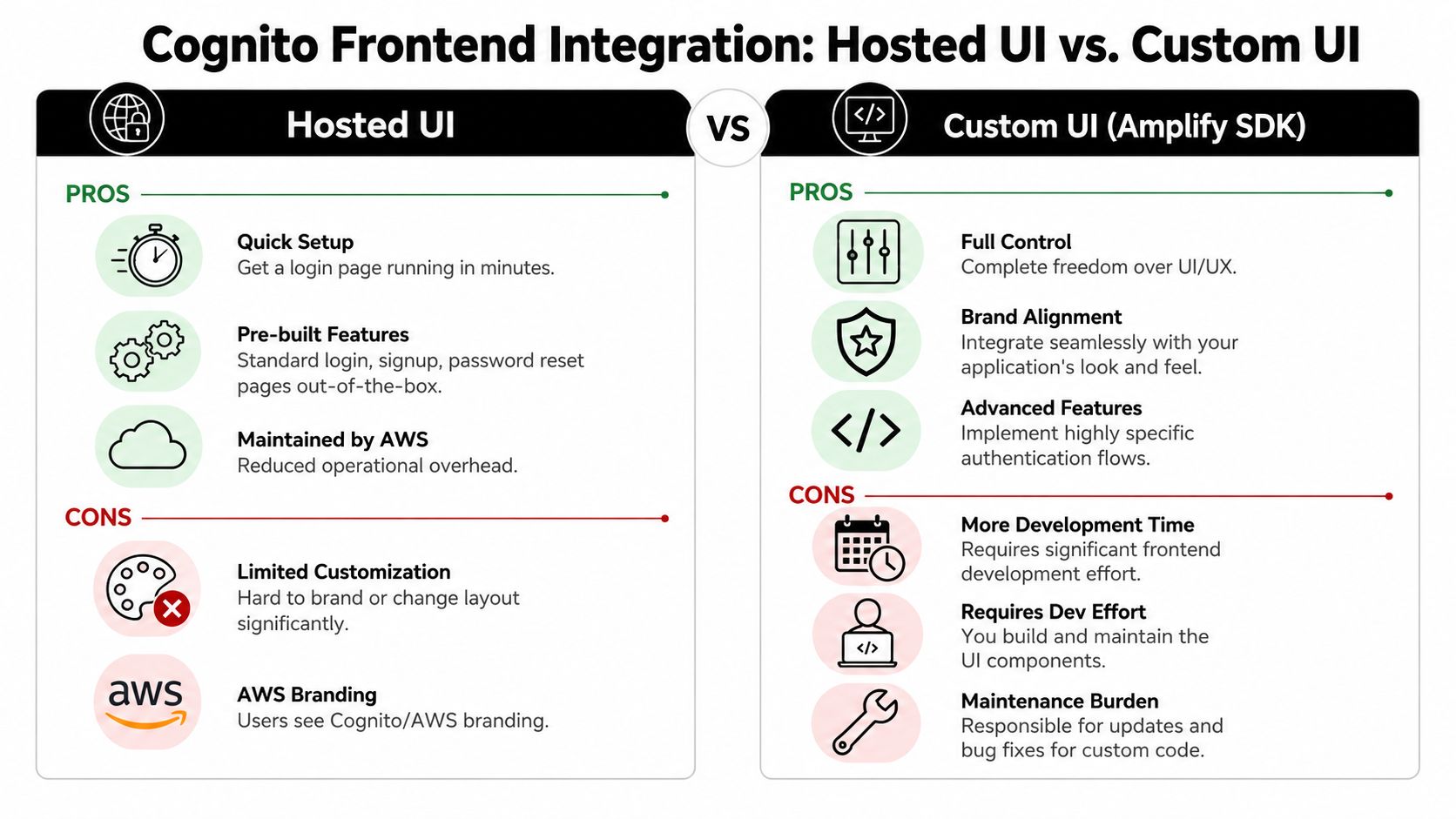
The frontend decision is simple to describe and harder to reverse later. You can use Cognito's Hosted UI, or you can build your own experience with SDK-driven flows.
For a serious DeFi product, I'd choose the custom route almost every time. Hosted UI is fine for internal dashboards, prototypes, or low-differentiation apps. It's rarely the right long-term answer when trust, brand control, and nuanced recovery flows matter.
A quick visual helps frame the trade-off.
Start tracking smart money today
Join thousands of traders using WalletFinder.ai to find profitable wallets and copy their trades.
Start Free Trial →
