
Agents AI Crypto: The Ultimate Guide
Discover how Agents AI Crypto systems are revolutionizing DeFi. This guide covers AI agent frameworks, automated trading use cases, and how to get started.
When you hear "AI agents in crypto," don't picture old, clunky trading bots that just followed a simple "if-then" script. We've moved way beyond that. Think of it less like a rigid calculator and more like a savvy financial analyst that works for you 24/7, constantly learning and adapting to the chaos of the crypto market.
What Are Autonomous Agents in Crypto?
At its heart, an AI crypto agent is a smart program built to operate on its own within the wild world of decentralized finance (DeFi). The old bots were pretty basic—maybe they'd buy an asset when a price indicator crossed a line. These new agents have a much more sophisticated digital mind. They can sift through massive streams of on-chain data, spot complex patterns, and execute entire strategies with multiple steps, all without you needing to lift a finger.
This independence is what truly makes them different. They aren't just tools you command; they're goal-oriented decision-makers. You could give an agent a simple goal, like maximizing the yield on your ETH, and it would get to work. It would constantly scan liquidity pools, compare lending rates, and even factor in gas fees to figure out the absolute best way to hit that target.
The Perfect Playground for AI
The crypto market is basically the ultimate playground for these AI agents. It never sleeps, and the blockchain provides a transparent, ever-expanding ocean of public data. This creates the perfect sandbox for an AI to learn, test, and execute.
An AI agent can analyze every single transaction on a blockchain—something no human team could ever do—to learn the behaviors of successful traders, identify emerging token trends, and react to market shifts in milliseconds.
The sheer volume of this data is staggering and only getting bigger. The global cryptocurrency market is on track to hit over $15 billion by 2030, with daily trading volumes already soaring. This massive scale creates the rich signal environment that agents need to find a statistical edge and effectively track what the "smart money" is doing. You can learn more about these market projections and their impact.
When you combine this firehose of data with clear success metrics (profit and loss) and the ability to directly execute trades on-chain, it's easy to see why crypto is becoming the premier training ground for the next wave of financial AI.
How AI Agent Architectures Actually Work
So, how do these crypto AI agents actually think? It’s not just a bunch of random code firing off transactions. There’s a structured, repeatable process at the heart of it all, one that mimics how a human expert might operate—only at a speed and scale that’s impossible for any person to match.
At its core, the agent’s logic often follows a simple but powerful cycle: Observe, Orient, Decide, and Act. It’s a concept borrowed from military strategy, but it applies perfectly to the fast-paced world of DeFi.
- Observe: The agent constantly pulls in a massive firehose of real-time data from countless sources. This includes prices, transaction volumes, social media sentiment, wallet movements—everything. Getting this data stream right is mission-critical, which is why a solid crypto price API is often the starting point.
- Orient: The agent sifts through all that noise to find the signal, identifying patterns, potential risks, and fleeting opportunities.
- Decide: Based on this analysis, it determines the best possible move to hit its programmed goal.
- Act: Finally, it executes a swap, a transfer, or another transaction directly on the blockchain.
This entire flow, from raw data to on-chain action, is a continuous loop.
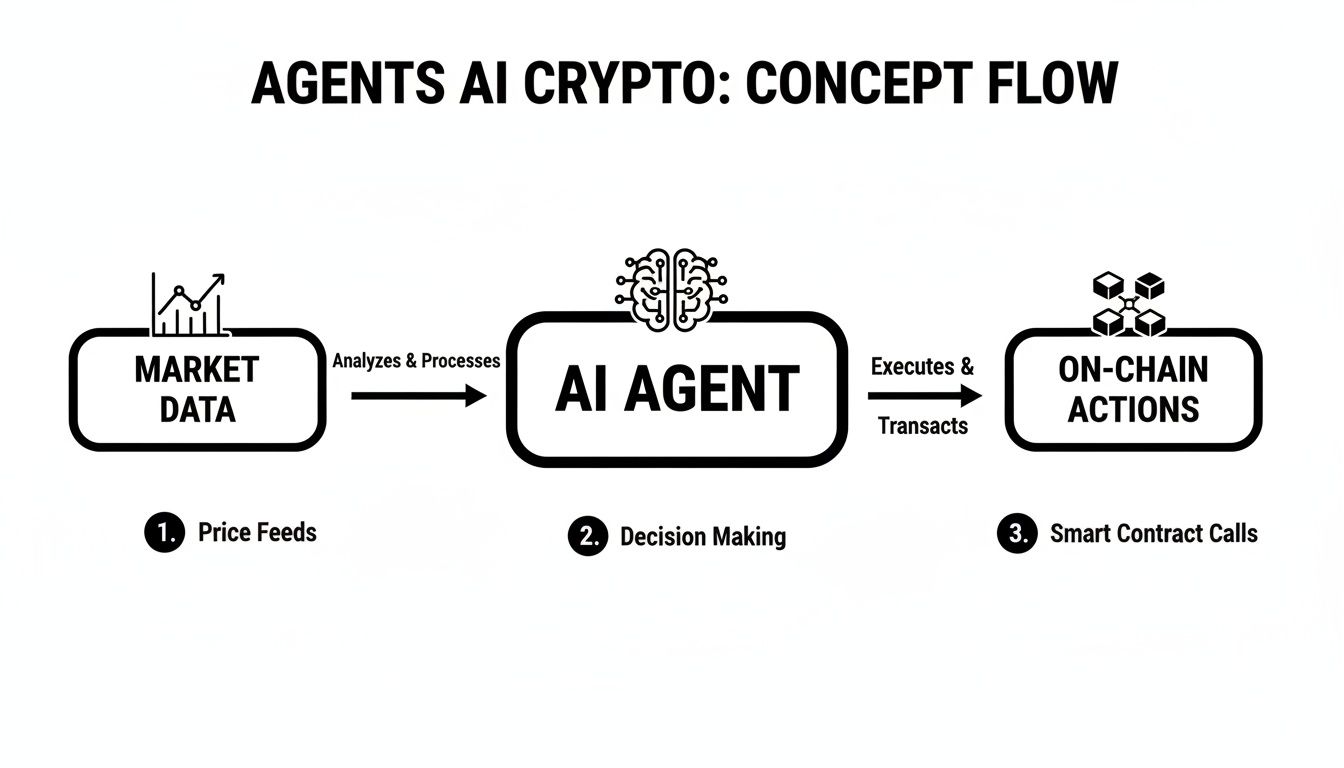
As the diagram shows, the agent acts as the "brain" between market data and the blockchain, turning information into automated, intelligent action.
Exploring Key AI Agent Toolchains
To actually build one of these agents, developers don’t start from scratch. They use specialized frameworks—or toolchains—that act as the foundational building blocks for creating autonomous systems. Think of them as construction kits for AI.
You’ll run into a few common approaches, each with its own strengths:
- AutoGPT: This one is great for laser-focused tasks. You give it a single, clear objective, like "find the top three trending memecoins on the Base network," and it will work autonomously until the job is done.
- LangChain: This is more like a set of programmable LEGO bricks. It excels at creating complex, multi-step workflows by letting you chain together language models, data sources, and on-chain tools to build sophisticated, reactive agents.
- Reinforcement Learning (RL): This is where agents truly learn and evolve on their own. An RL agent is basically thrown into a simulated market to trade. It learns from its profits (rewards) and its losses (punishments), running through thousands of strategies until it discovers a highly optimized approach that a human might never find.
The real magic happens when you start combining these toolchains. For instance, you could build a LangChain agent that listens for signals from a platform like Wallet Finder.ai. When an interesting wallet makes a move, it could trigger an AutoGPT instance to do a deep dive on the token's fundamentals before deciding whether to execute a copy trade.
The right framework depends entirely on what you want the agent to do—from simple, one-off tasks to discovering entirely new ways to navigate the market.
Comparing Popular AI Agent Toolchains
To make things clearer, here’s a quick breakdown of how these toolchains stack up for crypto-specific tasks. Each offers a different path to building an autonomous agent, so choosing the right one is key to success.
Start tracking smart money today
Join thousands of traders using WalletFinder.ai to find profitable wallets and copy their trades.
Start Free Trial →

