
Aero Staking Inc: Crypto Due Diligence Case Study
Confused by Aero Staking Inc? This aerospace case study teaches crypto investors vital due diligence to avoid costly mistakes.
You search a token name, skim a few results, see the word staking, and your brain fills in the rest. Yield. Validators. Lockups. APR math. That reflex is common in crypto, and it’s exactly why traders get trapped by bad assumptions before they even reach the wallet-analysis stage.
aero staking inc is a useful case study because the name sounds native to DeFi, but the actual company has nothing to do with blockchain. It’s an aerospace tooling manufacturer. That mismatch is more than a funny search error. It shows how easily surface-level research can point you toward the wrong conclusion, especially when a project name sounds familiar, technical, or adjacent to crypto language.
A junior trader usually thinks due diligence starts on-chain. It doesn’t. It starts with a simpler question.
Are you even researching the right thing?
The Crypto Investor's Dilemma with Aero Staking Inc
A trader sees “Aero Staking Inc” and assumes it might be a new protocol, a validator service, or some aviation-themed DeFi project. The name has the right ingredients. “Aero” sounds futuristic. “Staking” sounds native to crypto. “Inc” makes it look official.
Then the search results get weird.
One documented issue is that Aero Staking Inc’s aerospace specialization doesn’t come through clearly in search, and some results even describe it as serving “inline, roller, and skateboard enthusiasts”, which creates confusion for both aerospace buyers and crypto users trying to identify what the company does, as noted on the Aero Staking FAQ discussion of search confusion.
That’s the kind of moment where sloppy research turns expensive.
Why this matters to traders
Crypto attracts branding games. Some are deliberate. Some are just lazy. Either way, the market doesn’t care why you got confused. If you misidentify the entity behind a name, every downstream step gets corrupted:
- Your thesis breaks early: You think you’re evaluating token utility, but you’re reading about industrial tooling.
- Your source stack becomes garbage: You save the wrong links, infer the wrong business model, and compare the project against the wrong peers.
- Your on-chain work starts from a false premise: Even good wallet analysis won’t rescue a bad identity check.
Practical rule: Before you analyze token flows, verify that the name, company, product, and domain all belong to the same entity.
The real lesson inside the confusion
The aero staking inc example isn’t just about one company name. It exposes a broader due diligence failure mode. Traders often search for confirmation, not identity. They want the fast answer, not the correct one.
That habit is dangerous in crypto because naming overlap is common. A protocol can sound like an exchange. A token can sound like a real business. A brand can borrow language from a different industry and still look plausible long enough to fool a rushed investor.
If you want to stay out of low-quality setups, treat off-chain verification as your first filter, not your last.
What Aero Staking Inc Actually Is A Legacy in Aerospace
Aero Staking Inc belongs to the aerospace tooling field. It builds precision equipment used to install, remove, and test bearings in aircraft and related systems.
That distinction matters because a fast search can mislead a trader. The word "staking" pulls your attention toward DeFi, but the company itself operates in manufacturing. According to Aerospace Defense Review’s company profile of Aero Staking, Inc., its history traces back to a World War II Polish munitions factory that was later repurposed for aircraft parts production. The same profile describes a long operating history in aerospace bearing tools.
The company's core business
The simplest way to verify identity is to look at what the company sells and who buys it.
Aero Staking makes tools for bearing installation, bearing removal, and bearing testing. Its product line includes tri-roller machines, anvil tools, cutters, extractors, proof load testers, and torque breakaway tools. Those are shop-floor products for aerospace production and maintenance teams, not financial products for token holders.
If you're newer to this terminology, compare the research process to reading a token dashboard. In crypto, you would check token supply, validator design, or protocol fees. Here, the equivalent clues are product catalogs, engineering terms, customer types, and certification language. The company passes the identity test for an industrial manufacturer, not a blockchain project.
You can also compare the language around its business with a plain-English guide to how staking works in DeFi. The gap is immediate. One side talks about bearings, retention tools, and maintenance environments. The other talks about locking digital assets into a protocol.
Why the aerospace context matters
In aerospace, staking refers to a physical retention method. A tool applies force so a bearing stays secured under stress, vibration, and strict performance requirements. That use of the word sits much closer to fastening and machining than to yield generation or validator participation.
This is the kind of detail rushed investors skip.
A legitimate company with a real website and real products can still be irrelevant to your trade. That is the lesson here. Off-chain due diligence is not just about asking whether an entity exists. It is about asking whether the entity you found matches the thesis you are building.
A careful analyst checks four things before going any further: the domain, the product language, the industry context, and the customer base. In Aero Staking Inc's case, those signals point to aerospace manufacturers, subcontractors, end users, and MRO facilities. That is a clean identity match for an industrial toolmaker. It is not a crypto protocol wearing a technical-sounding name.
Aerospace Staking vs Crypto Staking Explained
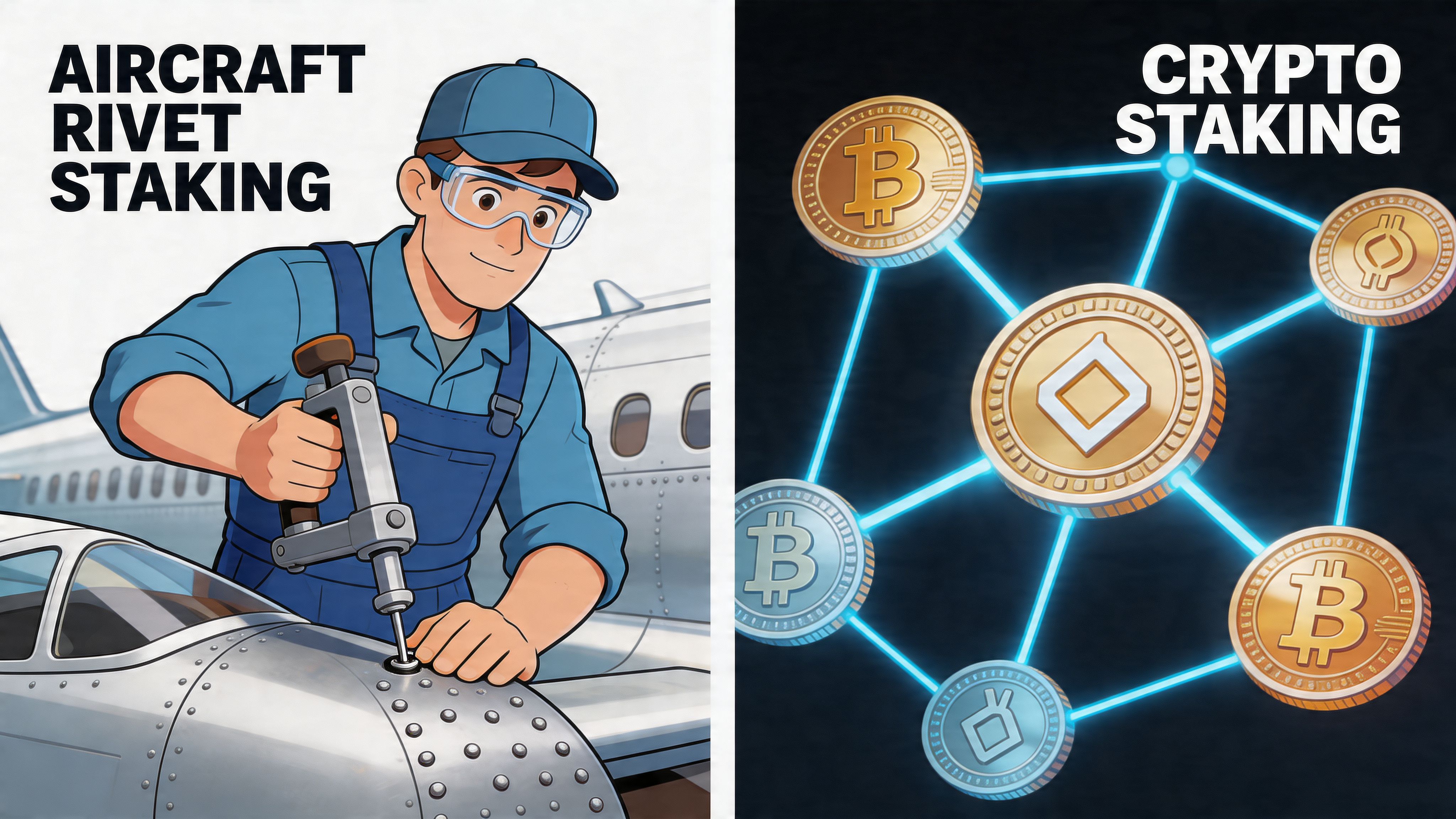
The confusion starts with one word: staking. But in practice, aerospace staking and crypto staking have almost nothing in common.
In aerospace, staking is physical retention
Aero Staking Inc specializes in Tri-Roller Swaging Tools (AST-series) used to install MS14103 bearings by applying controlled radial force and deforming the outer race into V-grooves, which creates a mechanical lock for high-vibration environments like turbine engines, according to the Aero Staking specifications page for cutting tools and cutters.
That same source states that these tools operate with ±0.001 inches tolerance, reduce installation time by 40% compared to other methods, support proof load capacities over 5,000 lbs, and achieve 99.5% first-pass success in production settings.
This is manufacturing language, not protocol language.
If you’re new to aerospace terms, think of it this way. The tool doesn’t “stake tokens.” It physically shapes metal so a bearing stays locked in place under stress and vibration. It’s closer to precision fastening than anything in finance.
In crypto, staking is a network and capital function
Crypto staking means locking assets into a blockchain or protocol process. You’re supporting validation, governance, security, or some reward mechanism. No one is deforming a metal race into a groove. No proof load machine is pressing against a component. The “stake” is economic, not mechanical.
If you want a cleaner primer on the DeFi meaning of the term, this guide on staking in DeFi gives the blockchain-side context.
Side-by-side comparison
| Term | Aerospace meaning | Crypto meaning |
|---|---|---|
| Staking | A mechanical process used to secure bearings or components | Locking digital assets into a protocol or network mechanism |
| Primary object | Physical parts and tooling | Tokens and smart contracts |
| Success criteria | Precision, retention, compliance, repeatability | Security, yield, participation, incentive alignment |
| Failure mode | Improper installation or component movement | Slashing, smart contract risk, token dilution, illiquidity |
| Evidence | Engineering specs, tool tolerances, test procedures | On-chain activity, contract code, wallet behavior |
Start tracking smart money today
Join thousands of traders using WalletFinder.ai to find profitable wallets and copy their trades.
Start Free Trial →

