
Holding Period Calculation: The Definitive Trader's Guide
Master the holding period calculation for crypto. This guide covers formulas, on-chain data analysis, and complex DeFi scenarios for tax reporting and alpha.
You close a trade, check the realized gain, and feel good about the exit. Then the annoying question hits: how long did you hold that position?
For a clean spot buy and sell, the answer sounds easy. In a real DeFi wallet, it usually isn't. You might have scaled in across several swaps, sold only part of the bag, restaked rewards, bridged the asset, or received a replacement token after a migration. Your PnL dashboard can still look neat while your holding period calculation is a mess.
That gap matters. A position's return tells you whether the trade worked. Its holding period tells you how the trade should be classified, compared, and reported. Experienced traders need both.
Why Your PnL Is Only Half the Story
A common mistake among active traders is treating realized PnL as the final answer. It isn't. It's only the price outcome.
Take a familiar sequence. You buy a token, add on weakness, trim into strength, then rotate the rest into another asset on a DEX. Weeks later, your wallet tracker shows a profitable series of trades. But once you try to classify each disposal, the easy story breaks. Which lot did that partial sale come from? Did the swap reset the clock? Did the staking rewards start a separate holding period?
Calculating the holding period marks a shift for traders from casual record-keeping to a professional process. If you only measure gain and loss, you're missing the time dimension of the trade. That time dimension often decides whether a disposal belongs in one reporting bucket or another, and it changes how you evaluate your own execution discipline.
A lot of performance review frameworks ignore this. They focus on attribution, entry timing, and exit efficiency. Those are useful, especially if you're already reviewing portfolio performance attribution methods. But a trade log that doesn't preserve holding periods is incomplete.
Where traders get blindsided
The problem usually shows up after the fact:
- Partial exits: You sell some of a position and assume the remaining tokens keep one simple timeline.
- On-chain income: Rewards arrive in kind, so they feel attached to the original position even when they may need separate tracking.
- Wallet fragmentation: One strategy spans multiple chains, bridges, and contracts, but your reporting still assumes one continuous hold.
Practical rule: If your wallet history includes more than a simple buy and full sale, your holding period calculation is already a lot-level problem, not a wallet-level one.
The traders who handle this well don't wait until reporting season. They record acquisition events, disposal events, and lot changes while the strategy is still fresh.
Understanding Holding Period and HPR
A trader buys ETH, stakes it, receives rewards, swaps part of the position into stETH, then sells only a slice weeks later. The PnL may look straightforward in a dashboard. The holding period and the return math usually are not.
Holding period measures how long a specific lot was owned. Holding Period Return, or HPR, measures what that lot produced over that ownership window, including price change and any cash flow or in-kind income tied to it.
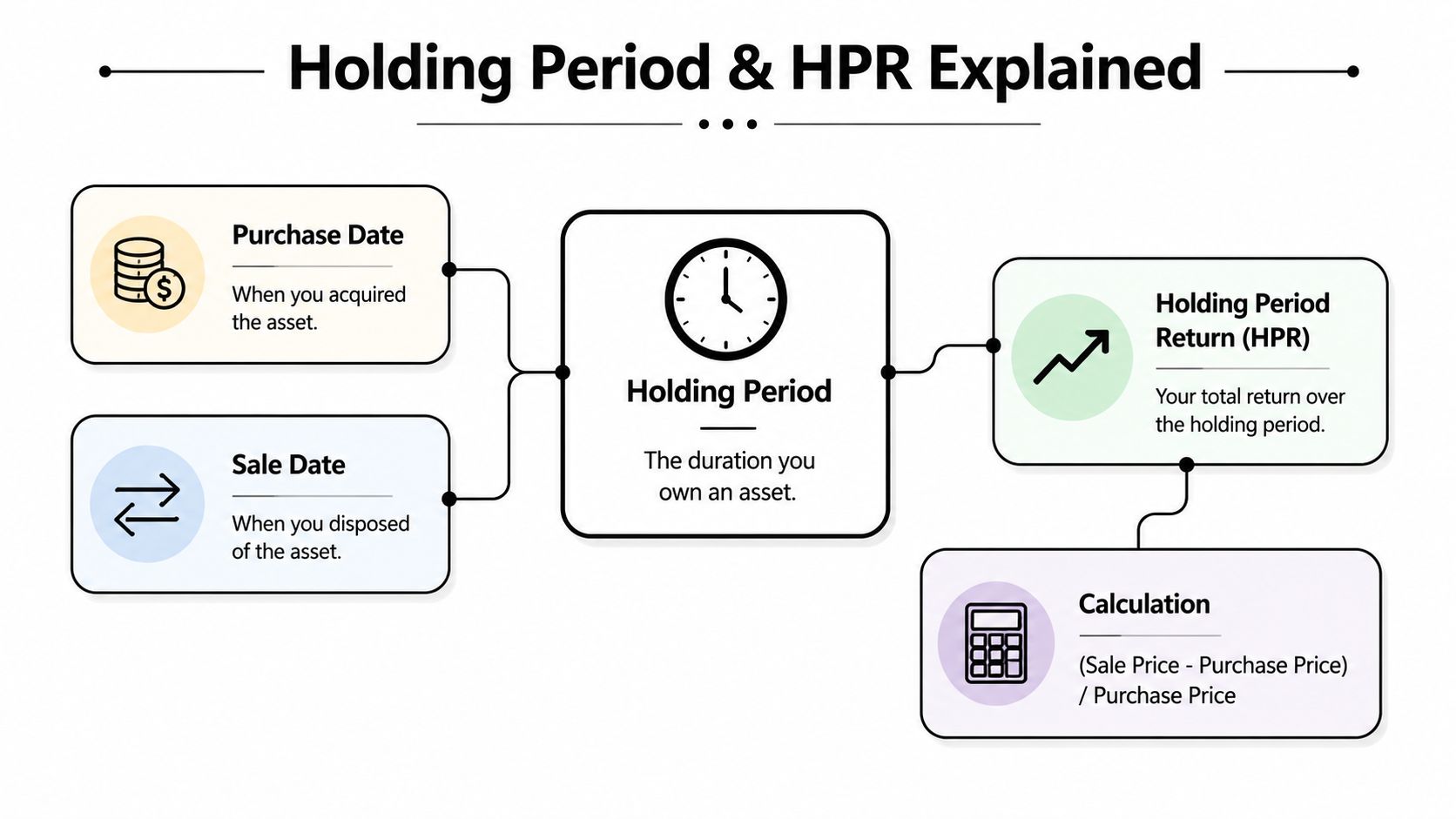
Traders often blur those concepts because both show up in the same position review. They should stay separate. One answers a timing question. The other answers a performance question.
What each metric actually tells you
A clean way to frame it:
| Concept | What it measures | Why traders use it |
|---|---|---|
| Holding period | Time between acquisition and disposal of a lot | Tax treatment, lot matching, strategy discipline |
| HPR | Total economic return during that period | Comparing outcomes across trades, wallets, and strategies |
Start tracking smart money today
Join thousands of traders using WalletFinder.ai to find profitable wallets and copy their trades.
Start Free Trial →

